ESO Telescope Captures the Most Detailed Infrared Map ever of our Milky Way

Astronomers have published a gigantic infrared map of the Milky Way containing more than 1.5 billion objects — the most detailed one ever made. Using the European Southern Observatory’s VISTA telescope, the team monitored the central regions of our Galaxy over more than 13 years. At 500 terabytes of data, this is the largest observational project ever carried out with an ESO telescope.

“We made so many discoveries, we have changed the view of our Galaxy forever,” says Dante Minniti, an astrophysicist at Universidad Andrés Bello in Chile who led the overall project.

This record-breaking map comprises 200,000 images taken by ESO’s VISTA — the Visible and Infrared Survey Telescope for Astronomy...

Read More

Air Pollution Exposure during Early Life can have Lasting Effects on the Brain’s White Matter

Exposure to certain pollutants, like fine particles (PM2.5) and nitrogen oxides (NOx), during pregnancy and childhood is associated with differences in the microstructure of the brain´s white matter, and some of these effects persist throughout adolescence. These are the main conclusions of a study led by the Barcelona Institute for Global Health (ISGlobal), a centre supported by “la Caixa” Foundation. The findings, published in Environmental Research, highlight the importance of addressing air pollution as a public health issue, particularly for pregnant women and children.

An increasing amount of evidence suggests that air pollution affects neurodevelopment in children...

Read More

AI could Predict Breast Cancer risk via ‘Zombie cells’

breast cancer
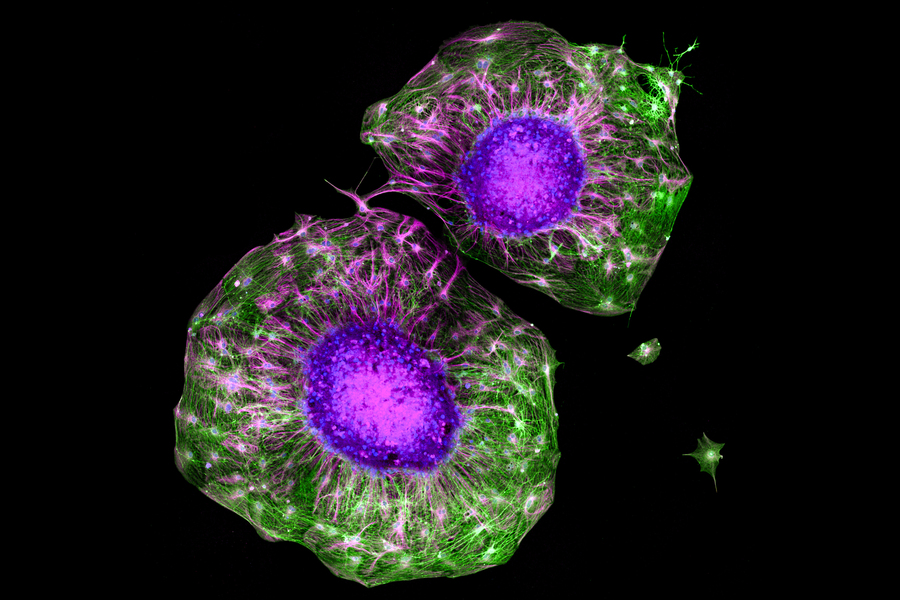
Three-dimensional culture of human breast cancer cells, with DNA stained blue and a protein in the cell surface membrane stained green. Credit: NCI Center for Cancer Research, National Cancer Institute, National Institutes of Health

Women worldwide could see better treatment with new AI technology, which enables better detection of damaged cells and more precisely predicts the risk of getting breast cancer, shows new research from the University of Copenhagen.

Breast cancer is one of the most common types of cancer. In 2022, the disease caused 670,000 deaths worldwide. Now, a new study from the University of Copenhagen shows that AI can help women with improved treatment by scanning for irregular-looking cells to give better risk assessment.

The study, published in The Lancet Dig...

Read More

Nuking a Huge Asteroid could Save Earth, Lab Experiment Suggests

A big asteroid could threaten life on Earth -- but nuclear bombs could come to the rescue, a new laboratory experiment suggests
A big asteroid could threaten life on Earth — but nuclear bombs could come to the rescue, a new laboratory experiment suggests.

The biggest real-life test of our planetary defenses was carried out in 2022, when NASA’s fridge-sized DART spacecraft smashed into a 160-metre (525-feet) wide asteroid, successfully knocking it well off course.

But for bigger asteroids, merely crashing spaceships into them will probably not do the trick.

When the roughly 10-kilometer wide Chicxulub asteroid struck the Yucatan peninsula around 66 million years ago, it is believed to have plunged Earth into darkness, sent kilometers-high tsunamis rippling around the globe and killed three quarters of all life—including wiping out the dinosaurs.

We humans are hoping to avoid a similar fate.

The...

Read More