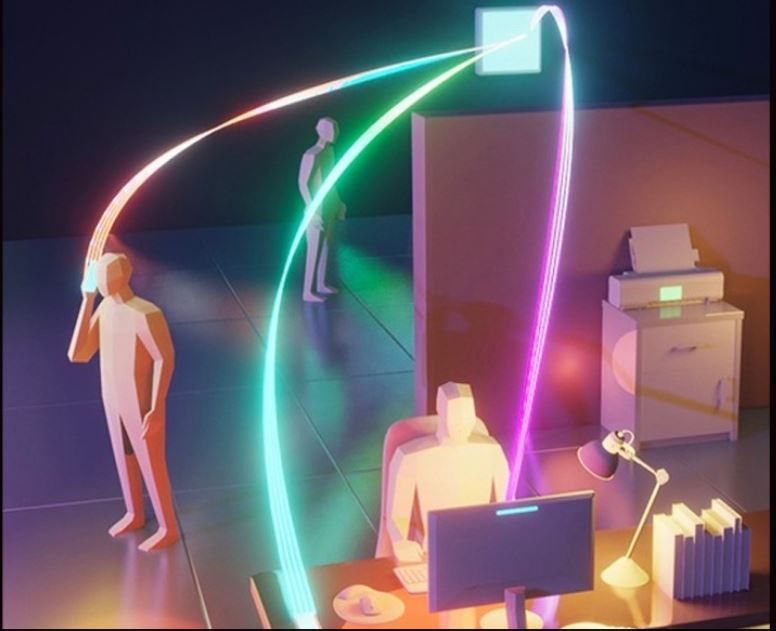
AI Networks are more Vulnerable to Malicious Attacks than previously thought

Artificial intelligence tools hold promise for applications ranging from autonomous vehicles to the interpretation of medical images. However, a new study finds these AI tools are more vulnerable than previously thought to targeted attacks that effectively force AI systems to make bad decisions.

At issue are so-called “adversarial attacks,” in which someone manipulates the data being fed into an AI system in order to confuse it. For example, someone might know that putting a specific type of sticker at a specific spot on a stop sign could effectively make the stop sign invisible to an AI system. Or a hacker could install code on an X-ray machine that alters the image data in a way that causes an AI system to make inaccurate diagnoses.

“For the most part, you can make all sorts o...

Read More

Dark Galactic region nicknamed ‘The Brick’ explained with Webb Telescope findings

The Galactic Center is full of stars: There are over half a million in this image. Using JWST’s specialized filters and a little bit of Photoshop, the team was able to remove the stars and show only the filamentary nebula of hot gas that permeates the inner Galaxy.  The bright regions are where hydrogen is a hot plasma, glowing from the energy from the massive stars.  The Brick is the dark region where that glowing plasma is blocked out.  Along the edge of the Brick, the glow is bluer: this blue appearance is caused by the CO ice blocking out the red light, letting only the blue through. Photos courtesy of Adam Ginsburg.

Using the James Webb Space Telescope, astronomers spot unexpected source of carbon monoxide ice at galactic region surprisingly devoid of stars.

In a recent study...

Read More

Photonic Chip that ‘Fits Together like Lego’ Opens Door to Semiconductor Industry

Dr Alvaro Casas Bedoya, holding the new chip, with Professor Ben Eggleton in the Sydney Nanoscience Hub.
Dr Alvaro Casas Bedoya, holding the new chip, with Professor Ben Eggleton in the Sydney Nanoscience Hub. Photo: Stefanie Zingsheim

A new semiconductor architecture integrates traditional electronics with photonic, or light, components could have application in advanced radar, satellites, wireless networks and 6G telecommunications. And it provides a pathway for a local semiconductor industry.

Researchers at the University of Sydney Nano Institute have invented a compact silicon semiconductor chip that integrates electronics with photonic, or light, components. The new technology significantly expands radio-frequency (RF) bandwidth and the ability to accurately control information flowing through the unit.

Expanded bandwidth means more information can flow through the chip and th...

Read More

Meteorites likely Source of Nitrogen for Early Earth

Results of study from Ryugu samples.

Micrometeorites originating from icy celestial bodies in the outer Solar System may be responsible for transporting nitrogen to the near-Earth region in the early days of our solar system. That discovery was published today in Nature Astronomy by an international team of researchers, including University of Hawai’i at Manoa scientists, led by Kyoto University.

Nitrogen compounds, such as ammonium salts, are abundant in material born in regions far from the sun, but evidence of their transport to Earth’s orbital region had been poorly understood.

“Our recent findings suggests the possibility that a greater amount of nitrogen compounds than previously recognized was transported near Earth, potentially serving as building blocks for life on o...

Read More