European Astronomers Detect New Component of Radio Halo in a Nearby Galaxy Cluster

European astronomers detect new component of radio halo in a nearby galaxy cluster
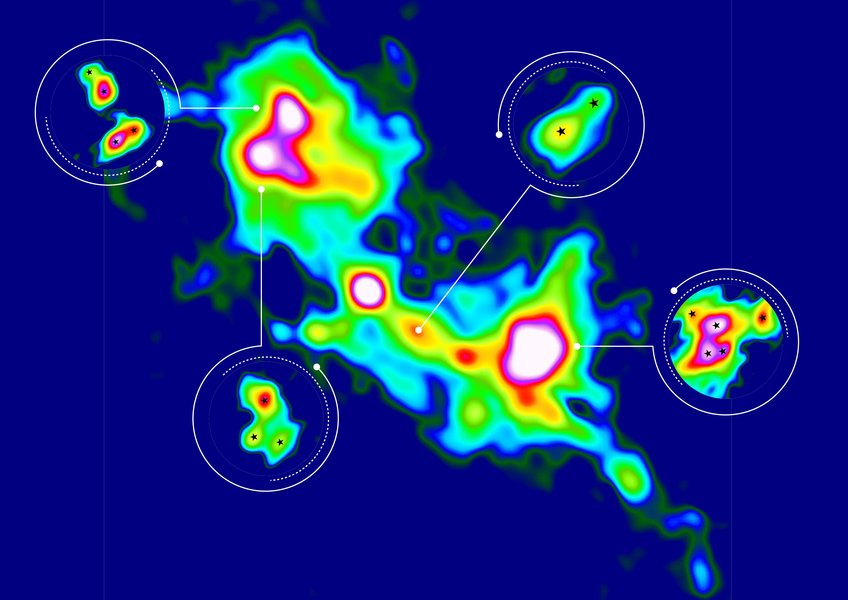
Composite RGB image of Abell 2142: radio (GMRT, 323 MHz) in red, optical (DSS-2, red filter) in green, and X-rays (XMM-Newton) in blue. Credit: Bruno et al., 2023.

Using the LOw Frequency ARray (LOFAR), astronomers from the University of Bologna, Italy and elsewhere, have conducted radio observations of the nearby galaxy cluster Abell 2142. In result, they detected a new component of the cluster’s giant radio halo. The finding was presented in a paper published August 15 on the pre-print server arXiv.

Galaxy clusters contain up to thousands of galaxies bound together by gravity. They are the largest known gravitationally bound structures in the universe, and could serve as excellent laboratories for studying galaxy evolution and cosmology.

Radio halos are enormous regions of diff...

Read More

Deficiency in Certain Brain Proteins shown to Promote Compulsive Behavior

Credit: Claudia Knorr/FMP

Our behavior is controlled through neural circuits in the brain. Molecular disturbances can lead to stereotypical behavior, as seen in neuropsychiatric disorders such as obsessive-compulsive and autism spectrum disorders.

A research team has now demonstrated that the absence of two proteins, Intersectin1 and Intersectin2, in mice leads to disrupted neural signaling and compulsive repetitive behavior, which is also observed in patients with Intersectin 1 mutations. This supports the idea that such defects can cause neuropsychiatric diseases. The study is published in Proceedings of the National Academy of Sciences.

Our brain is essentially our body’s computer...

Read More

Coffee Grounds offer Performance Boost for Concrete

Coffee offers performance boost for concrete
Graphical abstract. Credit: Journal of Cleaner Production (2023). DOI: 10.1016/j.jclepro.2023.138205

Engineers in Australia have found a way of making stronger concrete with roasted used-coffee grounds, to give the drink-additive a “double shot” at life and reduce waste going to landfills.

Lead author Dr. Rajeev Roychand from RMIT University said the team developed a technique to make concrete 30% stronger by turning waste coffee grounds into biochar, using a low-energy process without oxygen at 350 degrees Celsius.

“The disposal of organic waste poses an environmental challenge as it emits large amounts of greenhouse gases including methane and carbon dioxide, which contribute to climate change,” said Roychand, from the School of Engineering.

Australia generates 75 million ki...

Read More

Penetrating Radar Aboard the Chang’E-4 Rover Reveals Layers of the Moon’s History

Penetrating radar aboard the Chang'E-4 rover reveals layers of the moon's history
Image taken by the panoramic camera (PCAM) on board the Chinese Yutu 2 lunar rover as it looked back at the Chang’e 4 lander. Credit: Nature Communications (2019). DOI: 10.1038/s41467-019-12278-3/Wikimedia Commons/CC BY-SA

A team of space scientists at the Planetary Science Institute, working with colleagues from the Chinese Academy of Sciences, Shenzhen University and the University of Aberdeen, has used data from China’s Chang’E-4 rover to learn more about the history of the moon. In their study, reported in the Journal of Geophysical Research: Planets, the group analyzed lunar-penetrating radar (LPR) data sent back from the rover.

China’s Chang’E-4 rover has been wandering around on the far side of the moon since 2018...

Read More