Surprise COVID Discovery Helps Explain How Coronaviruses Jump Species

DNA-tethering and fusion of SARS-CoV-2 pseudoviruses and virus-like particles (VLP). The experiment design is schematized in panel (a), where DNA-functionalized viral particles are added to a microfluidic flow cell and allowed to bind to protein-free liposomes functionalized with complementary DNA. After unbound particles are washed away, fusion is initiated by addition of a soluble protease and monitored via lipid mixing, detected as fluorescence dequenching of Texas Red dye in the VLP or pseudoviral envelope. Representative images of a 10.1 × 9.6 μm sub-micrograph before and after lipid mixing are shown in panel (b) with a fusing particle outlined in magenta. The corresponding fluorescence intensity trace is plotted in panel (c).

Unexpected new insights into how COVID-19 infects ce...

Read More

Scientists Discover Novel Way of Reading Data in Antiferromagnets, Unlocking their use as Computer Memory

A microscopic image of the tiny device containing antiferromagnetic manganese bismuth telluride (green) that the Nanyang Technological University, Singapore researchers did their experiments on. The lines (light yellow) radiating from the centre are electrodes from which current was passed through the manganese bismuth telluride. (Image: NTU Singapore)

Scientists led by Nanyang Technological University, Singapore (NTU Singapore) investigators have made a significant advance in developing alternative materials for the high-speed memory chips that let computers access information quickly and that bypass the limitations of existing materials.

They have discovered a way that allows them to make sense of previously hard-to-read data stored in these alternative materials, known as antifer...

Read More

Astronomers Confirm Maisie’s Galaxy is Among Earliest Ever Observed

Astronomers confirm Maisie's galaxy is among earliest ever observed
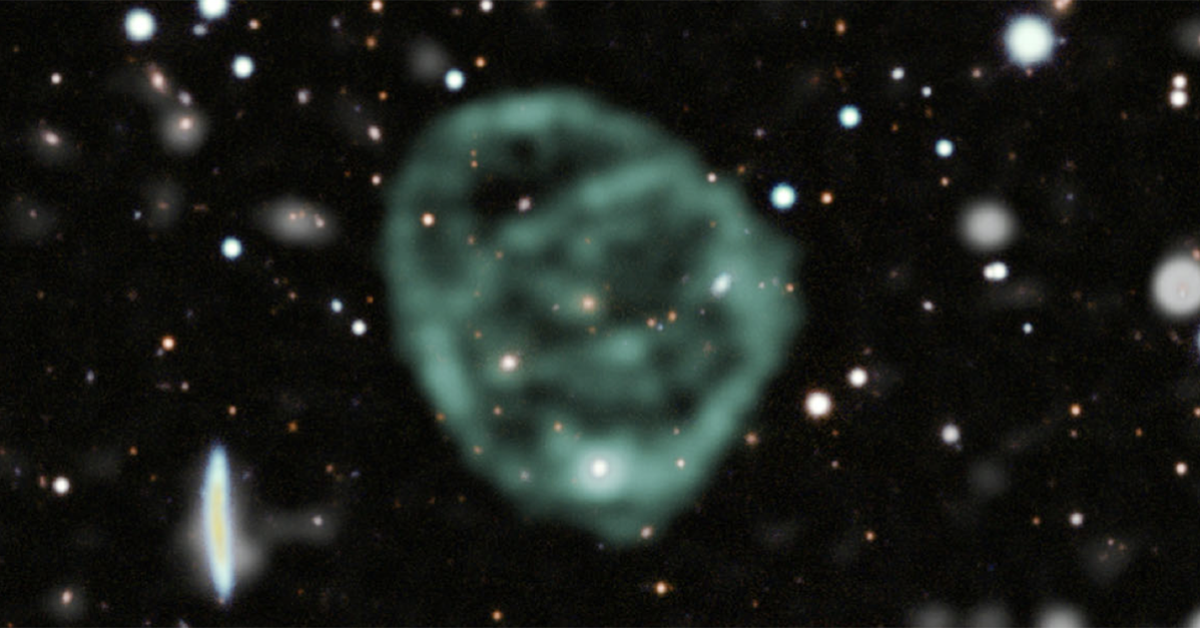
Spectroscopic observations reveal that Maisie’s galaxy, named after Steven Finkelstein’s daughter, was detected 390 million years after the Big Bang. That makes it one of the four earliest confirmed galaxies ever observed. Credit: NASA/STScI/CEERS/TACC/ University of Texas at Austin/S. Finkelstein/M. Bagley

Thanks to the James Webb Space Telescope, astronomers racing to find some of the earliest galaxies ever glimpsed have now confirmed that a galaxy first detected last summer is in fact among the earliest ever found. The findings are published in the journal Nature.

Follow-up observations since first detection of Maisie’s galaxy have revealed that it is from 390 million years after the Big Bang...

Read More

Scientists Identify Genes linked to High Production of Key Antibody

A rendering of a nanovial, a microscopic bowl-shaped container that the scientists used to capture individual cells and their secretions. The dark, donut-shaped object to the right is a cell; the blue-and-yellow objects to the left are secreted immunoglobulin G antibodies. (Image courtesy: Rene Chang/University of Washington)

A collaboration led by UCLA and the Seattle Children’s Research Institute has yielded new knowledge about the genes responsible for the production and release of immunoglobulin G, the most common type of antibody in the human body.

The finding has the potential to advance manufacturing of antibody-based therapies for diseases such as cancer and arthritis, as well as the development of medical treatments that rely on the production of antibodies.

Antibodies a...

Read More