Leather gets a power upgrade with laser-written microsupercapacitors

Researchers use lasers to turn leather into wearable power
Researchers have used a laser to write conductive patterns onto leather, creating microsupercapacitors that can store energy and help smooth electrical signals. Credit: Dong-Dong Han, Jilin University

Researchers have developed a simple and ecofriendly way to use a laser to turn natural leather into flexible and wearable energy devices. The new approach could lay the groundwork for more sustainable wearable electronics. In a paper in Optics Letters, the researchers demonstrate the new technique by creating microsupercapacitors on leather in various patterns, including a tiger, dragon and rabbit.

“Using a laser, we directly write conductive patterns onto vegetable-tanned leather to create microsupercapacitors that can store energy and help smooth electrical signals so that wearable e...

Read More

Scientists discover the “Goldilocks” secret behind life on Earth

Earth may be habitable because it got unbelievably lucky with its chemistry from the very start.

Earth may have won a cosmic chemistry lottery. Researchers found that during the planet’s earliest formation, oxygen had to be in an extremely narrow “Goldilocks zone” for two life-essential elements, phosphorus and nitrogen, to stay where life could use them. Too much or too little oxygen, and those ingredients could be lost or trapped deep inside the planet. This could reshape the search for life by showing that water alone is not enough.

Life cannot begin on a planet unless certain chemical elements are available in large enough amounts. Two of the most important are phosphorus and nitrogen...

Read More

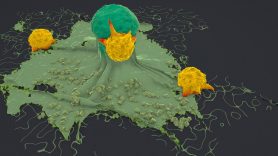
Loss of microbiota alters the profile of cells that protect the intestinal wall, experiments reveal

In red, intestinal wall cells producing less mucus (in green) in the large intestine of animals whose microbiota was depleted by antibiotics (right). On the left, the intestinal wall of animals that maintained an intact bacterial population produces more mucus (image: Vinicius Dias Nirello/IB-UNICAMP)

A research team led by scientists from the State University of Campinas (UNICAMP) in São Paulo, Brazil, has made significant progress in understanding the relationship between gut microbiota and intestinal cells. The study, published in the journal Gut Microbes, showed how microbiota and the compounds it produces, such as butyrate, influence the functioning of cells that line the large intestine...

Read More

These AI-powered guide dogs don’t just lead, they talk

These AI-powered guide dogs don't just lead, they talk
Scientists at Binghamton University have developed a robot guide dog system that communicates with the visually impaired and provides real-time feedback during travel. Credit: Jonathan Cohen.

Guide dogs are powerful allies, leading the visually impaired safely to their destinations, but they can’t talk with their owners—until now. Using large language models, a team of researchers at Binghamton University, State University of New York has created a talking robot guide dog system that determines an ideal route and safely guides users to their destination, offering real-time feedback along the way.

The paper, “From Woofs to Words: Towards Intelligent Robotic Guide Dogs with Verbal Communication,” was presented at the 40th Annual AAAI Conference on Artificial Intelligence (AAAI 2026)...

Read More