To raise new questions, new possibilities, to regard old problems from a new angle, requires creative imagination and marks real advance in science.
~Albert Einstein
Read More
Old Newtonian physics claimed that things have an objective reality separate from our perception of them. Quantum physics, and particularly Heisenberg's Uncertainty Principle, reveal that, as our perception of an object changes, the object itself literally changes.
~Marianne Williamson
Read More
A huge storm dominates the rather featureless surface of Saturn in an image taken by the Cassini spacecraft on Feb. 25, 2011, about 12 weeks after the powerful storm was first detected in the planet’s northern hemisphere. The megastorm is seen overtaking itself as it encircles the entire planet. Astronomers have found deep in the atmosphere the aftereffects of megastorms that occurred hundreds of years ago. The dark stripes are the shadows of Saturn’s rings. NASA/JPL/Space Science Institute
Megastorms leave marks on Saturn’s atmosphere for centuries. They regularly appear on Saturn, marring the relatively bland surface before disappearing. But radio observations show that the storms have long-lasting effects deeper in the atmosphere, in particular in the distribution of ammonia...
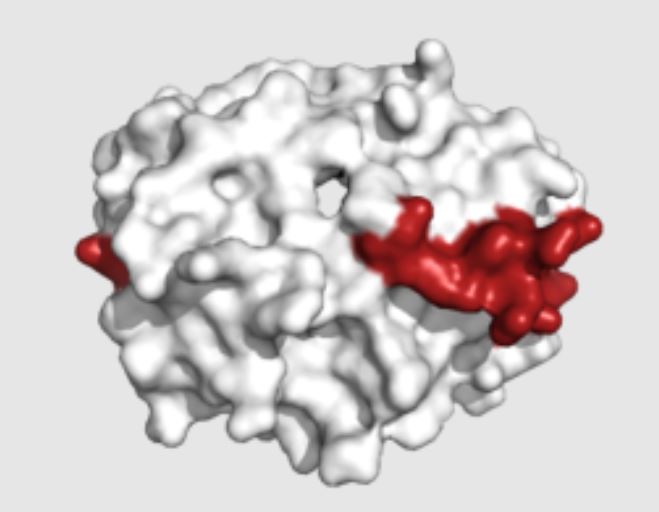
Image: Red-colored region depicts region on platelet factor 4 (PF4) molecule recognized by VITT-like antibodies obtained from patient 2 (adult). Credit: Mercy Daka (co-author) and Dr. Ishac Nazy (co-author)
A new observation suggests that a life-threatening blood clotting disorder can be caused by an infection with adenovirus, one of the most common respiratory viruses in pediatric and adult patients.
Platelets, or thrombocytes, are specialized cellular fragments that form blood clots when we get scrapes and traumatic injuries. Viral infections, autoimmune disease, and other conditions can cause platelet levels to drop throughout the body, termed thrombocytopenia.
After a robust clinical and research collaboration, Stephan Moll, MD, and Jacquelyn Baskin-Miller, MD, both in the UN...
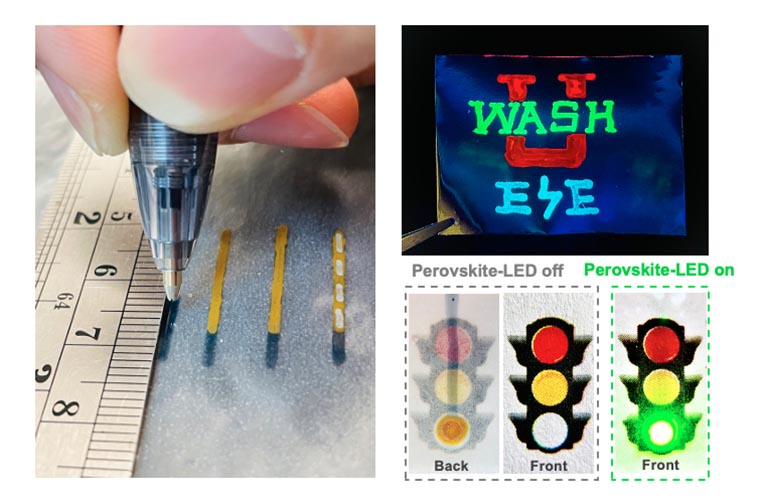
The invention of the printing press revolutionized duplication of the written word, giving the hands of tired scribes a break and making written material more accessible. A similar breakthrough has happened in reverse in the McKelvey School of Engineering at Washington University in St. Louis.
Researchers working with Chuan Wang, associate professor of electrical & systems engineering, have developed ink pens that allow individuals to handwrite flexible, stretchable optoelectronic devices on everyday materials including paper, textiles, rubber, plastics and 3D objects. Flexible optoelectronics for emitting and detecting light, which are already found in everyday objects like smartphones and fitness trackers, can bend, fold and flex while maintaining functionality.
An extreme star system is giving new meaning to the phrase “surf’s up.”
The star system intrigued researchers because it is the most dramatic “heartbeat star” on record. Now new models have revealed that titanic waves, generated by tides, are repeatedly breaking on one of the stars in the system—the first time this phenomenon has ever been seen on a star.
Heartbeat stars are stars in close pairs that periodically pulse in brightness, like the rhythm of a beating heart on an EKG machine. The stars in heartbeat systems loop through elongated oval orbits. Whenever they swing close together, the stars’ gravities generate tides—just as the Moon creates ocean tides on Earth...












Recent Comments