Researchers discover a way to Fight the Aging Process and Cancer Development

Microscope image of C. elegans 10 days after treatment with UV-B rays. Left: Worms with intact DREAM complex cannot repair DNA well. Right: Worms without DREAM complex repair damage and live longer.

The DREAM protein complex prevents the repair of genome damage in human cells, in mice and in the nematode Caenorhabditis elegans, a team of researchers at the University of Cologne has discovered. They also successfully inhibited this complex for the first time using a pharmaceutical agent.

“When we suppress the so-called DREAM complex in body cells, various repair mechanisms kick in, making these cells extremely resilient towards all kinds of DNA damage,” said Professor Dr Björn Schumacher, Director of the Institute for Genome Stability in Aging and Disease at the University of Cologne...

Read More

AI ‘Brain’ created from Core Materials for OLED TVs

A research team develops semiconductor devices for high-performance AI operations by applying IGZO materials widely used in OLED displays. ChatGPT’s impact extends beyond the education sector and is causing significant changes in other areas. The AI language model is recognized for its ability to perform various tasks, including paper writing, translation, coding, and more, all through question-and-answer-based interactions. The AI system relies on deep learning, which requires extensive training to minimize errors, resulting in frequent data transfers between memory and processors...

Read More

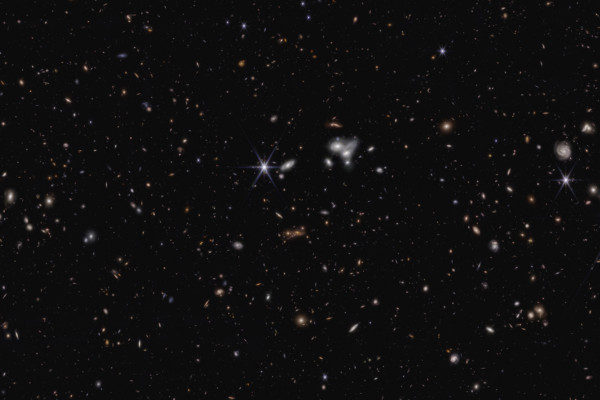
How Cosmic Winds Transform Galactic Environments

A composite closeup of the bright center of spiral galaxy NGC 253.

Researchers model how elements move across star-forming regions. Much like how wind plays a key role in life on Earth by sweeping seeds, pollen and more from one place to another, galactic winds — high-powered streams of charged particles and gases — can change the chemical makeup of the host galaxies they form in, simply by blowing in a specific direction.

Using observations made by NASA’s Chandra X-ray Observatory, a new study details how these energetic winds, once released from the center of a galaxy, directly influence the temperature and metal distribution of the rest of the region.

“Galactic winds are a large part of galaxy evolution in general,” said Sebastian Lopez, lead author of the study and a graduate...

Read More

Patient-specific Cells Generated from Thymus Organoids

Figure thumbnail gr1
Generation of hPSC-derived TECs in vitro
(A) Schematic of TEP-only sTOs.
(B) Representative IF images of KRT8 (green) and KRT5 (magenta) in day 16–22 TEPs and week 2 TEP-only sTOs (TEPs, n = 2 indepdendent experiment (ind. exp.), 2 hPSC lines; sTOs, n = 3 ind. exp., 2 hPSC lines).
(C–H) FC plots and quantification of EPCAM/HLA-DR (C and D), EPCAM/CD205 (E and F), and EPCAM/GFP (G and H) expression in day 16–22 TEPs and week 2 TEP-only sTOs.
(I) tSNE plots of EPCAM, HLA-DR, CD205, and GFP expression in 16–22 TEPs and week 2 TEP-only sTOs, n = 3 ind. exp., 1 hPSC line.
Plots show percentage of the mean; data are shown as mean Â±
± SEM.

Researchers have used pluripotent stem cells to make thymus organoids that support the development of patient-specific T cells, researchers report Marc...

Read More