Edible Electronics: How a Seaweed Second Skin could Transform Health and Fitness Sensor Tech

Dr Conor Boland and Adel Aljarid discuss their seaweed-based health sensor development in the lab at the University of Sussex

Scientists have used seaweed to develop biodegradable health sensors, which could be applied like a second skin. Scientists at the University of Sussex have successfully trialed new biodegradable health sensors that could change the way we experience personal healthcare and fitness monitoring technology.

The team at Sussex have developed the new health sensors — such as those worn by runners or patients to monitor heart rate and temperature — using natural elements like rock salt, water and seaweed, combined with graphene. Because they are solely made with ingredients found in nature, the sensors are fully biodegradable, making them more environmentally friendly than commonly used rubber and plastic-based alternatives...

Read More

Resurrected Supernova Provides Missing-link

An image of the central region of M77 taken by the Hubble space telescope (left). Right panels show the expanded view around SN 2018ivc based on the data taken by ALMA, at ~200 days (upper right) and ~ 1000 days (lower right)
An image of the central region of M77 taken by the Hubble space telescope (left), in which the position of SN 2018ivc is marked. Right panels show the expanded view around SN 2018ivc based on the data taken by ALMA, at ~200 days (upper right) and ~ 1000 days (lower right), clearly showing that the rebrightening happened at about one year after the SN explosion. Credit: (left) Based on observations made with the NASA/ESA Hubble Space Telescope, and obtained from the Hubble Legacy Archive, which is a collaboration between the Space Telescope Science Institute (STScI/NASA), the Space Telescope European Coordinating Facility (ST-ECF/ESA) and the Canadian Astronomy Data Centre (CADC/NRC/CSA). (right) ALMA (ESO/NAOJ/NRAO), K. Maeda et al.

Astronomers have discovered a supernova exhibiting un...

Read More

Real AI will need Biology: Computers powered by Human Brain Cells

Real AI will need biology: computers powered by human brain cells
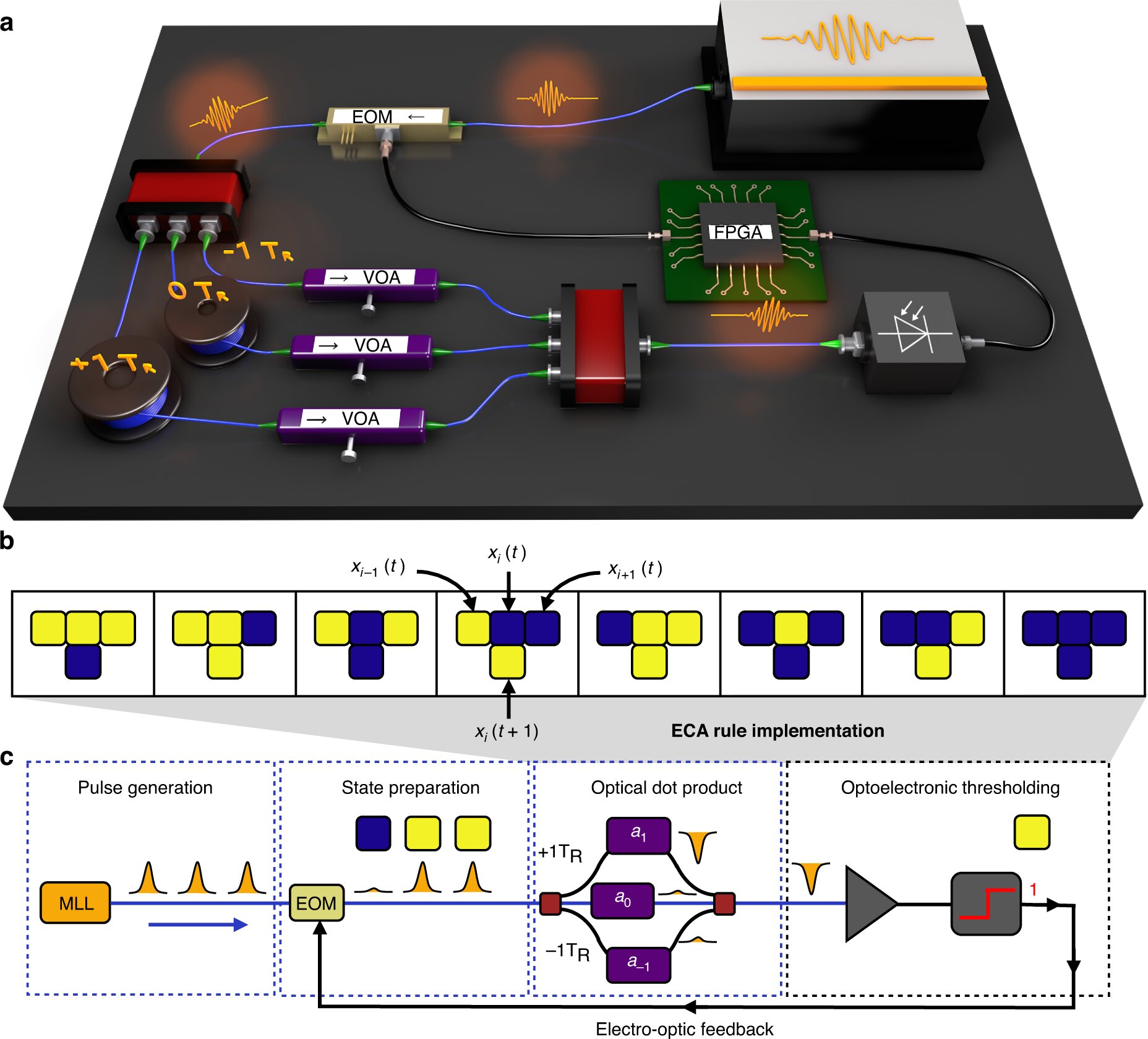
Credit: Frontiers in Science (2023). DOI: 10.3389/fsci.2023.1017235. https://www.frontiersin.org/journals/science/articles/10.3389/fsci.2023.1017235

The time has come to create a new kind of computer, say researchers from John Hopkins University together with Dr. Brett Kagan, chief scientist at Cortical Labs in Melbourne, who recently led development of the DishBrain project, in which human cells in a petri dish learnt to play Pong.

In an article published today (March 1) in Frontiers in Science, the team outlines how biological computers could surpass today’s electronic computers for certain applications while using a small fraction of the electricity required by today’s computers and server farms.

They’re starting by making small clusters of 50,000 brain cells grown from stem c...

Read More

Ultracool Dwarf Binary Stars Break Records

The researchers say that by studying similar star systems, we can learn more about potentially habitable planets beyond Earth. Ultracool dwarfs are much fainter and dimmer than the sun, so any worlds with liquid water on their surfaces — a crucial ingredient to form and sustain life — would need to be much closer to the star. NASA/JPL Caltech image

Astrophysicists discover the closest and oldest ultracool dwarf binary ever observed. Northwestern University and the University of California San Diego (UC San Diego) astrophysicists have discovered the tightest ultracool dwarf binary system ever observed.

The two stars are so close that it takes them less than one Earth day to revolve around each other. In other words, each star’s “year” lasts just 17 hours.

The newly discovered ...

Read More