To raise new questions, new possibilities, to regard old problems from a new angle, requires creative imagination and marks real advance in science.
~Albert Einstein
Read More
Old Newtonian physics claimed that things have an objective reality separate from our perception of them. Quantum physics, and particularly Heisenberg's Uncertainty Principle, reveal that, as our perception of an object changes, the object itself literally changes.
~Marianne Williamson
Read More
The team obtained the thermal emission spectrum of WASP-18 b by measuring the amount of light it emits over the Webb Telescope’s NIRISS SOSS 0.85 – 2.8 micron wavelength range, capturing 65% of the total energy emitted by the planet. WASP-18 b is so hot on the day side of this tidally locked planet that water molecules would be vaporized. Webb directly observed water vapor on the planet in even relatively small amounts, indicating the sensitivity of the observatory. Credit: NASA/JPL-Caltech (R. Hurt/IPAC)
400 light-years out there is something that is so tantalizing that astronomers have been studying it since its discovery in 2009. One orbit for WASP-18 b around its star that is slightly larger than our sun takes just 23 hours. There is nothing like it in our solar system.
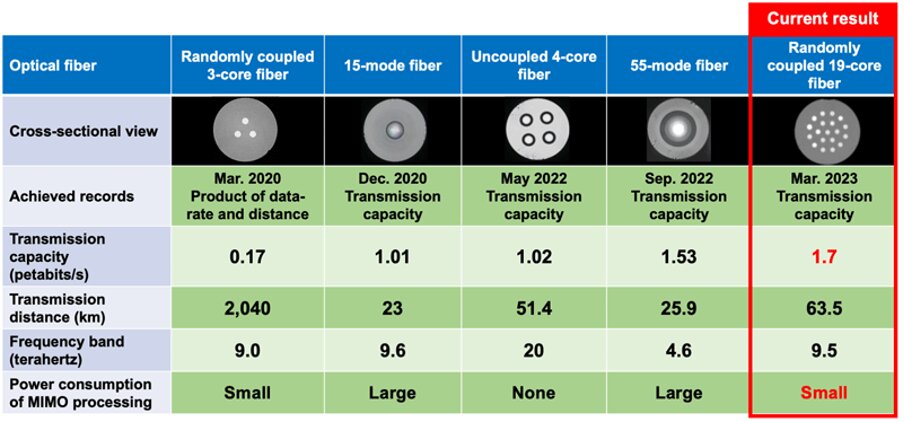
An optical fiber about the thickness of a human hair can now carry the equivalent of more than 10 million fast home internet connections running at full capacity.
A team of Japanese, Australian, Dutch, and Italian researchers has set a new speed record for an industry standard optical fiber, achieving 1.7 Petabits over a 67km length of fiber. The fiber, which contains 19 cores that can each carry a signal, meets the global standards for fiber size, ensuring that it can be adopted without massive infrastructure change. And it uses less digital processing, greatly reducing the power required per bit transmitted.
Macquarie University researchers supported the invention by developing a 3D laser-printed glass chip that allows low loss acce...
An experimental “decoy” has provided long-term protection from infection by the pandemic virus in mice, a new study finds. Led by researchers at NYU Grossman School of Medicine, the work is based on how the virus that causes COVID-19, SARS-CoV-2, uses its spike protein to attach to a protein on the surface of the cells that line human lungs. Once attached to this cell surface protein, called angiotensin converting enzyme 2 (ACE2), the virus spike pulls the cell close, enabling the virus to enter the cell and hijack its machinery to make viral copies.
Earlier in the pandemic, pharmaceutical companies designed monoclonal antibodies to glom onto the spike and neutralize the virus. Treatment of patients soon after infection was successful in preventing hospitalization and death...
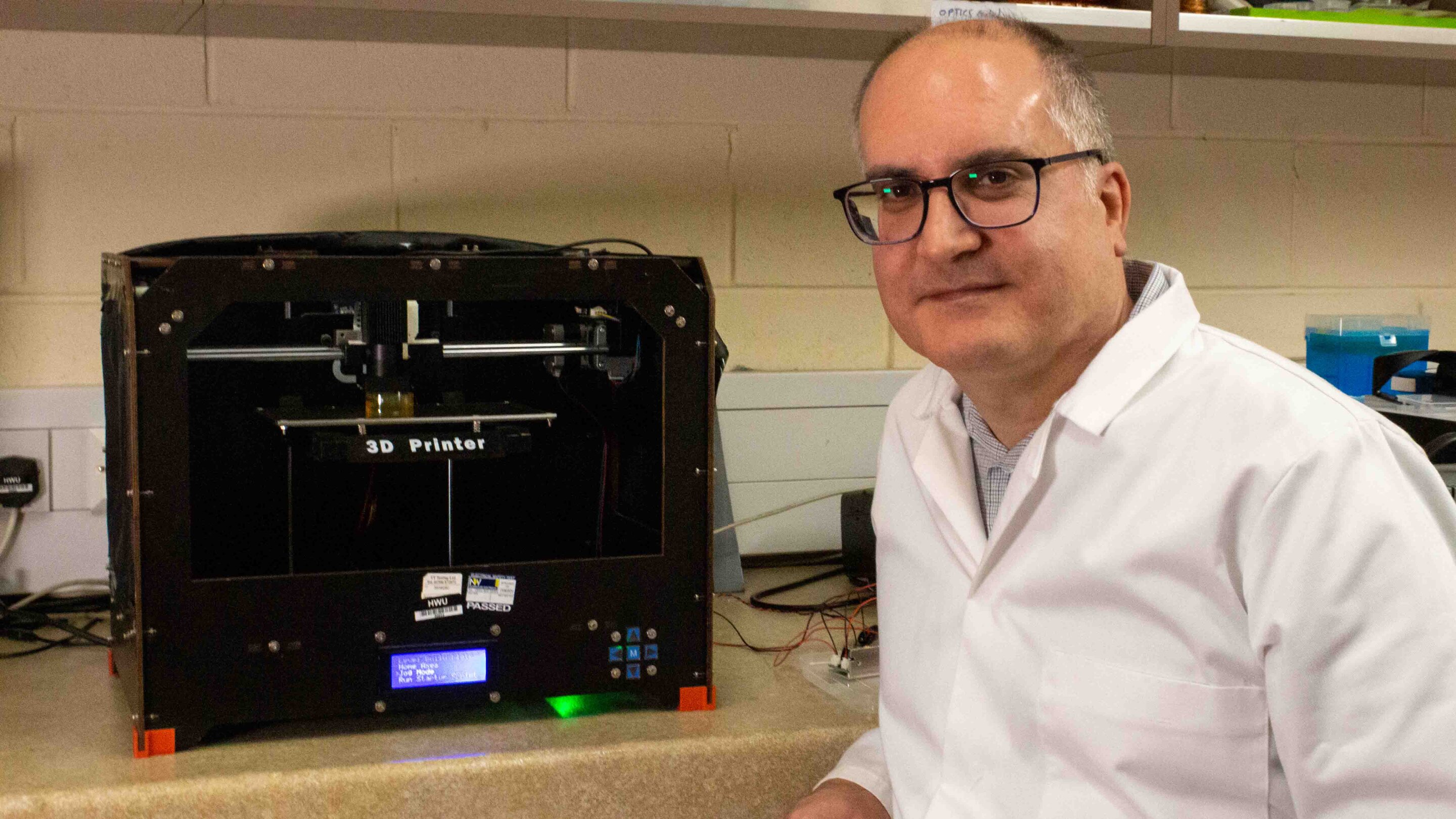
Dr Jose Marques-Hueso from the Institute of Sensors, Signals & Systems at Heriot-Watt University. Credit: Heriot-Watt University
Scientists have developed an advanced technique for 3D printing that is set to revolutionize the manufacturing industry.
The group, led by Dr. Jose Marques-Hueso from the Institute of Sensors, Signals & Systems at Heriot-Watt University in Edinburgh, has created a new method of 3D printing that uses near-infrared (NIR) light to create complex structures containing multiple materials and colors.
They achieved this by modifying a well-established 3D printing process known as stereolithography to push the boundaries of multi-material integration...












Recent Comments