To raise new questions, new possibilities, to regard old problems from a new angle, requires creative imagination and marks real advance in science.
~Albert Einstein
Read More
Old Newtonian physics claimed that things have an objective reality separate from our perception of them. Quantum physics, and particularly Heisenberg's Uncertainty Principle, reveal that, as our perception of an object changes, the object itself literally changes.
~Marianne Williamson
Read More
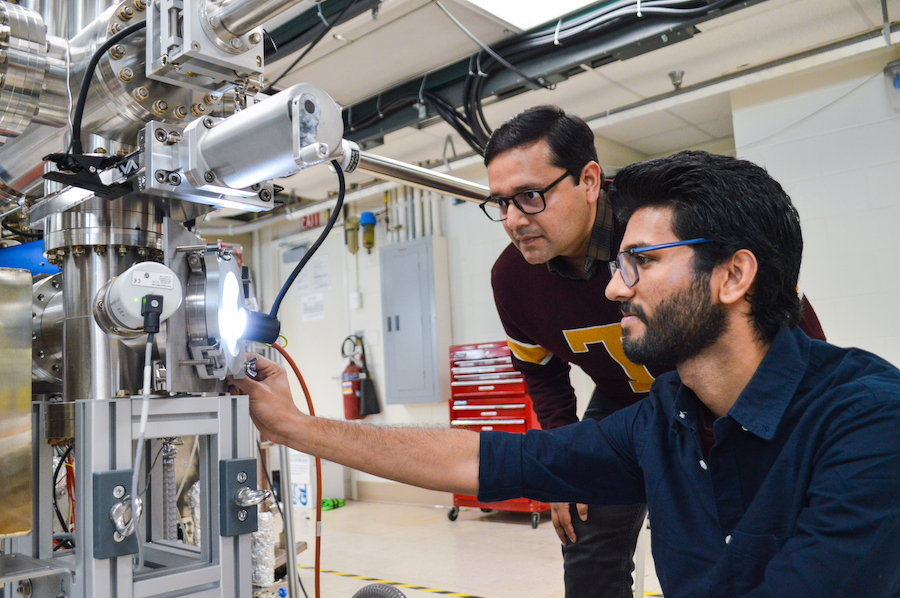
University of Minnesota chemical engineering and materials science researchers have developed a breakthrough method for creating high-quality metal oxide films that are important for next generation applications like quantum computing and microelectronics. Photo by Olivia Hultgren
New technique paves the way for easy oxidation of historically ‘stubborn’ metals. A University of Minnesota Twin Cities-led team has developed a first-of-its-kind, breakthrough method that makes it easier to create high-quality metal oxide thin films out of “stubborn” metals that have historically been difficult to synthesize in an atomically precise manner...
Regular physical activity and exercise may reduce bleeding in individuals with intracerebral hemorrhage, a University of Gothenburg study shows. The researchers emphasize the importance of physical activity to protect the brain.
The study, published in the journal Stroke and Vascular Neurology, analyzed data on 686 people treated for intracerebral hemorrhage at Sahlgrenska University Hospital in Gothenburg during the years 2014 to 2019.
The results are based on a retrospective analysis. Causal connections cannot be identified, but the findings are nonetheless clear: Those who reported regular physical activity had smaller hemorrhages than those who reported being inactive.
Physically active was defined as engaging in at least light physical activity, such a...
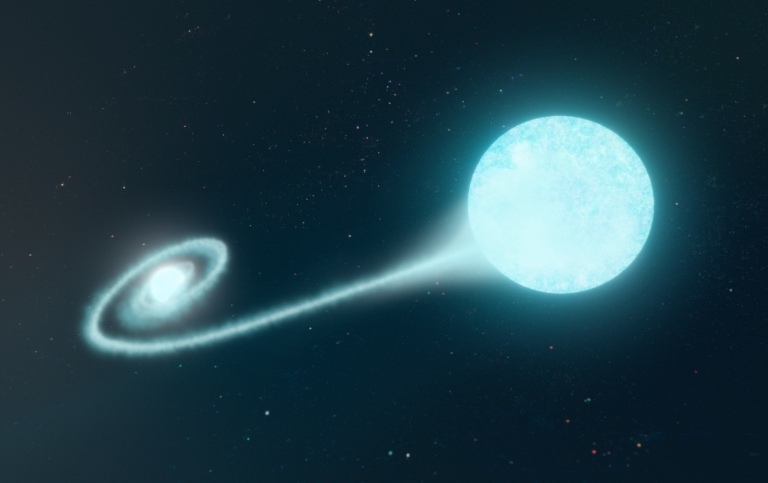
Artist impression of the double star system with a compact white dwarf star accreting matter from a helium-rich donor companion. The accretion eventually leads to the white dwarf going supernova. (credit: Adam Makarenko/W. M. Keck Observatory)
In the latest issue of the journal Nature, astronomers from Stockholm University reveal the origin of a thermonuclear supernova explosion. Strong emission lines of helium and the first detection of such a supernova in radio waves show that the exploding white dwarf star had a helium-rich companion.
Supernovae of Type Ia are important for astronomers since they are used to measure the expansion of the Universe. However, the origin of these explosions has remained an open question...
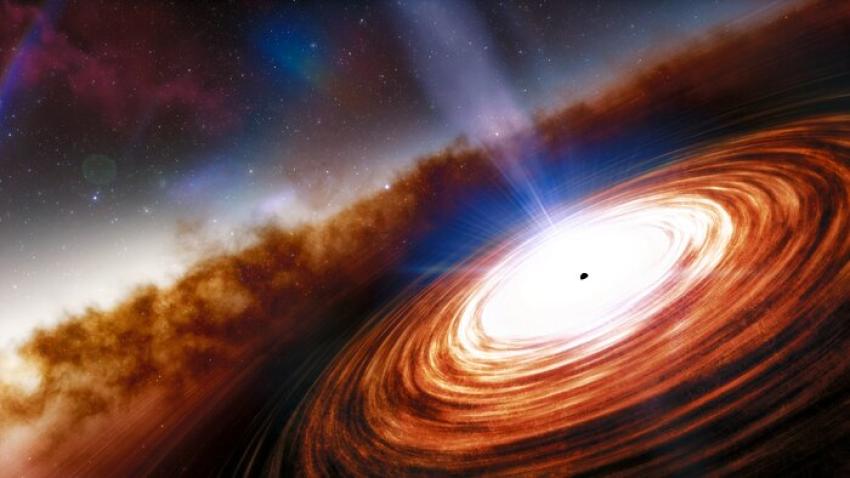
Artist’s impression of a quasar Credit NOIRLab/NSF/AURA/J. da Silva Licence type Attribution (CC BY 4.0)
Researchers have observed the X-ray emission of the most luminous quasar seen in the last 9 billion years of cosmic history, known as SMSS J114447.77-430859.3, or J1144 for short. The new perspective sheds light on the inner workings of quasars and how they interact with their environment. The research is published in Monthly Notices of the Royal Astronomical Society.
Hosted by a galaxy 9.6 billion light years away from the Earth, between the constellations of Centaurus and Hydra, J1144 is extremely powerful, shining 100,000 billion times brighter than the Sun...












Recent Comments