Quantum light source goes fully On-Chip, bringing Scalability to the Quantum Cloud

Quantum light source goes fully on-chip, bringing scalability to the quantum cloud
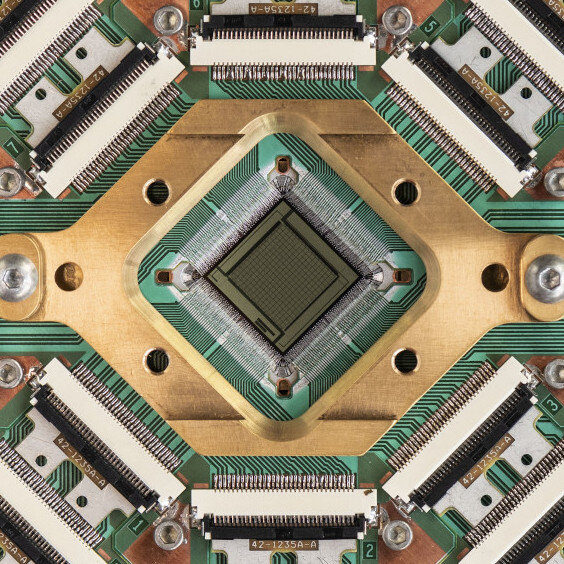
Artistic illustration of the chip-integrated quantum light source for the generation of entangled photons. Credit: Raktim Haldar/Michael Kues

An international team of researchers from Leibniz University Hannover (Germany), the University of Twente (Netherlands), and the start-up company QuiX Quantum has presented an entangled quantum light source fully integrated for the first time on a chip. The results of the study were published in the journal Nature Photonics.

“Our breakthrough allowed us to shrink the source size by a factor of more than 1,000, allowing reproducibility, stability over a longer time, scaling, and potentially mass-production. All these characteristics are required for real-world applications such as quantum processors,” says Prof. Dr...

Read More

Webb captures the Spectacular Galactic Merger Arp 220

Webb captures the spectacular galactic merger Arp 220
Credit: IMAGE: NASA, ESA, CSA, STScI, Image processing: Alyssa Pagan (STScI)

Shining like a brilliant beacon amidst a sea of galaxies, Arp 220 lights up the night sky in this view from NASA’s James Webb Space Telescope. Actually two spiral galaxies in the process of merging, Arp 220 glows brightest in infrared light, making it an ideal target for Webb. It is an ultra-luminous infrared galaxy (ULIRG) with a luminosity of more than a trillion suns. In comparison, our Milky Way galaxy has a much more modest luminosity of about ten billion suns.

Located 250 million light-years away in the constellation of Serpens, the Serpent, Arp 220 is the 220th object in Halton Arp’s Atlas of Peculiar Galaxies. It is the nearest ULIRG and the brightest of the three galactic mergers closest to Earth.

...Read More

Composition of Joint Lubricant potential Culprit behind Osteoarthritis

The complex interplay between phospholipid and hyaluronic acid self-assembly in solution, and the molecular weight of hyaluronic acid, determine surface affinity and the formation of a protective film on cartilage. Credit: Kangdi Sun, Tooba Shoaib, Mark W. Rutland, Changwoo Do, and Rosa M. Espinosa-Marzal

Neutron and light scattering, along with atomic force microscopy and quartz crystal microbalance, illuminate a mechanism explaining the ‘vicious circle’ of osteoarthritis.

The exact mechanism of cartilage breakdown in osteoarthritis is unknown, but damage from mechanical stress with insufficient self-repair is believed to be the main culprit...

Read More

Wonder material Graphene claims yet another Superlative

graphene

Researchers report record-high magnetoresistance that appears in graphene under ambient conditions. In a paper published in Nature this week (13 Apr 2023), researchers from The University of Manchester report record-high magnetoresistance that appears in graphene under ambient conditions.

Materials that strongly change their resistivity under magnetic fields are highly sought for various applications and, for example, every car and every computer contain many tiny magnetic sensors. Such materials are rare, and most metals and semiconductors change their electrical resistivity only by a tiny fraction of a percent at room temperature and in practically viable magnetic fields (typically, by less than a millionth of 1 %)...

Read More