To raise new questions, new possibilities, to regard old problems from a new angle, requires creative imagination and marks real advance in science.
~Albert Einstein
Read More
Old Newtonian physics claimed that things have an objective reality separate from our perception of them. Quantum physics, and particularly Heisenberg's Uncertainty Principle, reveal that, as our perception of an object changes, the object itself literally changes.
~Marianne Williamson
Read More
A team of researchers led by astronomers at NSF’s NOIRLab has uncovered striking new evidence for a mass migration of stars into the Andromeda Galaxy. Intricate patterns in the motions of stars reveal an immigration history very similar to that of the Milky Way. The new results were obtained with the DOE’s Dark Energy Spectroscopic Instrument on the Nicholas U. Mayall 4-meter Telescope at Kitt Peak National Observatory, a Program of NSF’s NOIRLab.
The Dark Energy Spectroscopic Instrument reveals compelling evidence of a mass migration of stars into Andromeda Galaxy. Intricate patterns in the motions of stars reveal an immigration history very similar to that of the Milky Way.
Over the course of billions of years, galaxies grow and evolve by forging new stars and merging with o...
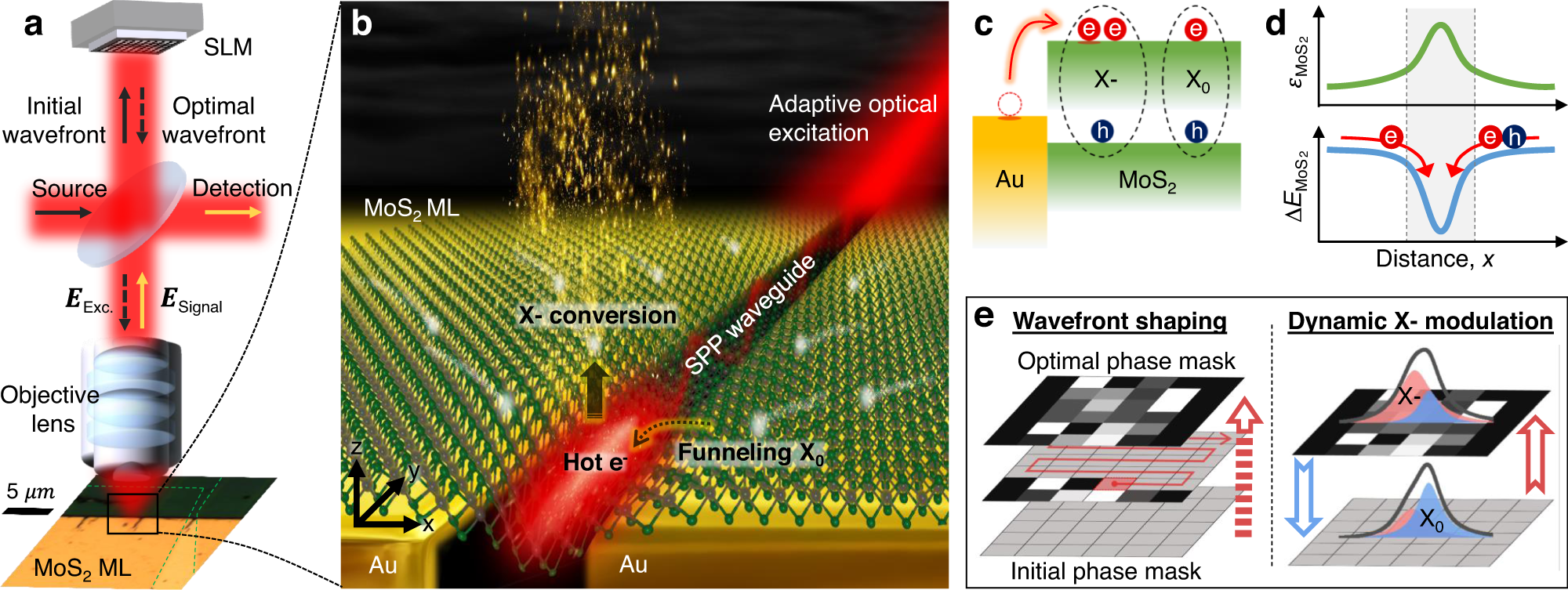
. Leakage-resistant property. Conceptual illustration of conventional nonporous (A) and multifunctional porous (B) EGaIn composites upon compression. Here, porous structures can provide damping effect to substantially reduce stresses induced on liquid metal conductive pathways (see details in fig. S5), therefore endowing leakage-resistant property. In addition, antimicrobial additive can offer antibacterial and antiviral property. (C) Chemical structure of the antimicrobial additive, ε-PL, modified with BEHS for uniform dispersion in solvents. (D) Schematic of the EGaIn particle made by tip sonication of bulk EGaIn. (E) 3D tomography image of porous composites before sintering, showing EGaIn particle (yellow) distributions in elastomers (pink). Scale bar, 100 μm. (F) Photographs of compr...Read More
Scientists have discovered a new ring system around a dwarf planet on the edge of the Solar System. The ring system orbits much further out than is typical for other ring systems, calling into question current theories of how ring systems are formed.
The ring system is around a dwarf planet, named Quaoar, which is approximately half the size of Pluto and orbits the Sun beyond Neptune.
The discovery, published in Nature, was made by an international team of astronomers using HiPERCAM — an extremely sensitive high-speed camera developed by scientists at the University of Sheffield which is mounted on the world’s largest optical telescope, the 10.4 metre diameter Gran Telescopio Canarias (GTC) on La Palma.
The rings are too small and faint to see directl...
Researchers at the University of East Anglia have helped develop a new blood test to detect prostate cancer with greater accuracy than current methods.
New research shows that the Prostate Screening EpiSwitch (PSE) blood test is 94 per cent accurate — beating the currently used prostate-specific antigen (PSA) blood test.
The research team say that the new test shows significant potential as an accurate and rapid cancer screening diagnostic.
The test was developed by Oxford Biodynamics in collaboration with UEA, Imperial College London and Imperial College NHS Trust.
Prof Dmitry Pshezhetskiy, from UEA’s Norwich Medical School, said: “Prostate cancer is the most common cancer in men and kills one man every 45 minutes in the UK.
Recent Comments