
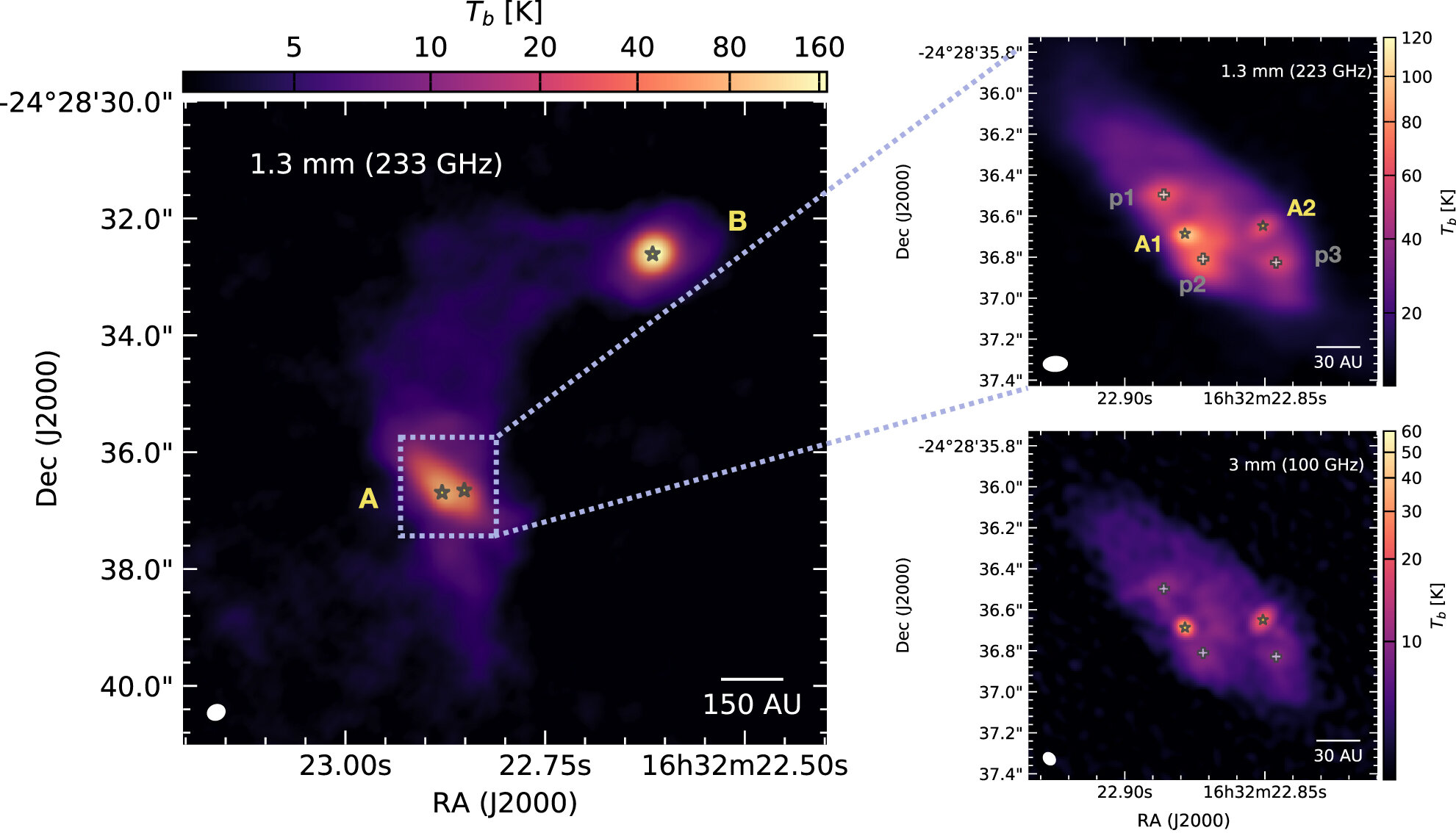
A team of researchers at Max Planck Institute for Extraterrestrial Physics, working with a colleague at the U...
Read More


Until we recognize the essential role of biology, our attempts to truly unify the universe will remain a train to nowhere. ~Robert Lanza Read More

Good health is not something we can buy. However, it can be an extremely valuable savings account. ~Anne Wilson Schaef Read More

The only way forward, if we are going to improve the quality of the environment, is to get everybody involved. ~Richard Rogers Read More

To raise new questions, new possibilities, to regard old problems from a new angle, requires creative imagination and marks real advance in science. ~Albert Einstein Read More

Old Newtonian physics claimed that things have an objective reality separate from our perception of them. Quantum physics, and particularly Heisenberg's Uncertainty Principle, reveal that, as our perception of an object changes, the object itself literally changes. ~Marianne Williamson Read More

Astronomy compels the soul to look upwards and leads us from this world to another. ~ Read More
December 29, 2022,
 Astronomy/Space
A team of researchers at Max Planck Institute for Extraterrestrial Physics, working with a colleague at the U...
Read More
December 28, 2022,
Health/Medical, Biology/Biotechnology
December 28, 2022,
Physics, Technology/Electronics, Environment/Geology

Emerging forms of thin-film device technologies that rely on alternative semiconductor materials, such as printable organics, nanocarbon allotropes and metal oxides, could contribute to a more economically and environmentally sustainable IoT, a KAUST-led international team suggests.
Their paper is published in the journal Nature Electronics.
The IoT is set to have a major impact on daily life and many industries...
Read More
December 28, 2022,
Astronomy/Space

In a recent study published in the Astrophysical Journal Letters, an international team of researchers led by the University of Cologne in Germany examined how solar flares erupted by the TRAPPIST-1 star could affect the interior heating of its orbiting exoplanets.
This study holds the potential to help us better understand how solar flares affect planetary evolution. The TRAPPIST-1 system is an exoplanetary system located approximately 39 light-years from Earth with at least seven potentially rocky exoplanets in orbit around a star that has 12 times less mass than our own sun. Since the parent star is much smaller than our own sun, then the the planetary orbits within the TRAPPIST-1 system are much smaller than our own solar system, as well...
Read More
Recent Comments