Future Smart Homes could be Powered with Electronics built on Stones

An array of stones
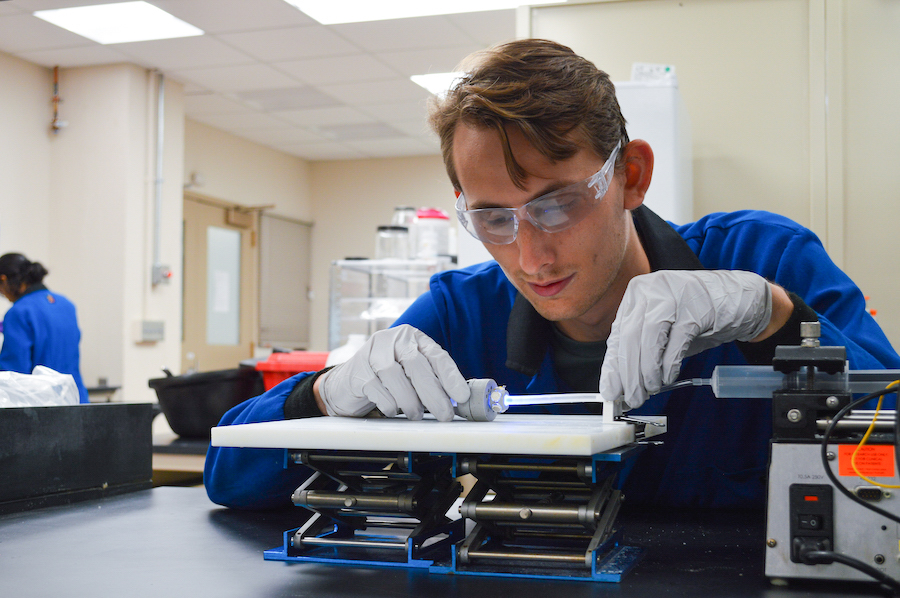
Interconnected microenergy devices built on marble tiles create customizable 3D power supply systems.
Credit: Adapted from ACS Nano 2022, DOI: 10.1021/acsnano.2c01753

What if you could power the smart thermostats, speakers and lights in your home with a kitchen countertop? Stones, such as marble and granite, are natural, eco-friendly materials that many people building or renovating houses already use. Now, in a step toward integrating energy storage with these materials, researchers have fabricated microsupercapacitors onto the surface of stone tiles. The devices, reported in ACS Nano, are durable and easily scaled up for customizable 3D power supplies.

It would be convenient if the surfaces in rooms could charge smart home devices or other small electronics without being connected ...

Read More

Webb reveals Steamy Atmosphere of Distant Planet in Detail

NASA’s James Webb Space Telescope has captured the distinct signature of water, along with evidence for clouds and haze, in the atmosphere surrounding a hot, puffy gas giant planet orbiting a distant Sun-like star.

The observation, which reveals the presence of specific gas molecules based on tiny decreases in the brightness of precise colors of light, is the most detailed of its kind to date, demonstrating Webb’s unprecedented ability to analyze atmospheres hundreds of light-years away.

While the Hubble Space Telescope has analyzed numerous exoplanet atmospheres over the past two decades, capturing the first clear detection of water in 2013, Webb’s immediate and more detailed observation marks a giant leap forward in the quest to characterize potentially habitable planets b...

Read More

The Ultimate Fate of a Star Shredded by a Black Hole

If a star (red trail) wanders too close to a black hole (left), it can be shredded, or spaghettified, by the intense gravity. Some of the star’s matter swirls around the black hole, like water down a drain, emitting copious X-rays (blue). Recent studies of these so-called tidal disruption events suggest that a significant fraction of the star’s gas is also blown outward by intense winds from the black hole, in some cases creating a cloud that obscures the accretion disk and the high-energy events happening within. (Image credit: NASA/CXC/M. Weiss)

In 2019 tidal disruption, much of star’s mass ended up in symmetrical cloud that hid a black hole...

Read More

New Pathway for Accumulation of Age-promoting ‘Zombie Cells’

X-shaped chromosomes are stained purple, and telomeres appear as green spots at chromosome tips. When researchers used a novel tool to induce oxidative damage specifically at telomeres, they can become fragile (green arrows), sending cells into senescence. The inset shows an enlarged chromosome with fragile telomeres, indicated by multiple green spots at chromosome tips.

Senescent cells — those that have lost the ability to divide — accumulate with age and are key drivers of age-related diseases, such as cancer, dementia and cardiovascular disease. In a new study, a team led by University of Pittsburgh and UPMC Hillman Cancer Center researchers has uncovered a mechanism by which senescent, or “zombie,” cells develop.

Published today in Nature Structural & Molecular Biology, the stud...

Read More