






The Laser Breakthrough that could make Tech even Faster

The laser breakthrough that could make tech even faster
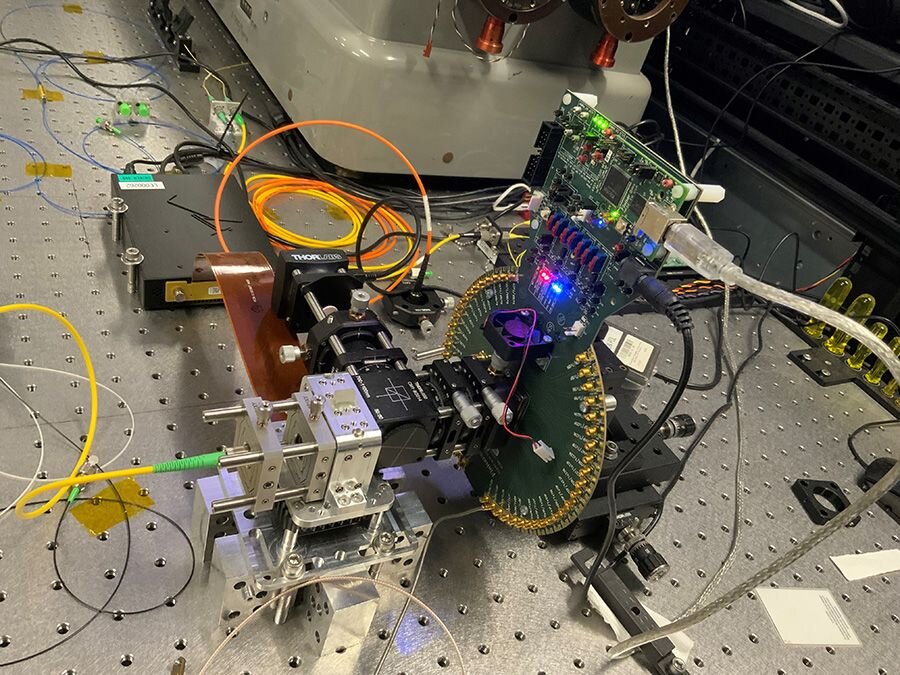
The laser tool developed by the UQ team. Credit: Dr Martin Plöschner

Lasers have become a major part of our day-to-day lives. From phones and tablets to self-driving cars and data communication—even the information you’re reading right now is likely being delivered to you via lasers.

The technology’s applications are so broad even the researchers who deal with lasers daily are continuously amazed.

Among them is University of Queensland Research Fellow Dr. Martin Plöschner from the School of Information Technology and Electrical Engineering (ITEE).

“I’ve been working with lasers for the past 15 years and yet I’m often surprised to find them in the most unexpected places,” Dr. Plöschner said.

“In many of their applications, lasers operate in part of the spectrum which is...

Read More
Mysterious Diamonds came from Outer Space, scientists say

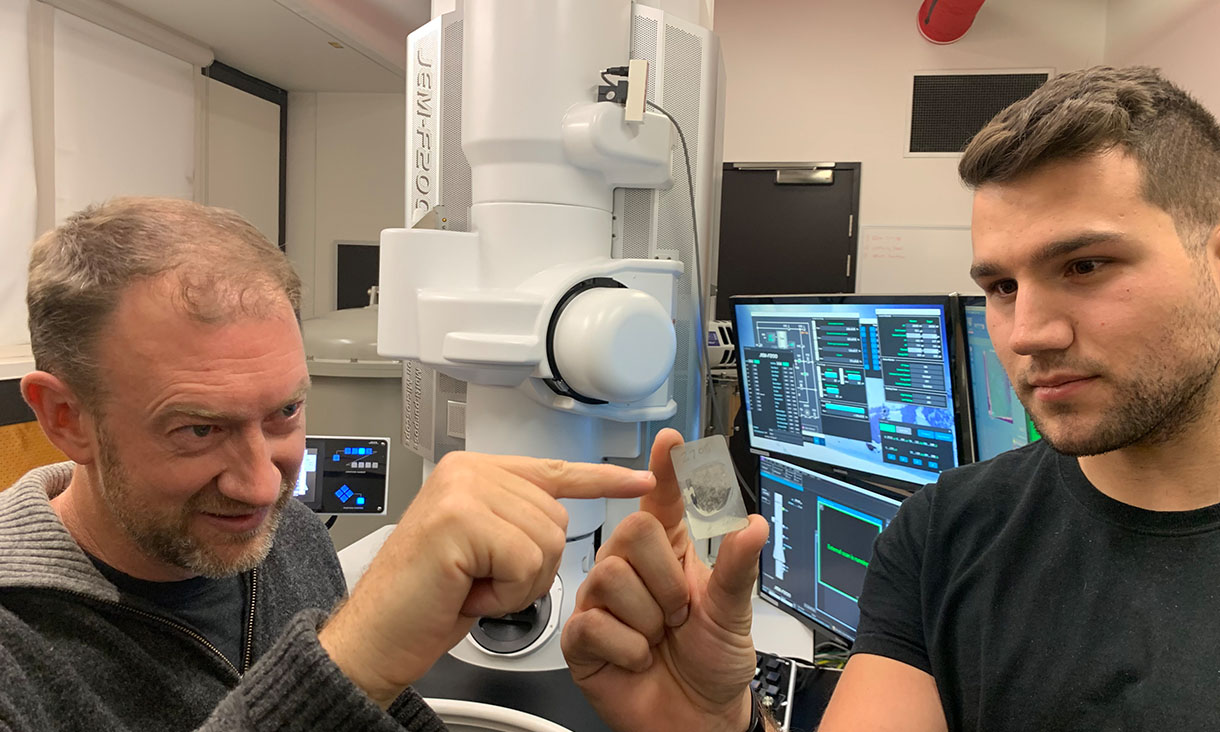
Monash University Professor Andy Tomkins (left) with RMIT University PhD scholar Alan Salek holding a ureilite meteor sample at the RMIT Microscopy and Microanalysis Facility. Credit: RMIT University

Strange diamonds from an ancient dwarf planet in our solar system may have formed shortly after the dwarf planet collided with a large asteroid about 4.5 billion years ago, according to scientists.

The research team says they have confirmed the existence of lonsdaleite, a rare hexagonal form of diamond, in ureilite meteorites from the mantle of the dwarf planet.

Lonsdaleite is named after the famous British pioneering female crystallographer Dame Kathleen Lonsdale, who was the first woman elected as a Fellow to the Royal Society.

The team—with scientists from Monash University, RM...

Read More

Scientists discover how Cells Repair Longevity-promoting ‘Recycling System’

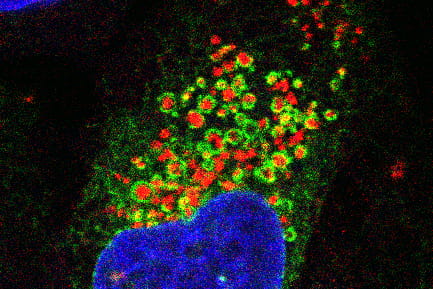
University of Pittsburgh researchers describe for the first time a pathway by which cells repair damaged lysosomes, structures that contribute to longevity by recycling cellular trash. The findings are an important step towards understanding and treating age-related diseases driven by leaky lysosomes.

“Lysosome damage is a hallmark of aging and many diseases, particularly neurodegenerative disorders such as Alzheimer’s,” said lead author Jay Xiaojun Tan, Ph.D., assistant professor of cell biology at Pitt’s School of Medicine and member of the Aging Institute, a partnership between Pitt and UPMC. “Our study identifies a series of steps that we believe is a universal mechanism for lysosomal repair, which we named the PITT pathway as a nod to the University of Pittsburgh.”

As the c...

Read More

Through the Quantum Looking Glass

Green laser light illuminates a metasurface that is a hundred times thinner than paper, that was fabricated at the Center for Integrated Nanotechnologies. CINT is jointly operated by Sandia and Los Alamos national laboratories for the Department of Energy Office of Science. (Photo by Craig Fritz) Click on the thumbnail for a high-resolution image.

A thin device triggers one of quantum mechanics’ strangest and most useful phenomena. An ultrathin invention could make future computing, sensing and encryption technologies remarkably smaller and more powerful by helping scientists control a strange but useful phenomenon of quantum mechanics, according to new research recently published in the journal Science.

Scientists at Sandia National Laboratories and the Max Planck Institute for the...

Read More