Flicker from the Dark: Reading between the lines to Model our Galaxy’s Central Black Hole

Researchers have shown in a single model the full story of how gas travels in the center of the Milky Way — from being blown off by stars to falling into the black hole.

Looks can be deceiving. The light from an incandescent bulb seems steady, but it flickers 120 times per second. Because the brain only perceives an average of the information it receives, this flickering is blurred and the perception of constant illumination is a mere illusion.

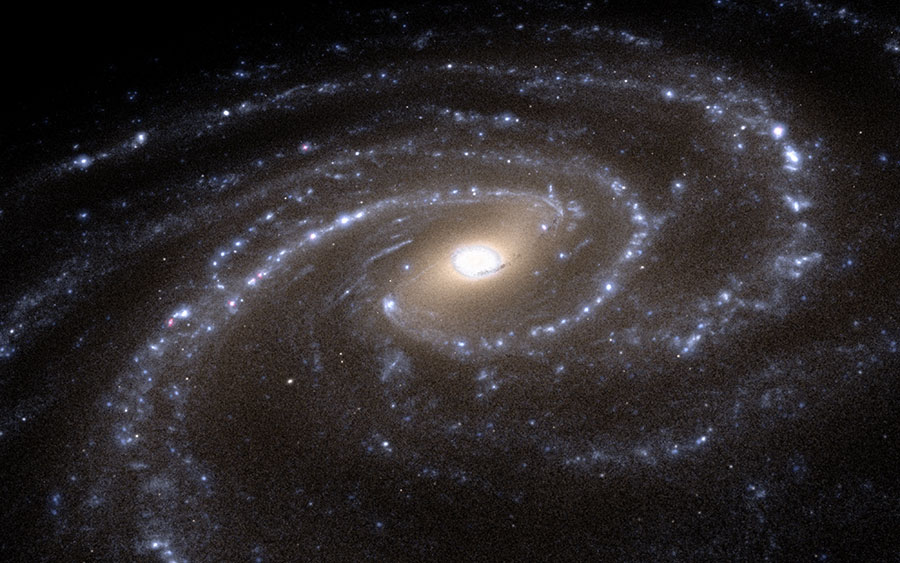
While light cannot escape a black hole, the bright glow of rapidly orbiting gas (recall the images of M87’s black hole and Sgr A) has its own unique flicker. In a recent paper, published in Astrophysical Journal Letters, Lena Murchikova, William D...

Read More

Breast Duct Treatment for Early Breast Cancer Eliminates all Signs of Disease in Laboratory Experiments

Dr. Guannan Wang performs intraductal injection under a microscope. Credit: Qinxin Jiang

Next step is to study in women receiving mastectomy. Delivering a targeted immunotoxin into breast ducts via openings in the nipple wiped out all visible and invisible precancerous lesions in laboratory studies, led by researchers at the Johns Hopkins Kimmel Cancer Center, of very early stage breast cancers.

A description of the work performed on mice, which the authors say provides a strong pre-clinical foundation for conducting feasibility and safety trials with patients who have stage 0 breast cancers, is published in the June 8 issue of the Proceedings of the National Academy of Sciences.

Stage 0 breast cancer, also known as ductal carcinoma in situ (DCIS), is characterized as the presenc...

Read More

Organic Bipolar Transistor developed

Organic bipolar transistors can also handle demanding data processing and transmission tasks on flexible electronic elements, e.g. here for electrocardiogram (ECG) data.

Researchers have developed a highly efficient organic bipolar transistor. The work opens up new perspectives for organic electronics – both in data processing and transmission, as well as in medical technology applications.

Prof. Karl Leo has been thinking about the realization of this component for more than 20 years, now it has become reality: His research group at the Institute for Applied Physics at the TU Dresden has presented the first highly efficient organic bipolar transistor. The results of the research work have now been published in the leading specialist journal Nature.

The invention of the transisto...

Read More

Scientists Map Sulfur Residue on Jupiter’s icy moon Europa

Composite image of the surface of Jupiter’s fourth largest moon Europa
Courtesy of NASA SwRI scientists used Hubble Space Telescope to image the surface of Jupiter’s fourth largest moon Europa (shown lower right in this composite image) in the ultraviolet, mapping concentrations of sulfur dioxide on its surface that likely came from Io (above), Jupiter’s ultra-volcanic moon.

Hubble Space Telescope ultraviolet data fills gap in observations. A Southwest Research Institute-led team used the Hubble Space Telescope to observe Jupiter’s moon, Europa, at ultraviolet wavelengths, filling in a “gap” in the various wavelengths used to observe this icy water world. The team’s near-global UV maps show concentrations of sulfur dioxide on Europa’s trailing side.

SwRI will further these studies using the Europa Ultraviolet Spectrograph (Europa-UVS), which will o...

Read More