Modified Microwave oven cooks up Next-gen Semiconductors

James Hwang
James Hwang, research professor in the Department of Materials Science and Engineering, right, at his modified microwave with Gianluca Fabi holding a semiconductor at left. Ryan Young/Cornell University

A household microwave oven modified by a Cornell engineering professor is helping to cook up the next generation of cellphones, computers and other electronics after the invention was shown to overcome a major challenge faced by the semiconductor industry.

The research is detailed in a paper published in Applied Physics Letters. The lead author is James Hwang, a research professor in the department of materials science and engineering.

As microchips continue to shrink, silicon must be doped, or mixed, with higher concentrations of phosphorus to produce the desired current...

Read More
Surprise finding suggests ‘Water Worlds’ are more Common than we thought

view of one hemisphere of Europa, a moon made of pale rock with orange streaks across surface
A new study suggests that many more planets in distant solar systems have large amounts of water than previously thought—as much as half water and half rock. The catch? It’s probably imbedded underground, as in Jupiter’s moon Europa, above.
Image courtesy of NASA/JPL-Caltech/SETI Institute

Analysis finds evidence for many exoplanets made of water and rock around small stars. A new study suggests that many more planets may have large amounts of water than previously thought–as much as half water and half rock. The catch? All that water is probably embedded in the rock, rather than flowing as oceans or rivers on the surface.

Water is the one thing all life on Earth needs, and the cycle of rain to river to ocean to rain is an essential part of what keeps our planet’s climate stabl...

Read More

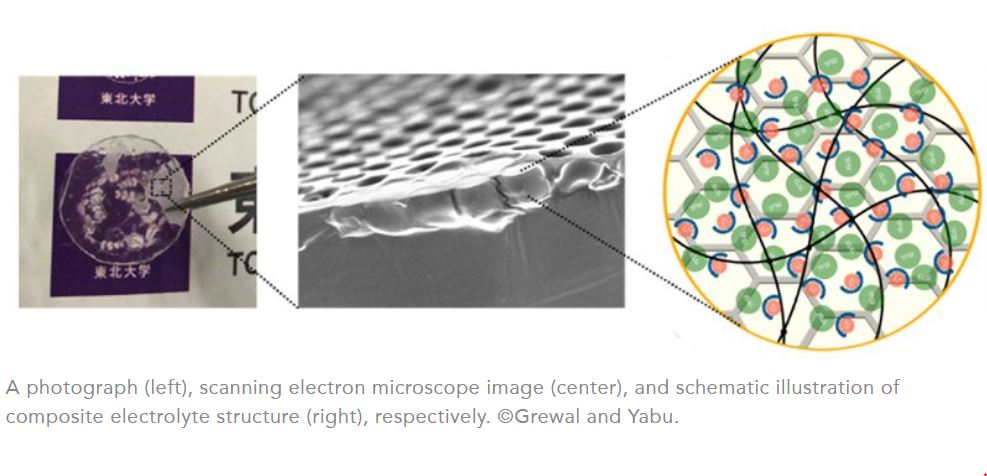
Researchers invent a new Hybrid Electrolyte for High Performance Li-ion Batteries

Crucial to our everyday use the Li-ion battery can be found everywhere. Research has now resulted in a hybrid electrolyte that is both more stable while also retaining excellent conductivity. This will pave the way to a safer polymeric solid electrolyte for Li-ion batteries with a myriad of applications.

Li-ion batteries (LIBs) are one of the most used batteries that support modern ITC society, including smartphones and EVs. LIBs are repeatedly charged and discharged by Li-ions passing back and forth between the positive and negative electrodes, with the Li-ion electrolyte acting as a passageway for the ions.

Normally, organic electrolytes such as liquid ethylene carbonate (EC) and their gels have been used as the Li-ion electrolyte due to their voltage resistance and ionic cond...

Read More

Two New Temperate Rocky Worlds discovered

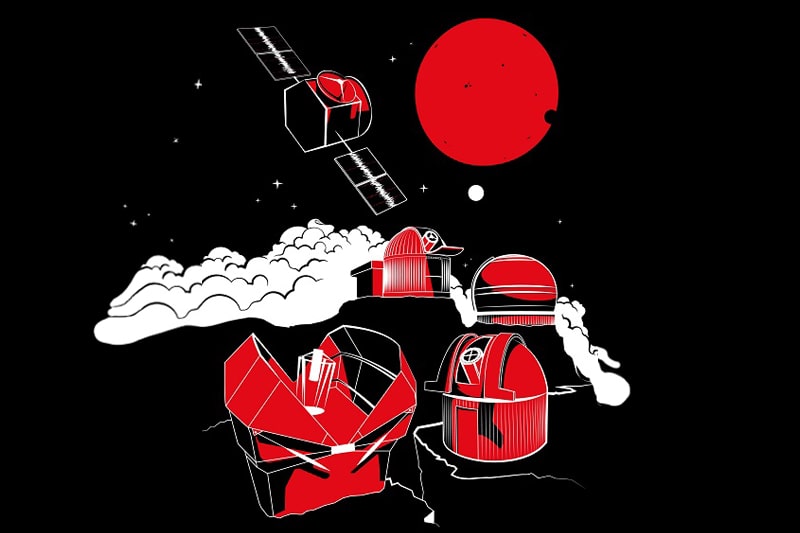
Artists illustration of the red star and two planets along with the SPECULOOS telescopes

An international research team including astronomers at the University of Birmingham, has just announced the discovery of two “super-Earth” planets orbiting LP 890-9, a small, cool star located about 100 light-years from Earth.

The star, also called TOI-4306 or SPECULOOS-2, is the second-coolest star found to host planets, after the famous TRAPPIST-1. This rare discovery is the subject of a forthcoming publication in the journal Astronomy & Astrophysics.

The system’s inner planet, called LP 890-9b, is about 30% larger than Earth and completes an orbit around the star in just 2.7 days. This first planet was initially identified as a possible planet candidate by NASA’s Transiting Exoplanet Survey Satellite (TESS), a space mission searching for exoplanets orbiting nearby stars...

Read More