Yoyo Stars responsible for Off-Center Bubbles

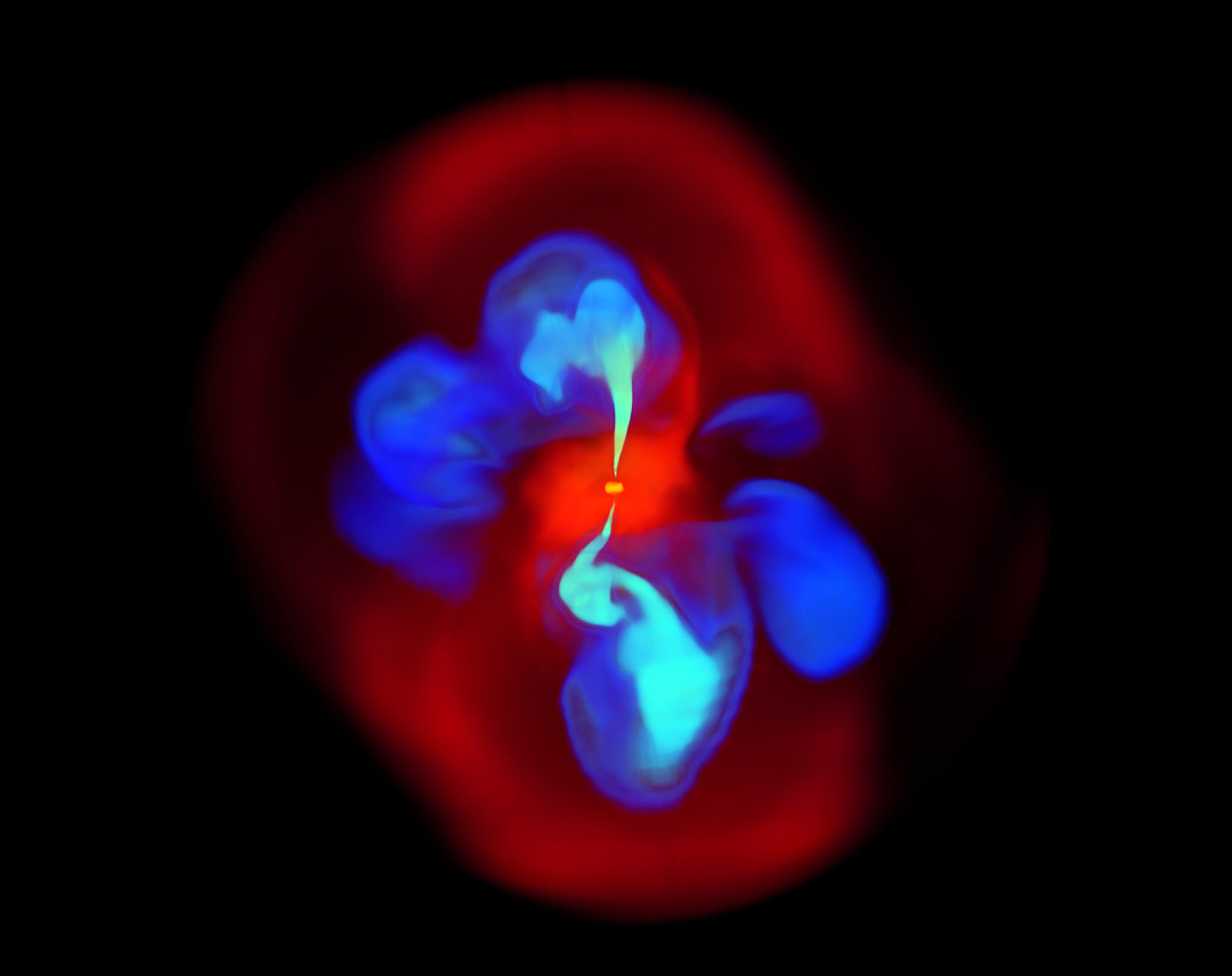
Simulated star cluster partially embedded in a cloud of hydrogen gas. (Credit: Michiko Fujii, Takaaki Takeda, 4D2U Project, National Astronomical Observatory of Japan)

Astronomers have developed a new code to simulate the formation of a cluster of baby stars. Comparison with the well-known real case of the Orion Nebula shows that its off-center bubble of ionized gas was caused by a massive star that was pushed out of the newborn cluster but is now falling back in.

Groups of stars often form together in clouds of cold hydrogen gas. The brightest and most massive stars ionize the surrounding gas, making it too hot to form new stars. In this way massive stars act as a feedback, shutting off new star formation...

Read More

Particle Accelerator Region revealed inside a Solar Flare

A new study offers the first direct evidence showing where near-light speed particle acceleration occurs inside the largest explosion known in the solar system, the solar flare. Image Credit: Sijie Yu of NJIT/CSTR; NOAA GOES-16/SUVI

A new study offers direct evidence showing where near-light speed particle acceleration occurs inside the largest explosion known in the solar system, the solar flare.

Solar flares are among the most violent explosions in our solar system, but despite their immense energy — equivalent to a hundred billion atomic bombs detonating at once — physicists still haven’t been able to answer exactly how these sudden eruptions on the Sun are able to launch particles to Earth, nearly 93 million miles away, in under an hour.

Now, in a study published June 8 in Na...

Read More

Nanotechnology used to Destroy and Prevent Relapse of Solid Tumor Cancers

 B7 co-stimulation enhances the anti-PD1-based immunosuppression reversal.

As people across the globe look forward to longer life expectancies, malignant cancers continue to pose threats to human health. The exploration and development of immunotherapy aims to seek new breakthroughs for the treatment of solid tumours.

The successful establishment of anti-tumour immunity requires the activation, expansion and differentiation of antigen-specific lymphocytes. This process largely depends on specific interactions between various T cells and antigen-presenting cells (APCs) in the body. However, existing tumour vaccines, such as neoantigen vaccines and various vector vaccines, all rely on random interactions with APCs in the body...

Read More

Earth-Abundant Solar Pixels found to produce Hydrogen for Weeks

Multiple BiOI and BiOI-BiVO4 pixels on a device.
Multiple BiOI and BiOI-BiVO4 pixels on a device. Credit: Dr Virgil Andrei.

Devices made of readily available oxide and carbon-based materials can produce clean hydrogen from water over weeks — according to new research.

The findings, co-led by Dr Virgil Andrei, a Research Fellow at St John’s College, University of Cambridge, with academics at Imperial College London, could help overcome one of the key issues in solar fuel production, where current earth-abundant light-absorbing materials are limited through either their performance or stability.

Underexplored materials for light harvesting

Hydrogen fuel will play a critical role in the transition to full decarbonisation and reaching the UK’s goal of net-zero emissions by 2050...

Read More