Unusual Neutron Star Spinning every 76 seconds discovered in Stellar Graveyard

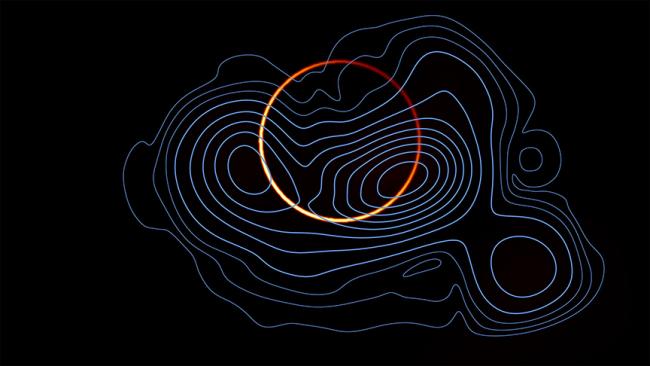
Artist impression of the 76s pulsar (in magenta) compared to other more rapidly spinning sources. Credit: Danielle Futselaar

An international team led by a University of Sydney scientist has discovered an unusual radio signal emitting neutron star that rotates extremely slowly, completing one rotation every 76 seconds.

The star is unique because it resides in the “neutron star graveyard,” where no pulsations are expected. The discovery was made by the MeerTRAP team using the MeerKAT radio telescope in South Africa and is published in Nature Astronomy.

The star was initially detected from a single pulse. It was then possible to confirm multiple pulses using simultaneous consecutive eight-second-long images of the sky, to confirm its position.

Neutron stars are extremely dense r...

Read More

New Laser Breakthrough to help understanding of Gravitational Waves

Metasurface card
A schematic of the apparatus used by the researchers. ‘f’ is the focal length of the lens.

Gravitational wave scientists from The University of Western Australia have led the development of a new laser mode sensor with unprecedented precision that will be used to probe the interiors of neutron stars and test fundamental limits of general relativity.

Research Associate from UWA’s Centre of Excellence for Gravitational Wave Discovery (OzGrav-UWA) Dr. Aaron Jones said UWA coordinated a global collaboration of gravitational wave, metasurface and photonics experts to pioneer a new method to measure structures of light called “eigenmodes.”

“Gravitational wave detectors like LIGO, Virgo and KAGRA store enormous amount of optical power and several pairs of mirrors are used to increas...

Read More

T cell warriors need their R&R

T cell warriors need their R & R

T cells, biology textbooks teach us, are the soldiers of the immune system, constantly on the ready to respond to a variety of threats, from viruses to tumors. However, without rest and maintenance T cells can die and leave their hosts more susceptible to pathogens, Yale scientists report May 27 in the journal Science.

“We may have to change how we teach T cell biology,” said Lieping Chen, the United Technologies Corporation Professor in Cancer Research at Yale and professor of immunobiology, of dermatology, and of medicine and senior author of the study.

Until pathogens are detected, T cells remain in a quiescent state. However, the molecular mechanisms that keep T cells inactive were previously unknown.

In the new study, Yale researchers show that a protein known as CD8a — ...

Read More

Toward Error-Free Quantum Computing

With fault-tolerant implementation the effort and complexity increase, but the resulting quality is better.

Fundamental building blocks for fault-tolerant quantum computing demonstrated. For quantum computers to be useful in practice, errors must be detected and corrected. At the University of Innsbruck, Austria, a team of experimental physicists has now implemented a universal set of computational operations on fault-tolerant quantum bits for the first time, demonstrating how an algorithm can be programmed on a quantum computer so that errors do not spoil the result.

In modern computers errors during processing and storage of information have become a rarity due to high-quality fabrication...

Read More