New Chip-based Beam Steering – Device Lays Groundwork for Smaller, Cheaper Lidar

Caption: The new OPA that replaces the multiple emitters of traditional OPAs with a slab grating to create a single emitter. This design enables a wide field of view without sacrificing beam quality.
Image Credit: Hao Hu, Technical University of Denmark

Technology could benefit lidar applications from autonomous driving to virtual reality. Researchers have developed a new chip-based beam steering technology that provides a promising route to small, cost-effective and high-performance lidar (or light detection and ranging) systems. Lidar, which uses laser pulses to acquire 3D information about a scene or object, is used in a wide range of applications such as autonomous driving, free-space optical communications, 3D holography, biomedical sensing and virtual reality.

“Optical beam ste...

Read More
Signs of Disturbance in Nearby Dwarf Galaxies indicate an Alternative Gavity Theory

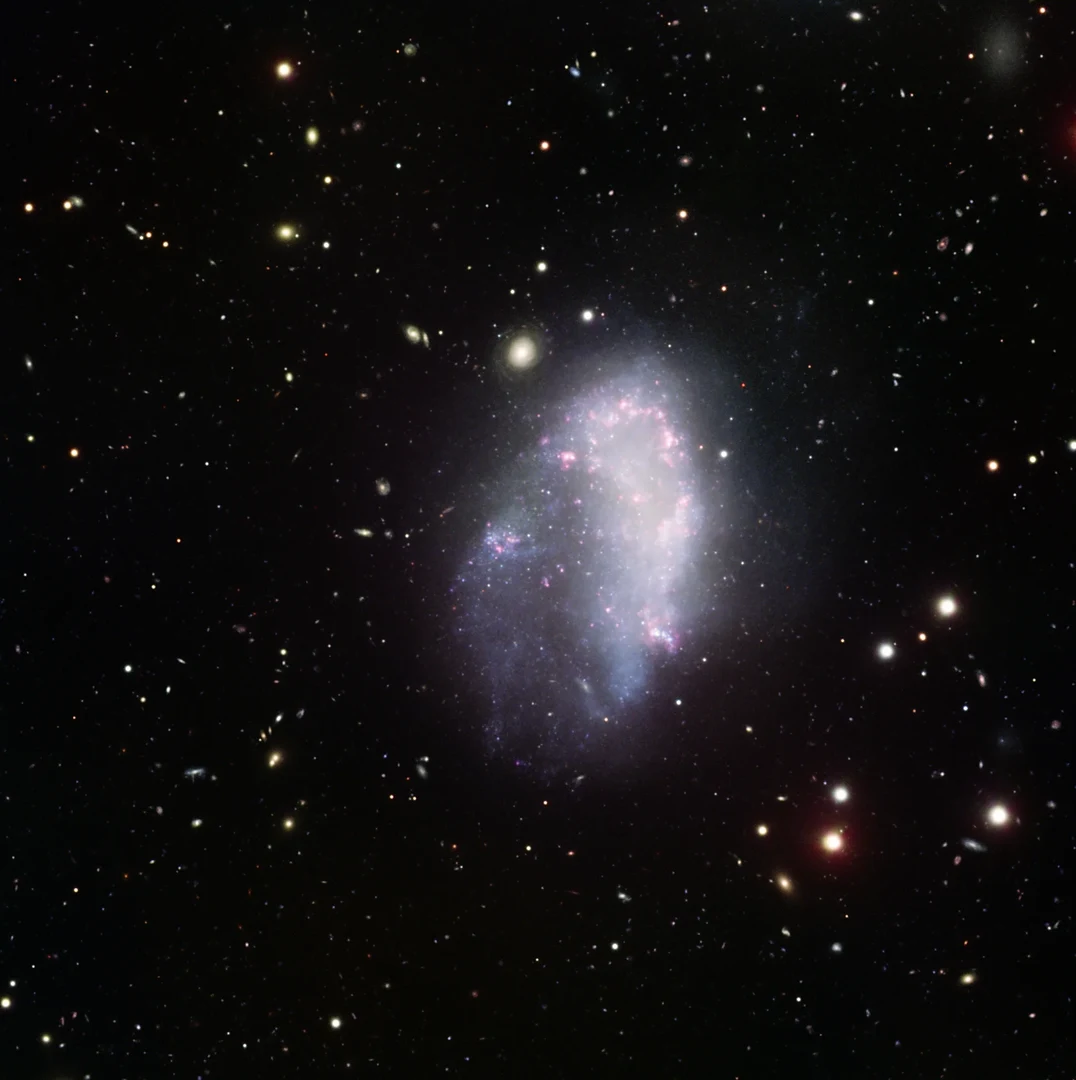
The dwarf galaxy NGC1427A flies through the Fornax galaxy cluster and undergoes disturbances which would not be possible if this galaxy were surrounded by a heavy and extended dark matter halo, as required by standard cosmology.
The dwarf galaxy NGC1427A flies through the Fornax galaxy cluster and undergoes disturbances which would not be possible if this galaxy were surrounded by a heavy and extended dark matter halo, as required by standard cosmology.© ESO

According to the standard model of cosmology, the vast majority of galaxies are surrounded by a halo of dark matter particles. This halo is invisible, but its mass exerts a strong gravitational pull on galaxies in the vicinity. A new study challenges this view of the Universe. The results suggest that the dwarf galaxies of Earth’s second closest galaxy cluster — known as the Fornax Cluster — are free of such dark matter halos.

Dwarf galaxies are small, faint galaxies that can usually be found in galaxy clusters or near larger galaxies...

Read More

New Patent-Pending method Mass-produces Antitumor cells to Treat Blood Diseases and Cancer

bao-cells
Xiaoping Bao, a Purdue University assistant professor from the Davidson School of Chemical Engineering, has improved upon traditional methods to create human immune cells from human pluripotent stem cells. The research was published in the peer-reviewed journal Cell Reports. (Syahrir Maulana/iStock photo)

A Purdue University chemical engineer has improved upon traditional methods to produce off-the-shelf human immune cells that show strong antitumor activity, according to a paper published in the peer-reviewed journal Cell Reports.

Xiaoping Bao, a Purdue University assistant professor from the Davidson School of Chemical Engineering, said CAR-neutrophils, or chimeric antigen receptor neutrophils, and engraftable HSCs, or hematopoietic stem cells, are effective types of therapies for...

Read More

Smart Lighting system based on Quantum Dots more accurately reproduces Daylight

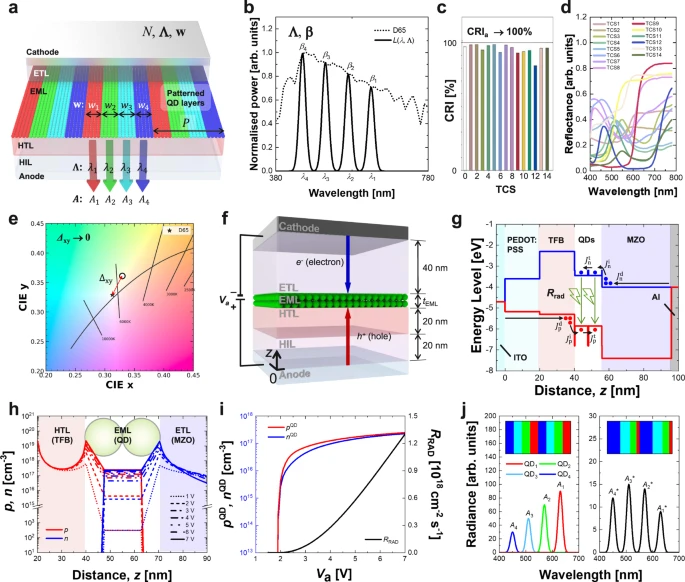
 A system architecture and design procedure of multi-primary coloured lighting system with patterned QD-LEDs.

Researchers have designed smart, colour-controllable whitelight devices from quantum dots – tiny semiconductors just a few billionths of a metre in size – which are more efficient and have better colour saturation than standard LEDs, and can dynamically reproduce daylight conditions in a single light.

The researchers, from the University of Cambridge, designed the next-generation smart lighting system using a combination of nanotechnology, colour science, advanced computational methods, electronics and a unique fabrication process.

The team found that by using more than the three primary lighting colours used in typical LEDs, they were able to reproduce daylight more accu...

Read More