Neuroscientists Identify Mechanism for Long Term Memory Storage

People working in Ted Abel’s lab in PBDB.

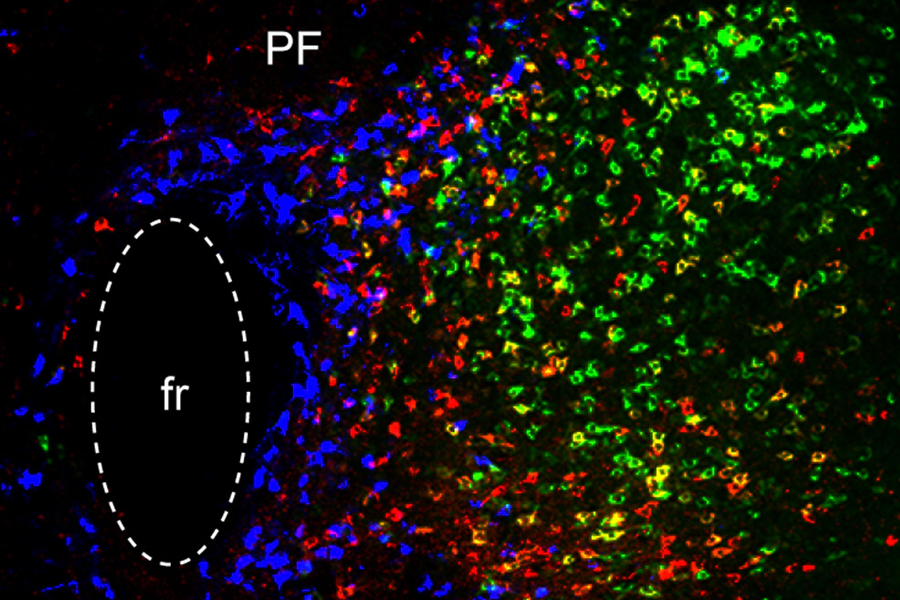
A University of Iowa neuroscience research team has identified a fundamental biochemical mechanism underlying memory storage and has linked this mechanism to cognitive deficits in mouse models of Alzheimer’s Disease and Related Dementias.

While working to understand how memories are formed and stored in the brain, the team identified a novel protein folding mechanism in the endoplasmic reticulum that is essential for long term memory storage. They further demonstrated that this mechanism is impaired in a tau-based mouse model of Alzheimer’s disease and that restoring this protein folding mechanism reverses memory impairment in this mouse model for the study of dementia...

Read More

Quantum Sensors: Measuring even more Precisely

Two teams of physicists have designed the first programmable quantum sensor, and tested it in the laboratory. To do so they applied techniques from quantum information processing to a measurement problem. The innovative method promises quantum sensors whose precision reaches close to the limit set by the laws of nature.

Atomic clocks are the best sensors humankind has ever built. Today, they can be found in national standards institutes or satellites of navigation systems. Scientists all over the world are working to further optimize the precision of these clocks...

Read More

Nearby Star could help explain why our Sun didn’t have Sunspots for 70 years

A new study has identified a nearby star whose sunspot cycles appear to have stopped. Studying this star might help explain the period from the mid 1600s to the early 1700s when our Sun paused its sunspot cycles. This image depicts a typical 11-year cycle on the Sun, with the fewest sunspots appearing at its minimum (top left and top right) and the most appearing at its maximum (center). Credit: NASA

Astronomers identified a nearby star whose sunspot cycles appear to have stopped. Studying this star might help explain the unusual period from the mid 1600s to the early 1700s when our Sun paused its sunspot cycles.

The number of sunspots on our Sun typically ebbs and flows in a predictable 11-year cycle, but one unusual 70-year period when sunspots were incredibly rare has mystified s...

Read More

Cryo-EM reveals how ‘911’ Molecule Helps Fix Damaged DNA

When something goes wrong during DNA replication, cells call their own version of 911 to pause the process and fix the problem—a failsafe that is critical to maintaining health and staving off disease.

Now, scientists at Van Andel Institute and The Rockefeller University have for the first time revealed how a key piece of this repair process—appropriately called the 911 DNA checkpoint clamp—is recruited to the site of DNA damage. The findings, published today in Nature Structural and Molecular Biology, illuminate new insights into the way cells ensure genetic instructions are properly passed from one generation of cells to the next. The project was led by the study’s co-corresponding authors Huilin Li, Ph.D., of VAI, and Michael E. O’Donnell, Ph.D...

Read More