Scientists Announce Discovery of Supermassive Binary Black Holes

Two supermassive black holes orbit one another in a binary system. They are 10 times closer to each other than the black holes in the only other known supermassive binary black hole system. Photo credit: Caltech/R. Hurt (IPAC)

Two black holes orbiting one another eventually will merge. A team of researchers from Purdue University and other institutions have discovered a supermassive black hole binary system, one of only two known such systems. The two black holes, which orbit each other, likely weigh 100 million suns each. One of the black holes powers a massive jet that moves outward at very close to the speed of light. The system is so far away that the visible light seen today was emitted 8.8 billion years ago.

The two are only between 200 AU and 2,000 AU apart (one AU is the di...

Read More

Magnetism helps Electrons Vanish in High-temp Superconductors

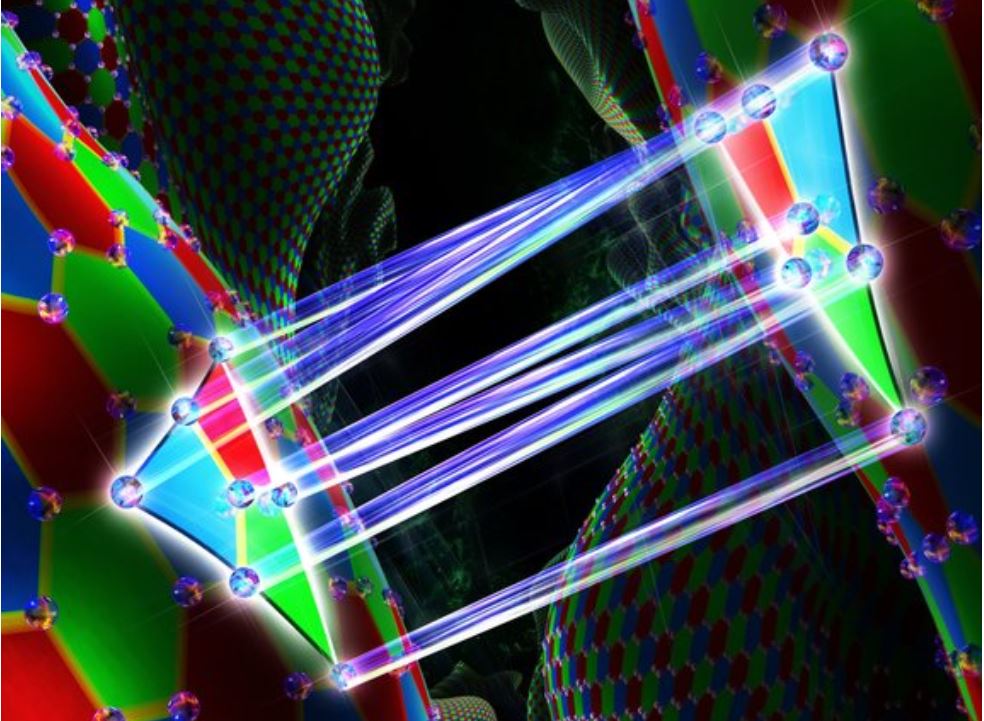
The Fermi surface on the left shows the arrangement of electrons in a copper-oxide high temperature superconductor before the “critical point.” After the critical point, the Fermi surface on the right shows that most electrons vanish. Research by the Brad Ramshaw’s lab connects this disappearance with magnetism.

A physicist’s discovery could lead to the engineering of high-temp superconducting properties into materials useful for quantum computing, medical imaging.

Superconductors — metals in which electricity flows without resistance — hold promise as the defining material of the near future, according to physicist Brad Ramshaw, and are already used in medical imaging machines, drug discovery research and quantum computers being built by Google and IBM.

However, the super-...

Read More

The New, Improved Dragonfly is a Galactic Gas Detector

This image zooms in on a newly forming tidal dwarf galaxy, which appears like a clump of gas at the edge of the disk of the M82 galaxy. Red regions are emissions from ionized gas. (Courtesy of the Dragonfly telescope team)

The Dragonfly telescope is undergoing a metamorphosis. For the past decade, the Dragonfly Telephoto Array — designed by Yale’s Pieter van Dokkum and the University of Toronto’s Roberto Abraham and located in New Mexico — has conducted groundbreaking science by detecting faint starlight within dimly lit parts of the night sky. The telescope uses clusters of telephoto lenses to create images, much the way a dragonfly’s eyes gather visual data.

The telescope has spotted previously unseen “fluffy” galaxies, diffuse dwarf galaxies, and galaxies with little or no dark m...

Read More

Smart LED Contact Lenses for Treating Diabetic Retinopathy

Diabetes is a long-term chronic disease with many complications and requires care over a lifetime. The longer a patient suffers from diabetes, the higher the risk of developing retinopathy which can progressively lead to a decline in vision and even to blindness.

A POSTECH research team led by Professor Sei Kwang Hahn and Ph.D. candidate Geon-Hui Lee (Department of Materials Science and Engineering) in collaboration with Dr. Sangbaie Shin of PHI BIOMED Co. has recently developed a smart contact lens-type wearable device to prevent diabetic retinopathy and treat it in its early stages by irradiating 120 µW far red/LED light to the retina. This technology for smart LED contact lens has attracted a great attention for various ophthalmologic diseases.

Diabetic retinopathy is curren...

Read More