To raise new questions, new possibilities, to regard old problems from a new angle, requires creative imagination and marks real advance in science.
~Albert Einstein
Read More
Old Newtonian physics claimed that things have an objective reality separate from our perception of them. Quantum physics, and particularly Heisenberg's Uncertainty Principle, reveal that, as our perception of an object changes, the object itself literally changes.
~Marianne Williamson
Read More
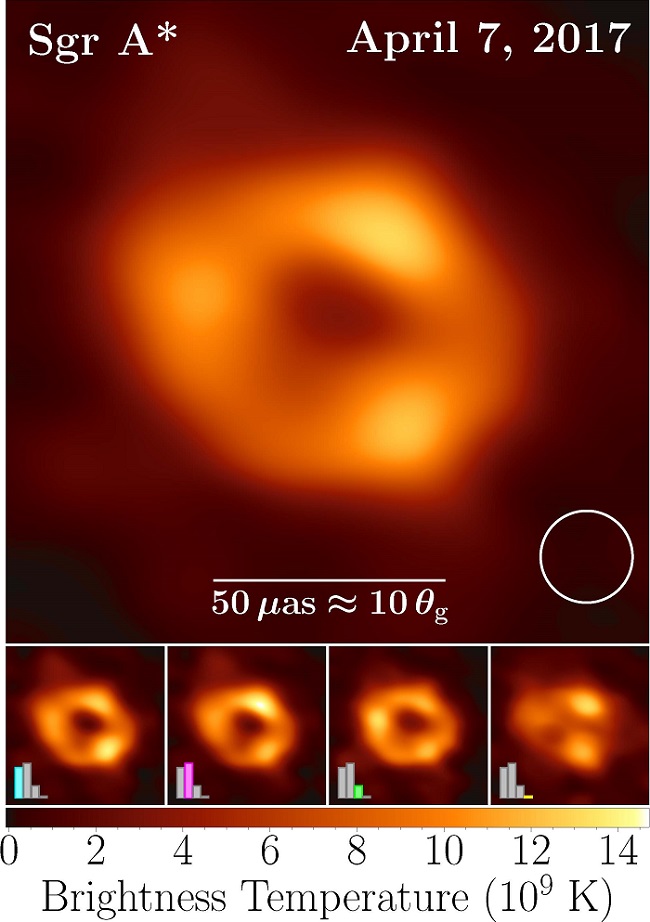
EHT image of Sgr A* (top; Paper I). Ring-like images dominate the wide range of images obtained across multiple methods, however, variability and sparse visibility domain coverage make selection of a single image impossible (Paper III). The inset images represent different imaging solutions and their associated frequency (histograms).
Astronomers have unveiled the first image of the supermassive black hole at the centre of our own Milky Way galaxy. This result provides overwhelming evidence that the object is indeed a black hole and yields valuable clues about the workings of such giants, which are thought to reside at the centre of most galaxies...
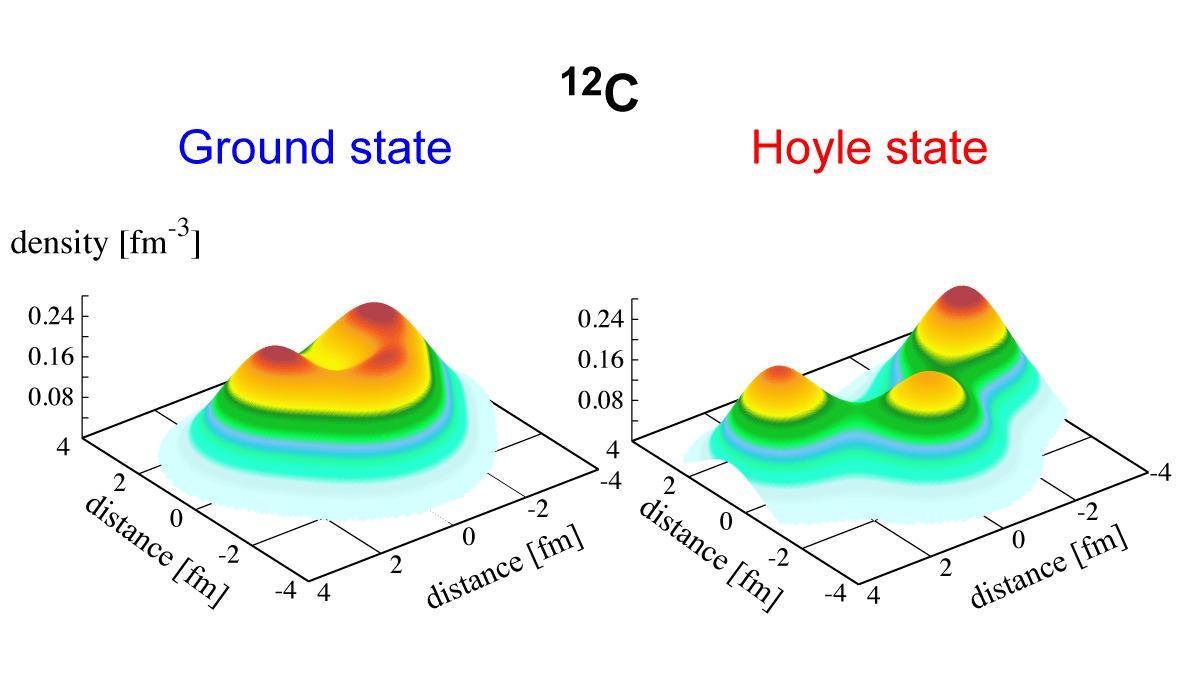
These computer simulations show the structures of carbon-12 in the unstable, excited Hoyle state and as a stable ground state, the stuff of life. Image courtesy of James Vary.
With the help of the world’s most powerful supercomputer and new artificial intelligence techniques, an international team of researchers has theorized how the extreme conditions in stars produce carbon-12, which they describe as “a critical gateway to the birth of life.”
The researchers’ fundamental question: “How does the cosmos produce carbon-12?” said James Vary, a professor of physics and astronomy at Iowa State University and a longtime member of the research collaboration.
“It turns out it’s not easy to produce carbon-12,” Vary said.
It takes the extreme heat and pressures inside stars or in stell...
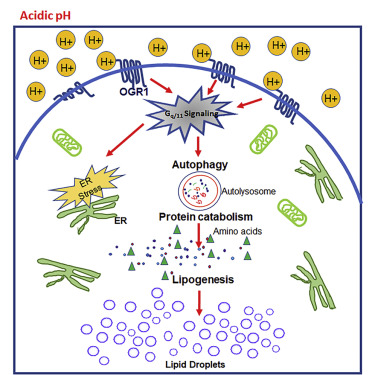
The alterations are associated with poor outcomes and disease progression. Alterations in metabolic processes are a hallmark of cancer and can lead to a tumor environment that is acidic. As a result, cancer cells must adapt to survive in this inhospitable environment. In a new study published in the journal Cell Reports, Moffitt Cancer Center researchers show that cancer cells in an acidic environment undergo lipid synthesis and accumulation. The team identified the key signaling molecules responsible for these changes and discovered that these alterations are associated with poor outcomes and disease progression among breast cancer patients.
Cancer cells undergo numerous changes that promote cell survival and continued growth...
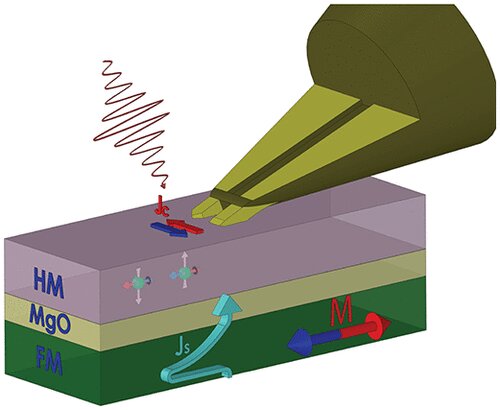
An intermediate layer consisting of a few atoms is helping to improve the transport of spin currents from one material to another. Until now, this process involves significant losses. A team from Martin Luther University Halle-Wittenberg (MLU), the Max Planck Institute (MPI) for Microstructure Physics, and the Freie Universität Berlin reports in the scientific journal ACS Nano Letters on how this can be avoided. The researchers thus demonstrate important new insights relevant for many spintronic applications, for example energy-efficient and ultrafast storage technologies of the future.
In modern microelectronics, the charge of electrons is used to carry information in electronic components, mobile p...











Recent Comments