To raise new questions, new possibilities, to regard old problems from a new angle, requires creative imagination and marks real advance in science.
~Albert Einstein
Read More
Old Newtonian physics claimed that things have an objective reality separate from our perception of them. Quantum physics, and particularly Heisenberg's Uncertainty Principle, reveal that, as our perception of an object changes, the object itself literally changes.
~Marianne Williamson
Read More
Researchers were able to directly image newly forming exoplanet AB Aurigae b over a 13-year span using Hubble’s Space Telescope Imaging Spectrograph (STIS) and its Near Infrared Camera and Multi-Object Spectrograph (NICMOS). In the top right, Hubble’s NICMOS image captured in 2007 shows AB Aurigae b in a due south position compared to its host star, which is covered by the instrument’s coronagraph. The image captured in 2021 by STIS shows the protoplanet has moved in a counterclockwise motion over time. Credits: Science: NASA, ESA, Thayne Currie (Subaru Telescope, Eureka Scientific Inc.); Image Processing: Thayne Currie (Subaru Telescope, Eureka Scientific Inc.), Alyssa Pagan (STScI)
NASA’s Hubble Space Telescope has directly photographed evidence of a Jupiter-like protoplanet for...
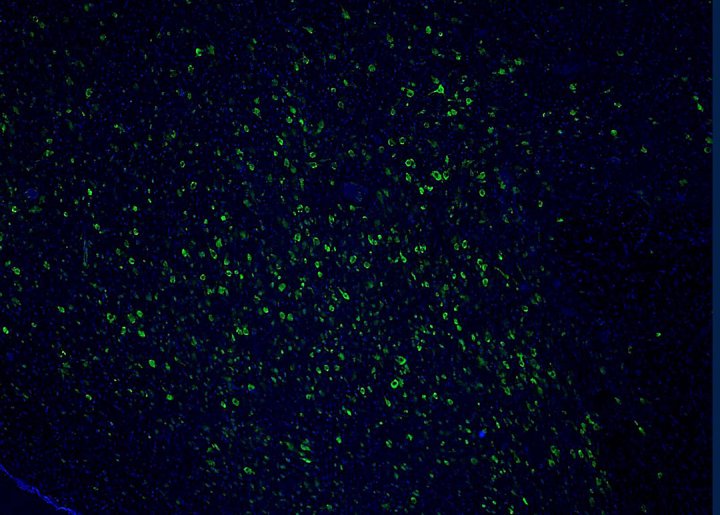
Neurons that promote wakefulness in the brain of an Alzheimer’s patient (green). There are far fewer functioning neurons that would be seen in a healthy brain, indicating that the awake system is weakened in this patient. Image by Grinberg Lab
Reviving ‘awake neurons’ could be the solution to their sleepiness. The lethargy that many Alzheimer’s patients experience is caused not by a lack of sleep, but rather by the degeneration of a type of neuron that keeps us awake, according to a study that also confirms the tau protein is behind that neurodegeneration.
The study’s findings contradict the common notion that Alzheimer’s patients sleep during the day to make up for a bad night of sleep and point toward potential therapies to help these patients feel more awake.
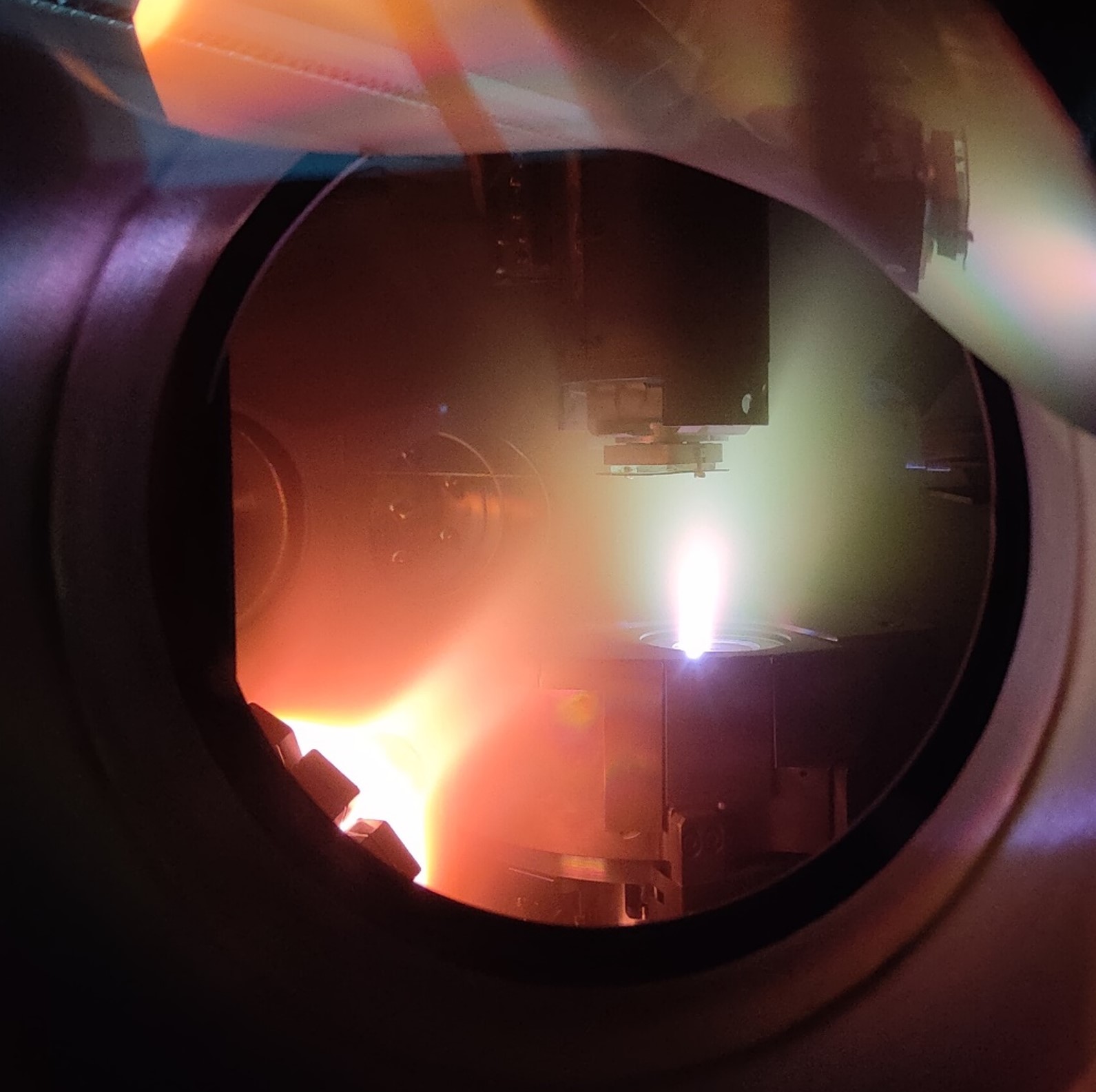
Producing low-cost metal-oxide thin films with high electronic quality for solar water splitting is not an easy task. Especially since quality improvements of the upper metal oxide thin films need thermal processing at high temperatures, which would melt the underlying glass substrate. Now, a team has solved this dilemma: A high intensity and rapid light pulse directly heats the semiconducting metal-oxide thin film, allowing it to reach the optimal temperature without damaging the substrate.
Solar energy can directly drive electrochemical reactions at the surface of photoelectrodes...
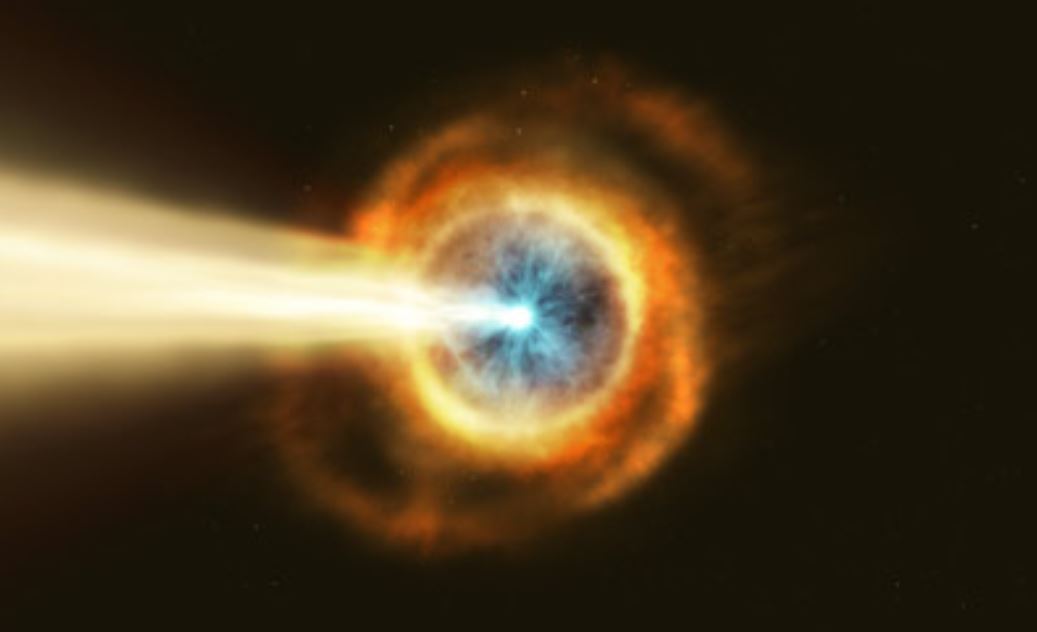
The presence of unusually energetic gamma rays seen in some afterglows from intense gamma-ray bursts (GRBs) could be explained by a new mathematical model developed by RIKEN researchers. This finding could help to shed light on the origin of GRBs.
A GRB is a spectacular eruption of energy produced by violent events such as the explosive death of a massive star, or the collision of two neutron stars...








Recent Comments