Cannabis impacts Sperm Counts, Motility in Two Generations of mice

Mice who were exposed to cannabis looked dope as hell but had seriously impacted sperm count. Image credit: Egoreichenkov Evgenii/3dsam79/Shutterstock.com

An intense but short-term exposure to cannabis vapor lowered sperm counts and slowed sperm movement, or motility, not only in the directly exposed male mice but also in their sons.

The Washington State University study, published in the journal Toxicological Sciences, builds on other human and animal studies, showing that cannabis can impede male reproductive function. The current study uses more controlled circumstances than human studies, which often have to rely on surveys, and is the first known reproductive study to use vaporized whole cannabis in mice, which is the more common form humans use...

Read More

Green Information Technologies: Superconductivity meets Spintronics

Credit: CC0 Public Domain

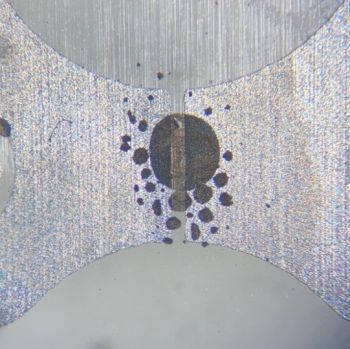
When two superconducting regions are separated by a strip of non-superconducting material, a special quantum effect can occur, coupling both regions: The Josephson effect. If the spacer material is a half-metal ferromagnet novel implications for spintronic applications arise. An international team has now for the first time designed a material system that exhibits an unusually long-range Josephson effect: Here, regions of superconducting YBa2Cu3O7 are separated by a region of half-metallic, ferromagnetic manganite (La2/3Sr1/3MnO3) one micron wide.

With the help of magneto-transport measurements, the researchers were able to demonstrate the presence of a supercurrent circulating through the manganite — this supercurrent is arising from the superconducting co...

Read More

TESS discovers a Planet the size of Mars but with the Makeup of Mercury

Caption:An illustration of a red dwarf star orbited by an exoplanet.
Credits:Credit: NASA/ESA/G. Bacon (STScI)

The boiling new world, which zips around its star at ultraclose range, is among the lightest exoplanets found to date. The TESS mission has discovered an ultra-short-period planet (USP) that is also super light. The planet is named GJ 367 b, and it orbits its star in just eight hours. The planet is about the size of Mars, and half as massive as the Earth, making it one of the lightest planets discovered to date.

Ultra-short-period planets are small, compact worlds that whip around their stars at close range, completing an orbit — and a single, scorching year — in less than 24 hours...

Read More

Study links High Cholesterol, Cardiovascular Disease to Plastics

In a mouse study, a team led by a biomedical scientist found a phthalate — a chemical used to make plastics more durable — led to increased plasma cholesterol levels. Plastics, part of modern life, are useful but can pose a significant challenge to the environment and may also constitute a health concern. Indeed, exposure to plastic-associated chemicals, such as base chemical bisphenol A and phthalate plasticizers, can increase the risk of human cardiovascular disease. What underlying mechanisms cause this, however, remain elusive.

A team led by Changcheng Zhou, a biomedical scientist at the University of California, Riverside, now raises the hopes of solving the mystery...

Read More