



Mini Electricity Generator made from Quantum Dots

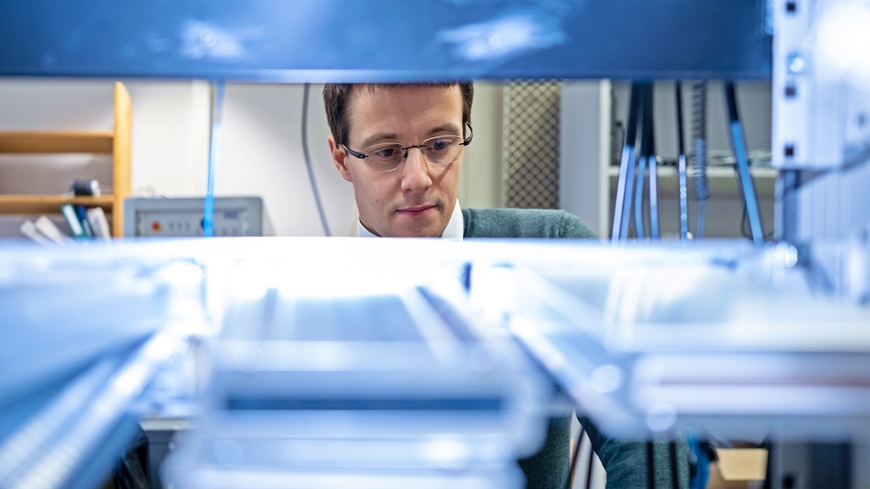
Mickael L. Perrin in his lab at Empa. Here he will set on to create a quantum heat engine that operates at room temperature using graphene nanoribbons. Image: Empa

Machines and electronic devices often generate waste heat that is difficult to utilize. If electricity could be generated from this waste heat, it would offer a means for a clean and sustainable power production: Such a technology would be ideally suited for low-power electronics applications such as wearables or low-cost Internet-of-Things devices. This includes, for example, wearable (medical) devices and sensors, with a wide range of applications in the healthcare and sports industry, in smart buildings and mobility applications.

Thermoelectric generators, machines that generate electricity by exploiting temperature di...

Read More


Internal Ocean in Small Saturn Moon uncovered

NASA / JPL-Caltech / Space Science Institute An SwRI scientist has discovered that Saturn’s small moon Mimas (left) likely has something in common with its larger neighbor Enceladus: an internal ocean beneath a thick icy surface. Thought to be a frozen inert satellite, Mimas is now considered a “stealth” ocean world with a surface that does not betray what lies beneath. This discovery could greatly expand the number of potentially habitable worlds thought to exist.

Discovery could point to a new class of ‘stealth’ ocean worlds. A Southwest Research Institute scientist set out to prove that the tiny, innermost moon of Saturn was a frozen inert satellite and instead discovered compelling evidence that Mimas has a liquid internal ocean...

Read More

Research Team identifies New Mechanism for Protecting DNA

Discovery offers hope to better understand how diseases like cancer, premature aging can be prevented. Researchers from Case Western Reserve University have identified a new mechanism by which a protein known for repairing damaged DNA also protects the integrity of DNA by preserving its structural shape.

The discovery, involving the protein 53BP1, offers insight into understanding how cells maintain the integrity of DNA in the nucleus, which is critical for preventing diseases like premature aging and cancer.

A research team led by Youwei Zhang, an associate professor of pharmacology at the Case Western Reserve School of Medicine and a member of the Molecular Oncology Program at the Case Comprehensive Cancer Center, conducted the study. The findings were published (Jan...

Read More

Selective Membrane may Cycle Dual-ion Batteries Closer to Reality

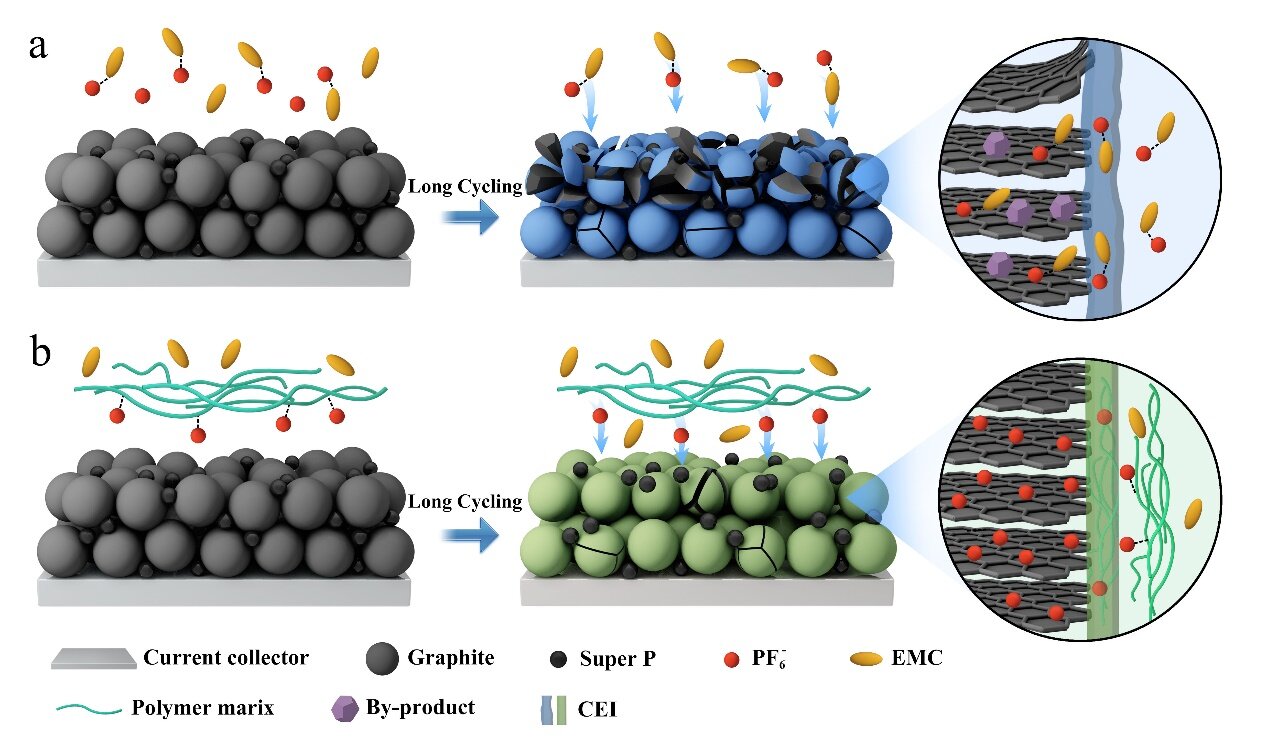
Schematic illustration of the EMC co-intercalation behavior comparison in LE (a) or PCME (b) based DIBs. Credit: Jiang Hongzhu

Lithium-ion batteries are relatively safe, long-lasting, fast charging and better for the environment than non-rechargeable batteries—right? Not quite. The rocking-chair mechanism that allows for commercial power storage generally uses rare earth elements, such as nickel and cobalt.

Researchers have long been on the hunt for alternative batteries that boast all the benefits of lithium-ion versions but include ecological and economic advantages.

Now, a team from the Qingdao Institute of Bioenergy and Bioprocess Technology (QIBEBT), Chinese Academy of Sciences (CAS), is closing in on an improved approach...

Read More