


Researchers offer Future 6G Network Concept

Credit: CC0 Public Domain

NIST and international researchers propose a “cognitive” 6G network—significantly enhancing the 5G network that encodes and transmits data with their meaning or semantics.

With commercial 5G rapidly deploying, researchers have begun to look at 6G. Its key technologies for mobile communication networks are expected to become available as early as 2023, with 6G networks emerging in 2030, according to Saad et al. Compared to 5G, the 6G network will increase data rates by over 100 times, to one terabyte per second or more, enabling the inclusion of edge intelligent devices and computing. To move large amounts of data to where and when it is needed, 6G networks will need to customize services to meet demands, transmit valued data, and interact with users.

T...

Read More

Cosmic History can explain the Properties of Mercury, Venus, Earth and Mars

This is the sharpest image ever taken by ALMA — sharper than is routinely achieved in visible light with the NASA/ESA Hubble Space Telescope. It shows the protoplanetary disc surrounding the young star HL Tauri. These new ALMA observations reveal substructures within the disc that have never been seen before and even show the possible positions of planets forming in the dark patches within the system. Credit: ALMA (ESO/NAOJ/NRAO)

Astronomers have managed to link the properties of the inner planets of our solar system with our cosmic history: with the emergence of ring structures in the swirling disk of gas and dust in which these planets were formed...

Read More

Scientists identify Antibodies that can Neutralize Omicron

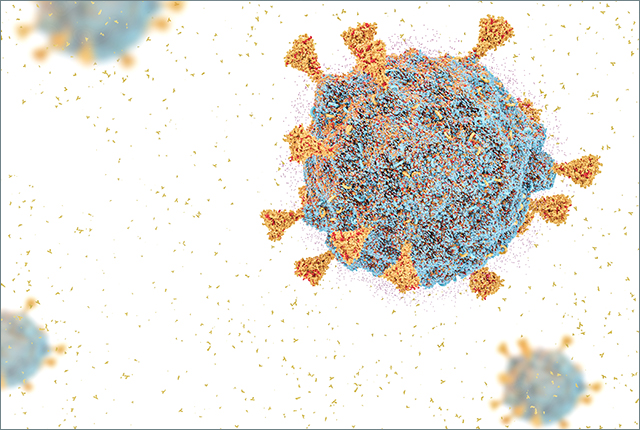
COVID-19 virus SARS-COV-2 OMICRON strain, covid-19 South African variant B.1.1.529 omicron 3d rendering

An international team of scientists have identified antibodies that neutralize omicron and other SARS-CoV-2 variants. These antibodies target areas of the virus spike protein that remain essentially unchanged as the viruses mutate.

By identifying the targets of these “broadly neutralizing” antibodies on the spike protein, it might be possible to design vaccines and antibody treatments that will be effective against not only the omicron variant but other variants that may emerge in the future, said David Veesler, investigator with the Howard Hughes Medical Institute and associate professor of biochemistry at the University of Washington School of Medicine in Seattle...

Read More

New Data-Decoding approach could lead to Faster, Smaller Digital Tech

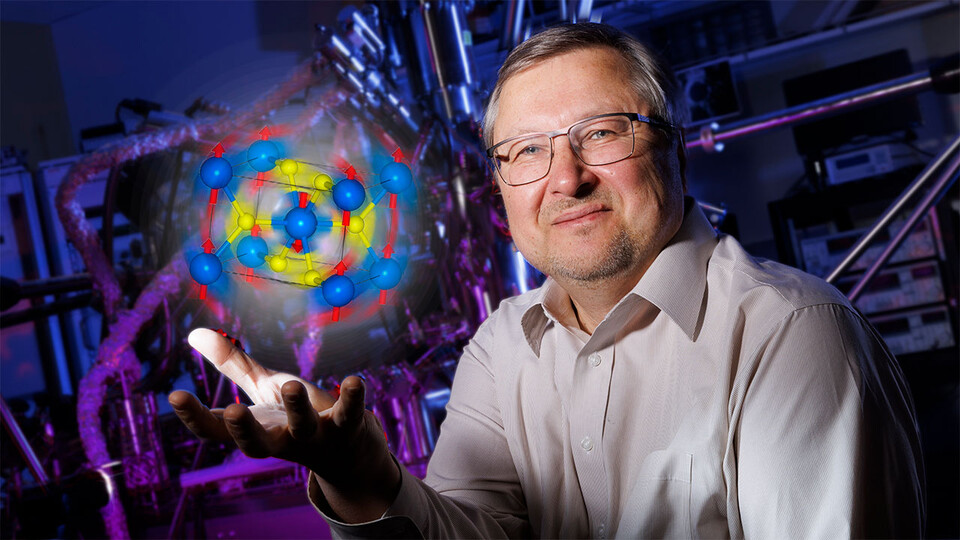
Photo-illustration by Craig Chandler | University Communication
Evgeny Tsymbal “holds” a rendering of the atomic structure found in ruthenium oxide, a material whose properties could point the way to faster digital devices packed with more memory.

Most scientists would blanch at being labeled a spin doctor. But when it comes to Evgeny Tsymbal, Ding-Fu Shao and their colleagues, the lab coat fits.

The University of Nebraska–Lincoln physicists have charged to the forefront of spintronics, a next-gen class of data storage and processing poised to complement the digital electronics that have ruled the realm of high tech for decades.

Ahead of that future, though, loom nanoscale obstacles whose size belies their difficulty...

Read More