To raise new questions, new possibilities, to regard old problems from a new angle, requires creative imagination and marks real advance in science.
~Albert Einstein
Read More
Old Newtonian physics claimed that things have an objective reality separate from our perception of them. Quantum physics, and particularly Heisenberg's Uncertainty Principle, reveal that, as our perception of an object changes, the object itself literally changes.
~Marianne Williamson
Read More
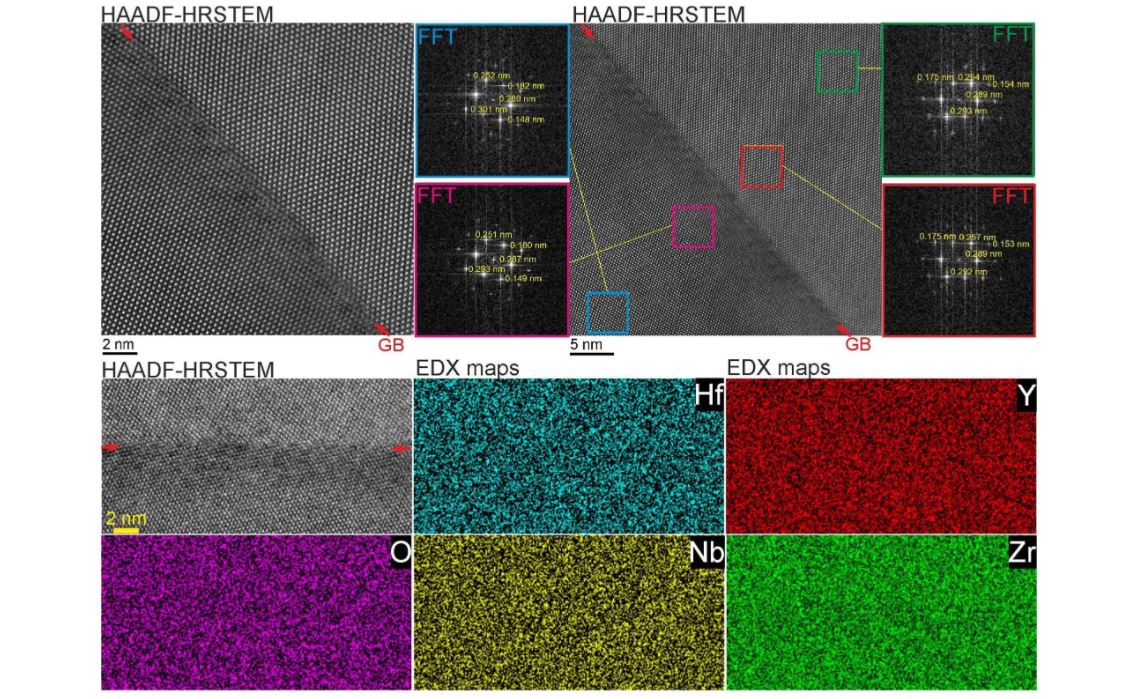
Nanoscale study and local chemical analysis of a grain boundary of a (Zr0.9 Hf0.1 O2)0.775 (Y0.5 Nb0.5 O2)0.225 (weeping) sample prepared by FIB. The micrographs are HAADF-STEM and HAADF-HRSTEM images as well as high resolution EDX elemental maps of the sample. Atomic-resolution HAADF micrographs are raw images, showing no significant intensity variation along the grain boundary (GB). The high resolution EDX maps suggest no significant element segregation at the grain boundary.
Discovery could lead to improvements in medical devices and electronics. An international team of researchers from the University of Minnesota Twin Cities and Kiel University in Germany have discovered a path that could lead to shape-shifting ceramic materials...
Sunlight reflects off tiny, interplanetary dust particles, creating the faint column of glowing light seen against the stars in this image. New research suggests that cosmic dust might be an important source of phosphorus for life on Earth. Credit: Malcol, CC BY 3.0 Source: Journal of Geophysical Research: Space Physics
When Earth formed 4.5 billion years ago, any phosphorus that was present likely sank into the molten core because of the element’s distinct chemical properties. However, phosphorus is essential for life; it is found in DNA, RNA, and other important biological molecules. So it is probable that the phosphorus that made life possible was delivered to Earth’s surface from extraterrestrial origins, and previous studies have suggested meteorites as potential sources.
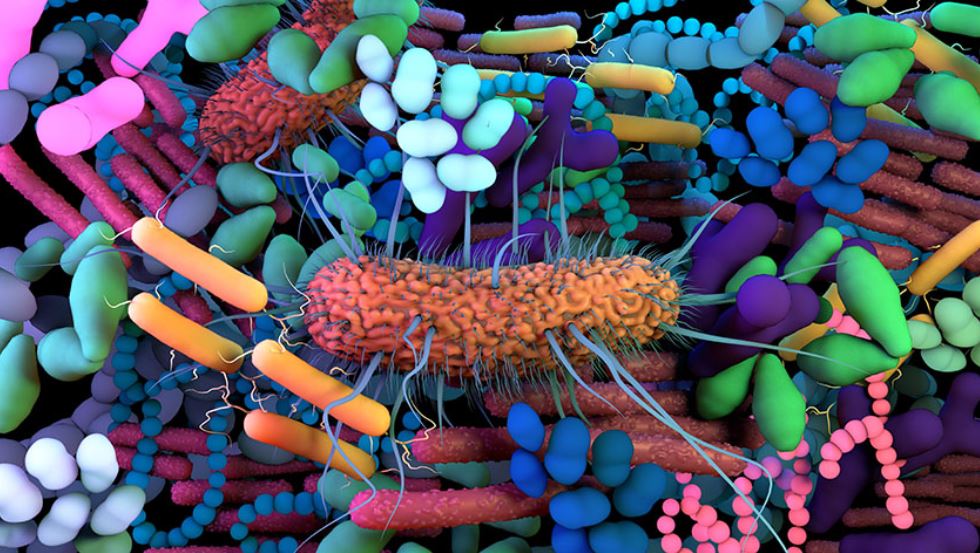
Research in mice demonstrates how diet alters a gut microbe molecule that, in turn, prompts immune cells to downregulate inflammation. The study elucidates molecular mechanism behind long-standing belief that diet, microbiota, and immunity influence one another in myriad ways. If affirmed in larger animals and humans, the findings could inform the design of small-molecule drugs that regulate immune response to treat inflammatory conditions.
The cliché “you are what you eat” has been used for hundreds of years to illustrate the link between diet and health. Now, an international team of researchers has found the molecular proof of this concept, demonstrating how diet ultimately affects immunity through the gut microbiome.
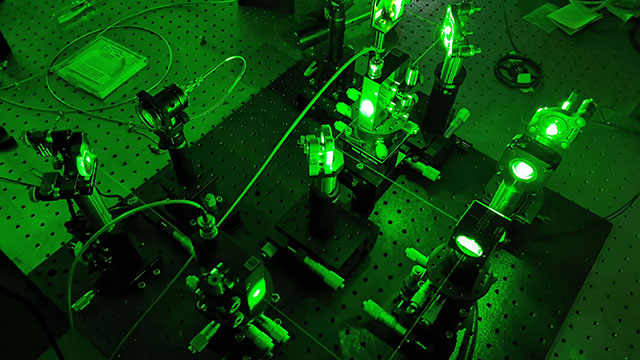
A setup of one of the prototypes in the laboratory
Device can see around corners and through scattering media like fog and human tissue. Northwestern University researchers have invented a new high-resolution camera that can see the unseen — including around corners and through scattering media, such as skin, fog or potentially even the human skull.
Called synthetic wavelength holography, the new method works by indirectly scattering coherent light onto hidden objects, which then scatters again and travels back to a camera. From there, an algorithm reconstructs the scattered light signal to reveal the hidden objects...












Recent Comments