To raise new questions, new possibilities, to regard old problems from a new angle, requires creative imagination and marks real advance in science.
~Albert Einstein
Read More
Old Newtonian physics claimed that things have an objective reality separate from our perception of them. Quantum physics, and particularly Heisenberg's Uncertainty Principle, reveal that, as our perception of an object changes, the object itself literally changes.
~Marianne Williamson
Read More
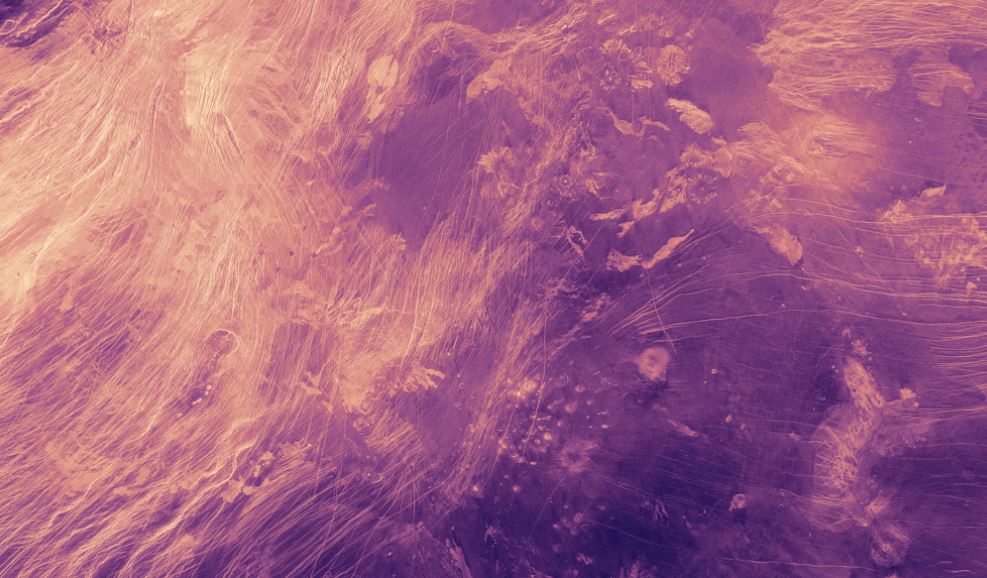
A false-color radar image mosaic of the Venus lowlands. The brighter, fine peach lines are tectonic structures and the darker, purple areas are relatively smooth volcanic plains. Some small volcanoes appear near the bottom center. This image was made with radar data returned by NASA’s Magellan mission, which operated between 1990 and 1994, and shows an area about 1,400 km (870 miles) across. (Image: NASA)
Strange ‘eggshell planets’ are among the rich variety of exoplanets possible, according to a study from Washington University in St. Louis. These rocky worlds have an ultra-thin outer brittle layer and little to no topography. Such worlds are unlikely to have plate tectonics, raising questions as to their habitability.
Only a small subset of extrasolar planets are likely eggshell...
Altered function of the red blood cells leads to vascular damage in type 2 diabetes. Results from a new study in cells from patients with type 2 diabetes and mice show that this effect is caused by low levels of an important molecule in the red blood cells. The study by researchers at Karolinska Institutet in Sweden has been published in the journal Diabetes.
It is well known that patients with type 2 diabetes have an increased risk of cardiovascular disease. Overtime type 2 diabetes may damage blood vessels, which could lead to life-threatening complications such as heart attack and stroke...
The Generator network (G) uses statistical distributions learned from prior observations to imagine new materials with specific properties. Credit: Wesley Reinhart. All Rights Reserved.
The person staring back from the computer screen may not actually exist, thanks to artificial intelligence (AI) capable of generating convincing but ultimately fake images of human faces. Now this same technology may power the next wave of innovations in materials design, according to Penn State scientists.
“We hear a lot about deepfakes in the news today – AI that can generate realistic images of human faces that don’t correspond to real people,” said Wesley Reinhart, assistant professor of materials science and engineering and Institute for Computational and Data Sciences faculty co-hire, at Penn S...
Image Credit: NASA, ESA, and Y. Chou (Academia Sinica, Institute of Astronomy and Astrophysics); Processing: Gladys Kober (NASA/Catholic University of America)
These cosmic ribbons of gas have been left behind by a titanic stellar explosion called a supernova. DEM L249 is thought to be the remnant of a Type 1a supernova, the death of a white dwarf star. White dwarf stars are usually stable, but in a binary system—two stars orbiting each other—a white dwarf can gravitationally pull so much matter from its companion that it reaches critical mass and explodes.
DEM L249, located in the Large Magellanic Cloud, is an unusual supernova remnant...












Recent Comments