


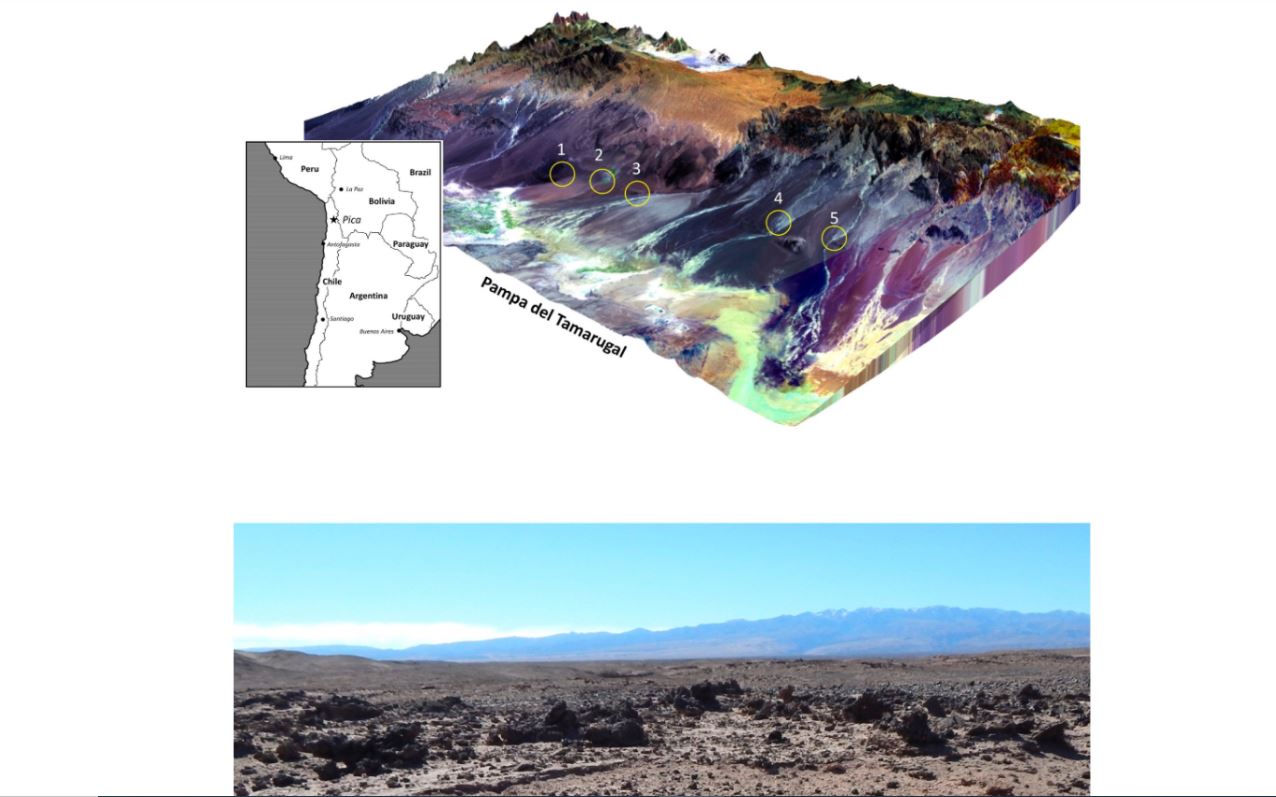
Vast Patches of Glassy Rock in Chilean Desert likely created by Ancient Exploding Comet

Heat from a comet exploding just above the ground fused the sandy soil into patches of glass stretching 75 kilometers, a study led by Brown University researchers found. Around 12,000 years ago, something scorched a vast swath of the Atacama Desert in Chile with heat so intense that it turned the sandy soil into widespread slabs of silicate glass. Now, a research team studying the distribution and composition of those glasses has come to a conclusion about what caused the inferno.

In a study published in the journal Geology, researchers show that samples of the desert glass contain tiny fragments with minerals often found in rocks of extraterrestrial origin...

Read More
Virus can Infect the Inner Ear, study finds

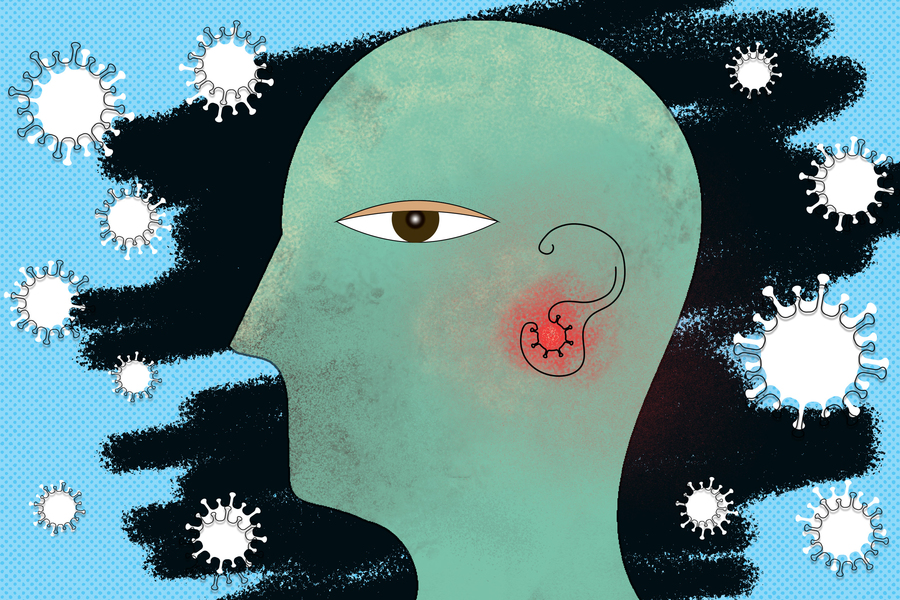
ear infection graphic
Caption: A new study from MIT and Massachusetts Eye and Ear provides evidence that the SARS-CoV-2 virus can infect cells of the inner ear.
Credits:Image: Christine Daniloff, MIT

The prevalence of auditory symptoms in COVID-19 patients is unknown, but infection of the inner ears may be responsible for hearing and balance problems.

Many Covid-19 patients have reported symptoms affecting the ears, including hearing loss and tinnitus. Dizziness and balance problems can also occur, suggesting that the SARS-CoV-2 virus may be able to infect the inner ear.

A new study from MIT and Massachusetts Eye and Ear provides evidence that the virus can indeed infect cells of the inner ear, including hair cells, which are critical for both hearing and balance...

Read More

Key to Resilient Energy-efficient AI/machine learning may reside in Human Brain

Synchronization of neural oscillations achieved by astrocytes
Synchronization of neural oscillations is achieved by astrocytes through information sharing among their glial network. Credit: Elizabeth Floresgomez Murray. All Rights Reserved.

A clearer understanding of how a type of brain cell, astrocytes function and can be emulated in the physics of hardware devices, may result in artificial intelligence (AI) and machine learning that autonomously self-repairs and consumes much less energy than the technologies currently do, according to a team of Penn State researchers.

Astrocytes are named for their star shape and are a type of glial cell, which are support cells for neurons in the brain. They play a crucial role in brain functions such as memory, learning, self-repair and synchronization.

“This project stemmed from recent observations in...

Read More

BICEP3 Tightens the Bounds on Cosmic Inflation

A telescope pokes out from a metal dish.
The BICEP3 telescope at the South Pole. (BICEP/Keck Collaboration)

Physicists looking for signs of primordial gravitational waves by sifting through the earliest light in the cosmos – the cosmic microwave background (CMB) – have reported their findings: still nothing.

But far from being a dud, the latest results from the BICEP3 experiment at the South Pole have tightened the bounds on models of cosmic inflation, a process that in theory explains several perplexing features of our universe and which should have produced gravitational waves shortly after the universe began.

“Once-promising models of inflation are now ruled out,” said Chao-Lin Kuo, a BICEP3 principal investigator and a physicist at Stanford University and the Department of Energy’s SLAC National Accelerator Laborato...

Read More