





Cause of Alzheimer’s Progression in the Brain

For the first time, researchers have used human data to quantify the speed of different processes that lead to Alzheimer’s disease and found that it develops in a very different way than previously thought. Their results could have important implications for the development of potential treatments.

The international team, led by the University of Cambridge, found that instead of starting from a single point in the brain and initiating a chain reaction which leads to the death of brain cells, Alzheimer’s disease reaches different regions of the brain early. How quickly the disease kills cells in these regions, through the production of toxic protein clusters, limits how quickly the disease progresses overall.

The researchers used post-mortem brain samples from Alzheimer’s pat...

Read More
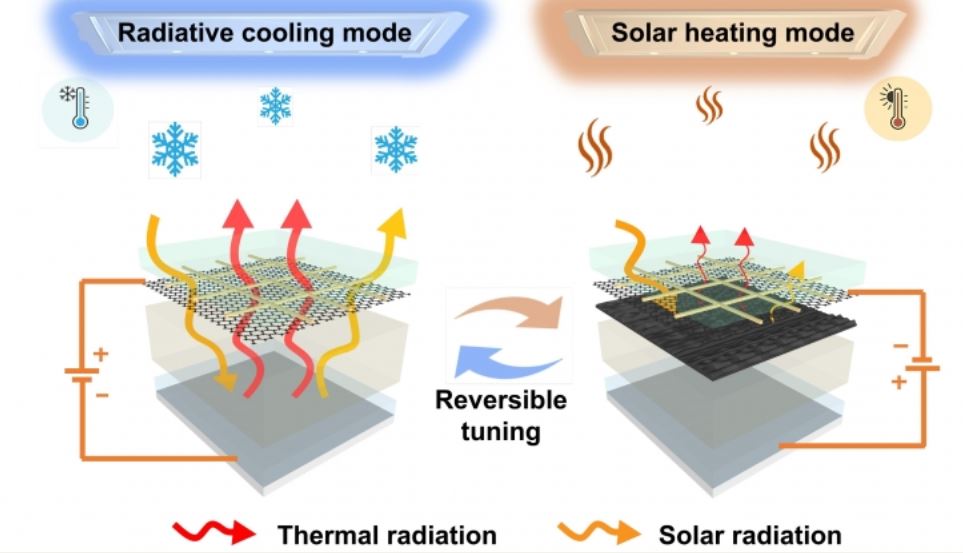
Smart Material Switches between Heating and Cooling in minutes

A demonstration of the “smart-window-like” portion of the passive heating and cooling technology. Electricity causes the device to either clear (left) to reveal a mirror that reflects sunlight and allows heat to escape, or to darken with tiny nanoparticles (right), which traps both sunlight and heat. Credit: Po-Chun Hsu, Duke University

Passive technology on roofs and facades could greatly reduce HVAC energy consumption. Engineers have developed smart material technology that, with the flip of a switch, can alternate between harvesting heat from sunlight and allowing an object to cool. The window-like device has no moving parts and could be a boon for HVAC savings, potentially cutting energy usage by nearly 20% in the United States alone.

As anyone who has ever parked a car in t...

Read More

The Upside-Down Orbits of a Multi-Planetary System

Astronomers have discovered exoplanets that orbit in planes at 90 degrees from each other. When planets form, they usually continue their orbital evolution in the equatorial plane of their star. However, an international team, led by astronomers from the University of Geneva (UNIGE), Switzerland, has discovered that the exoplanets of a star in the constellation Pisces orbit in planes perpendicular to each other, with the innermost planet the only one still orbiting in the equatorial plane. Why so? This radically different configuration from our solar system could be due to the influence of a distant companion of the star that is still unknown...

Read More

Unlocking the Technology to produce Unbreakable Screens

Unlocking the technology to produce unbreakable screens
Luminating composite glass. Credit: The University of Queensland

Cracked phone screens could become a thing of the past thanks to breakthrough research conducted at The University of Queensland.

The global team of researchers, led by UQ’s Dr Jingwei Hou, Professor Lianzhou Wang and Professor Vicki Chen, have unlocked the technology to produce next-generation composite glass for lighting LEDs and smartphone, television and computer screens.

The findings will enable the manufacture of glass screens that are not only unbreakable but also deliver crystal clear image quality.

Dr Hou said the discovery was a huge step forward in perovskite nanocrystal technology as previously, researchers were only able to produce this technology in the bone-dry atmosphere of a laboratory setting.

...Read More