To raise new questions, new possibilities, to regard old problems from a new angle, requires creative imagination and marks real advance in science.
~Albert Einstein
Read More
Old Newtonian physics claimed that things have an objective reality separate from our perception of them. Quantum physics, and particularly Heisenberg's Uncertainty Principle, reveal that, as our perception of an object changes, the object itself literally changes.
~Marianne Williamson
Read More
Regenerative fuel cells, with high round-trip efficiencies like that produced with a catalyst developed in the lab of Vijay Ramani, are well suited for submersibles, drones, and spacecraft, as well as for off-grid energy storage. (Submersible rendering image: Shutterstock)
The key is the ‘bifunctionality index’ A team has developed a catalyst that can be used to both generate fuel and provide power. A single device that both generates fuel and oxidant from water and, when a switch is flipped, converts the fuel and oxygen into electricity and water, has a host of benefits for terrestrial, space and military applications...
OSIRIS-REx mission scientists thought sampling a piece of Bennu would be like a walk on the beach, but the surprisingly craggy surface proved to be more of a challenge.NASA/Goddard/University of Arizona
Using data from NASA OSIRIS-REx mission, scientists concluded that asteroids with highly porous rocks, such as Bennu, should lack fine-grained material on their surfaces.
Scientists thought asteroid Bennu’s surface would be like a sandy beach, abundant in fine sand and pebbles, which would have been perfect for collecting samples.Past telescope observations from Earth’s orbit had suggested the presence of large swaths of fine-grain material called fine regolith that’s smaller than a few centimeters.
But when the spacecraft of NASA’s University of Arizona-led OSIRIS-REx asteroid sa...
Immunofluorescence images show that when an injured muscle is treated with mechanotherapy (right), its muscle fiber type composition changes compared to untreated muscles (left). The resulting composition of the treated muscle is more similar to that of healthy muscle, implying that treatment helps restore proper muscle function. Credit: Wyss Institute at Harvard University
Study in mice confirms link between mechanotherapy and immunotherapy in muscle regeneration. Massage has been used to treat sore, injured muscles for more than 3,000 years, and today many athletes swear by massage guns to rehabilitate their bodies...
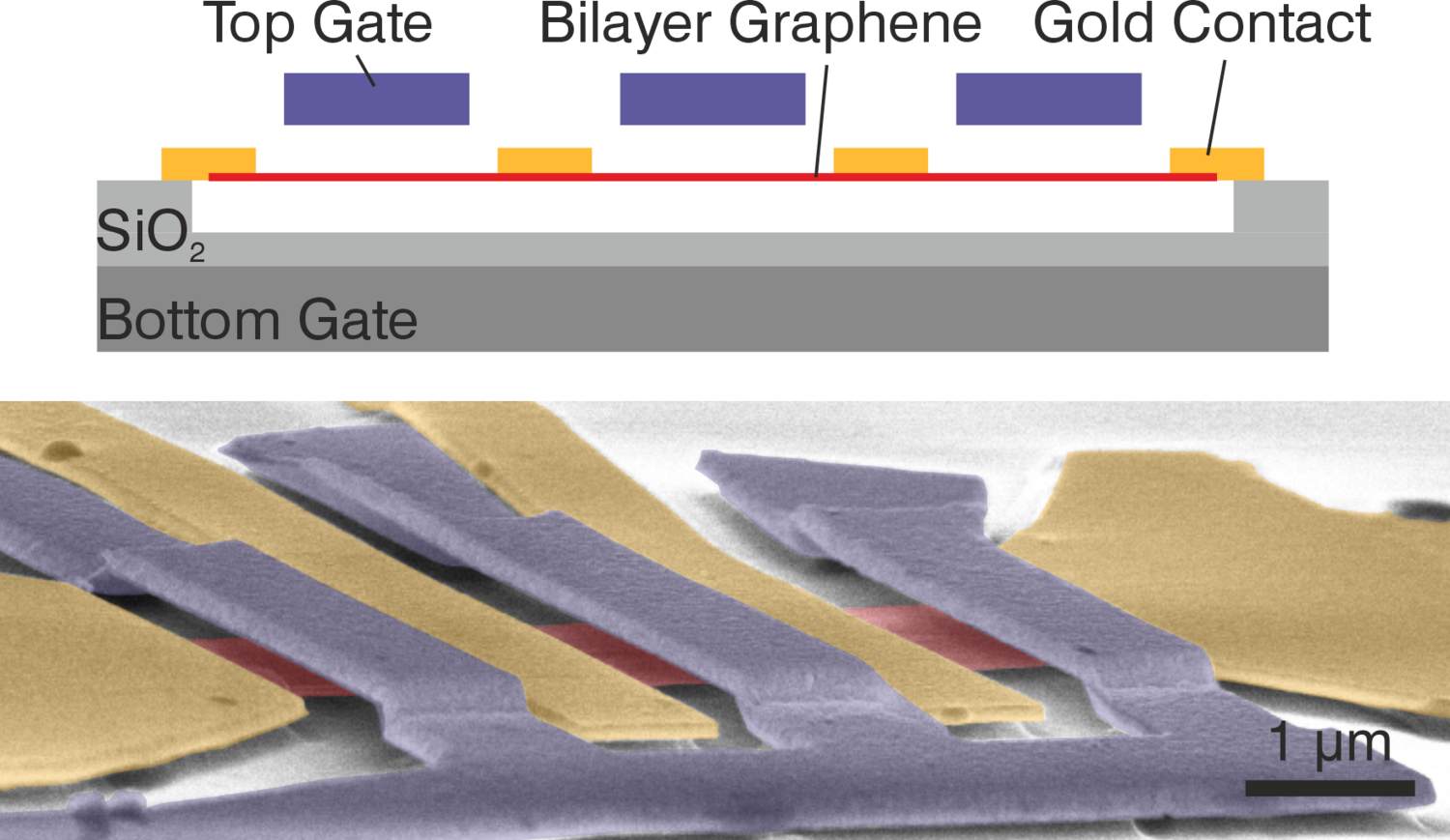
The gold contacts are shown as yellow, the graphene double layers red, and the metal bridge blue.
Photo: Fabian Geisenhof/Jakob Lenz
International research team finds atomically-thin carbon generates its own magnetic field. Usually, the electrical resistance of a material depends very much on its physical dimensions and fundamental properties. Under special circumstances, however, this resistance can adopt a fixed value that is independent of the basic material properties and “quantised” (meaning that it changes in discrete steps rather than continuously). This quantisation of electrical resistance normally occurs within strong magnetic fields and at very low temperatures when electrons move in a two-dimensional fashion...











Recent Comments