To raise new questions, new possibilities, to regard old problems from a new angle, requires creative imagination and marks real advance in science.
~Albert Einstein
Read More
Old Newtonian physics claimed that things have an objective reality separate from our perception of them. Quantum physics, and particularly Heisenberg's Uncertainty Principle, reveal that, as our perception of an object changes, the object itself literally changes.
~Marianne Williamson
Read More
This figure from the study shows some simulation results. Each blue line is an individual ISO. The top represents the osculating pericenter distance in AUs. The bottom shows inclination in degrees. In their simulations, individual objects don’t become distinguishable until after about 100 million years. When a blue line ends, that ISO has left the Solar System. Image Credit: Napier et al 2021.
Now that we know that interstellar objects (ISOs) visit our solar system, scientists are keen to understand them better. How could they be captured? If they’re captured, what happens to them? How many of them might be in our solar system?
One team of researchers is trying to find answers.
We know of two ISOs for certain: “Oumuamua and comet2I/Borisov...
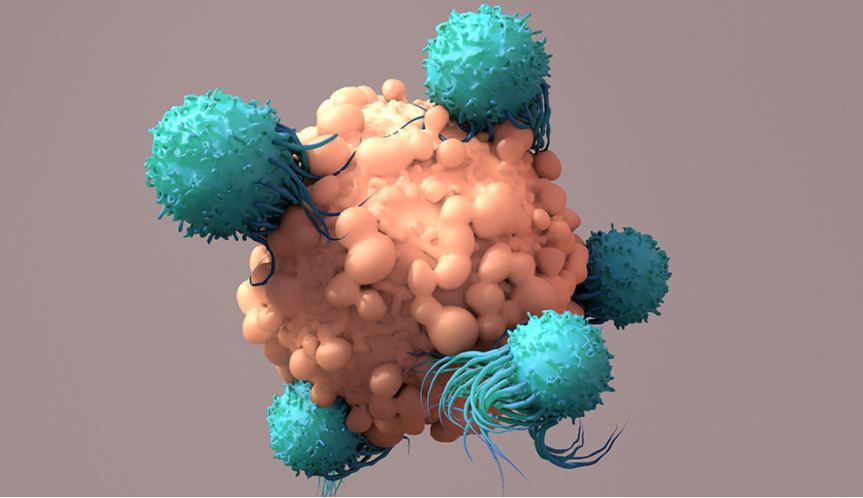
SSRIs and other serotonin blockers cause immune cells to recognize tumor cells again and eliminate them efficiently. (Bild: istock.com/Design Cells)
Classic antidepressants could help improve modern cancer treatments. They slowed the growth of pancreatic and colon cancers in mice, and when combined with immunotherapy, they even stopped the cancer growth long-term. In some cases the tumors disappeared completely, researchers at UZH and USZ have found. Their findings will now be tested in human clinical trials.
Serotonin is a neurotransmitter that is also known as the happiness hormone because of its beneficial effects on mood. In depressed people, the concentration of serotonin in the brain is reduced. The hormone also influences many other functions throughout the body...
A laser heats up ultra-thin bars of silicon. (Credit: Steven Burrows/JILA)
When you shrink down to very small scales, heat doesn’t always behave the way you think it should. Now, new findings from the nano realm could help researchers to gain a better handle on the flow of heat in electronic devices.
A team of physicists at CU Boulder has solved the mystery behind a perplexing phenomenon in the nano realm: why some ultra-small heat sources cool down faster if you pack them closer together. The findings, published today in the journal Proceedings of the National Academy of Sciences (PNAS), could one day help the tech industry design faster electronic devices that overheat less.
“Often, heat is a challenging consideration in designing electronics...
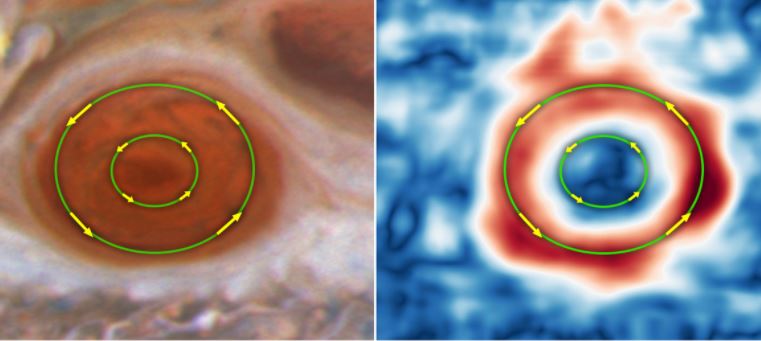
Like the speed of an advancing race car driver, the winds in the outermost “lane” of Jupiter’s Great Red Spot are accelerating – a discovery only made possible by NASA’s Hubble Space Telescope, which has monitored the planet for more than a decade.
Researchers analyzing Hubble’s regular “storm reports” found that the average wind speed just within the boundaries of the storm, known as a high-speed ring, has increased by up to 8 percent from 2009 to 2020. In contrast, the winds near the red spot’s innermost region are moving significantly more slowly, like someone cruising lazily on a sunny Sunday afternoon.
The massive storm’s crimson-colored clouds spin counterclockwise at speeds that exceed 400 miles per hour – and the vortex is bigger than Earth itself...












Recent Comments