New Radio Receiver opens Wider Window to Radio Universe

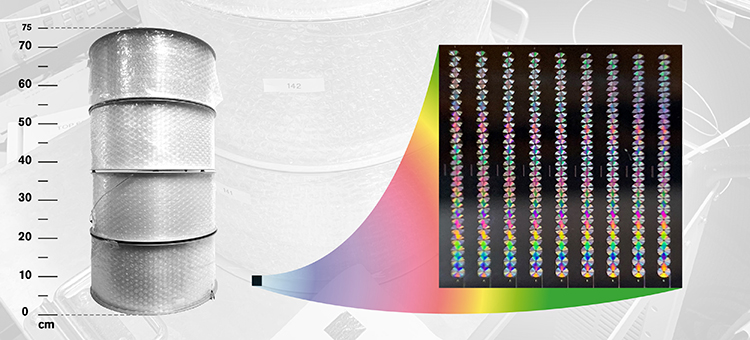
Distribution of CO isotopologues in the Orion molecular cloud observed simultaneously with the newly developed broadband receiver. (Credit: Osaka Prefecture University/NAOJ)

Researchers have used the latest wireless technology to develop a new radio receiver for astronomy. The receiver is capable of capturing radio waves at frequencies over a range several times wider than conventional ones, and can detect radio waves emitted by many types of molecules in space at once. This is expected to enable significant progresses in the study of the evolution of the Universe and the mechanisms of star and planet formation.

Interstellar molecular clouds of gas and dust provide the material for stars and planets...

Read More

Our Genes Shape our Gut Bacteria

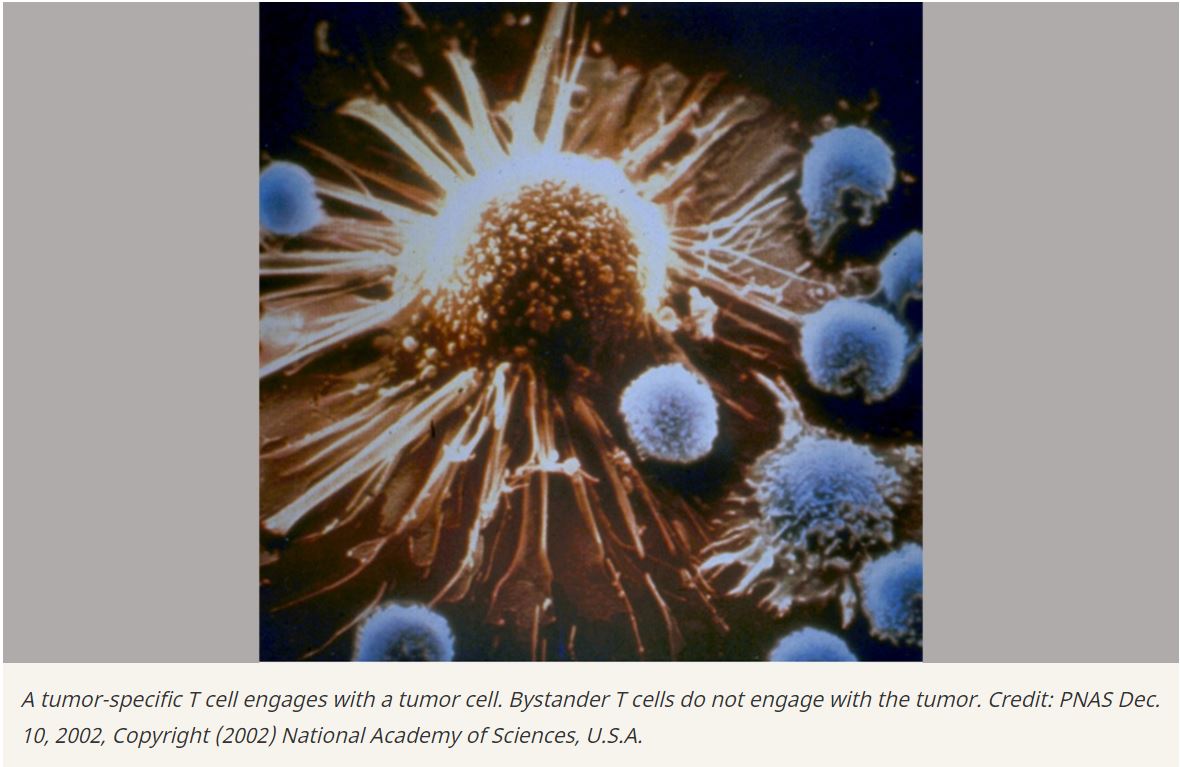
Our gut microbiome — the ever-changing “rainforest” of bacteria living in our intestines — is primarily affected by our lifestyle, including what we eat or the medications we take, most studies show. But a University of Notre Dame study has found a much greater genetic component at play than was once known.

In the study, published recently in Science, researchers discovered that most bacteria in the gut microbiome are heritable after looking at more than 16,000 gut microbiome profiles collected over 14 years from a long-studied population of baboons in Kenya’s Amboseli National Park. However, this heritability changes over time, across seasons and with age. The team also found that several of the microbiome traits heritable in baboons are also heritable in humans.

“The environme...

Read More

New Imaging Technique may Boost Research in Biology, Neuroscience

Mouse muscle.
TFM and DEEP-TFM images of a mouse muscle specimen at a 190-um-deep imaging plane. The blue and red channels are respectively nucleus (stained with Hoechst 33342) and F-actin (stained with Alexa Fluor 568 Phalloidin). Courtesy of Dushan N. Wadduwage

Scientists hope it will allow them to see inner workings of systems. A research team presents a new process that uses computational imaging to get high resolution images at a rate 100 to 1,000 times faster than other state-of-the-art technologies that use complex algorithms and machine learning.

Microscopists have long sought to find a way to produce high-quality, deep-tissue imaging of living subjects in a timely fashion...

Read More

Satellite Galaxies can carry on Forming Stars when they Pass Close to their Parent Galaxies

Image of the simulated local group used for the article. Left, image of dark matter; on the right, gas distribution. The three main galaxies of the Local Group (MW, M31 and M33) are indicated. Credit: CLUES simulation team.
Image of the simulated local group used for the article. Left, image of dark matter; on the right, gas distribution. The three main galaxies of the Local Group (MW, M31 and M33) are indicated. Credit: CLUES simulation team

Historically most scientists thought that once a satellite galaxy has passed close by its higher mass parent galaxy its star formation would stop because the larger galaxy would remove the gas from it, leaving it shorn of the material it would need to make new stars. However, for the first time, a team led by the researcher at the Instituto de Astrofísica de Canarias (IAC), Arianna di Cintio, has shown using numerical simulations that this is not always the case...

Read More