



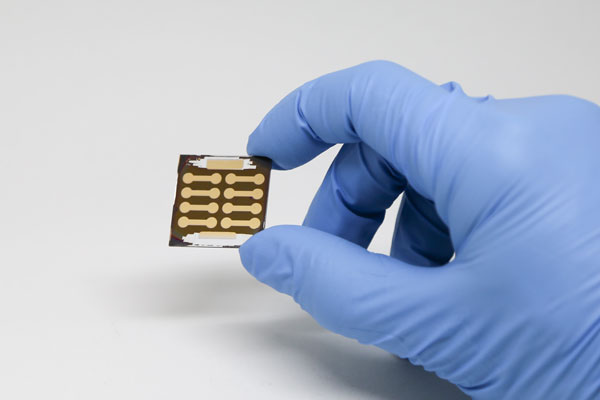
The new perovskite solar cells have achieved an efficiency of 20.1 per cent and can be manufactured at low temperatures, which reduces the cost and expands the number of possible applications. (Photo: Kevin Soobrian)
Research removes a key barrier to large-scale manufacture of low-cost, printable perovskite solar cells. A U of T Engineering innovation could make printing solar cells as easy and inexpensive as printing a newspaper. “Economies of scale have greatly reduced the cost of silicon manufacturing,” said Professor Ted Sargent, Canada Research Chair in Nanotechnology. “Perovskite solar cells can enable us to use techniques already established in the printing industry to produce solar cells at very low cost. Potentially, perovskites and silicon cells can be married to improve efficiency further, but only with advances in low-temperature processes.”
Today, virtually all commercial solar cells are made from thin slices of crystalline silicon which must be processed to a very high purity. It’s an energy-intensive process, requiring temperatures higher than 1,000 C and large amounts of hazardous solvents. In contrast, perovskite solar cells depend on a layer of tiny crystals – each about 1,000 times smaller than the width of a human hair – made of low-cost, light-sensitive materials. Because the perovskite raw materials can be mixed into a liquid to form a kind of ‘solar ink’, they could be printed onto glass, plastic or other materials using a simple inkjet printing process.
But, until now, there’s been a catch: in order to generate electricity, electrons excited by solar energy must be extracted from the crystals so they can flow through a circuit. That extraction happens in a special layer called the electron selective layer, or ESL. The difficulty of manufacturing a good ESL has been one of the key challenges holding back the development of perovskite solar cell devices. “The most effective materials for making ESLs start as a powder and have to be baked at high temperatures, above 500 degrees Celsius,” said Tan. “You can’t put that on top of a sheet of flexible plastic or on a fully fabricated silicon cell – it will just melt.”
Tan and his colleagues developed a new chemical reaction than enables them to grow an ESL made of nanoparticles in solution, directly on top of the electrode. While heat is still required, the process always stays lower than 150C, much lower than the melting point of many plastics. The new nanoparticles are coated with a layer of chlorine atoms, which helps them bind to the perovskite layer on top – this strong binding allows for efficient extraction of electrons. In a paper recently published in Science, Tan and his colleagues report the efficiency of solar cells made using the new method at 20.1%.
“This is the best ever reported for low-temperature processing techniques,” said Tan. He adds that perovskite solar cells using the older, high-temperature method are only marginally better at 22.1%, and even the best silicon solar cells can only reach 26.3%. Another advantage is stability. Many perovskite solar cells experience a severe drop in performance after only a few hours, but Tan’s cells retained more than 90% of their efficiency even after 500 hours.
“The Toronto team’s computational studies beautifully explain the role of the newly developed electron-selective layer. The work illustrates the rapidly-advancing contribution that computational materials science is making towards rational, next-generation energy devices,” said Professor Alan Aspuru-Guzik, Department of
Keeping cool during the manufacturing process opens up a world of possibilities for applications of perovskite solar cells, from smartphone covers that provide charging capabilities to solar-active tinted windows that offset building energy use. Tan’s technology could be used in tandem with conventional solar cells. “With our low-temperature process, we could coat our perovskite cells directly on top of silicon without damaging the underlying material,” said Tan. “If a hybrid perovskite-silicon cell can push the efficiency up to 30 per cent or higher, it makes solar power a much better economic proposition.” http://news.engineering.utoronto.ca/printable-solar-cells-just-got-little-closer/?_ga=1.195331948.1180808848.1486483274


Recent Comments