



The smallest planet in our Solar System will pass directly between the Earth and the Sun May 9. The last time this happened was in 2006, and the next 2 occasions will be in 2019 and 2032. During the transit, which takes place in the afternoon and early evening in the UK, Mercury will appear as a dark silhouetted disk against the bright surface of the Sun.
From the UK the transit begins at 1112 GMT (1212 BST), when the limb of Mercury appears to touch the limb of the Sun, and ends at 1842 GMT (1942 BST) when the limb of the silhouetted planet appears to leave the Sun. Observers in different locations will see the transit taking place at a slightly different time, as the planet will appear to take a slightly different path across the Sun.

The transit of Mercury of November 2006. Mercury appears as a small circle in the lower half of the image, and has quite a different appearance to the sunspot groups on the right and left hand limbs of the Sun. Credit: TheBrockenInAGlory
The entire event is visible from most of Western Europe, the western part of North and West Africa, the eastern part of North America and most of South America. Most of the transit (either ending with sunset or starting at sunrise) will be visible from the rest of North and South America, the eastern half of the Pacific, the rest of Africa and most of Asia. Observers in E Asia, SE Asia and Australasia will not be able to see the transit.
Mercury completes each orbit around the Sun every 88 days, and passes between the Earth and Sun every 116 days. As the orbit of Mercury around the Sun is tilted compared with the orbit of the Earth around the Sun, the planet normally appears to pass above or below our nearest star. A transit can only take place when the Earth, Mercury and the Sun are exactly in line in 3 dimensions.
There are 13 or 14 transits of Mercury each century, so they are comparatively rare events, though each one can typically be seen over a large area of the Earth’s surface. A transit was first seen in 1631, 2 decades after the invention of the telescope, by French astronomer Pierre Gassendi. The most recent transit of Mercury visible in the UK was in 2003 (the 2006 event was visible in the western hemisphere), which was followed by even rarer transits of Venus in 2004 and 2012.
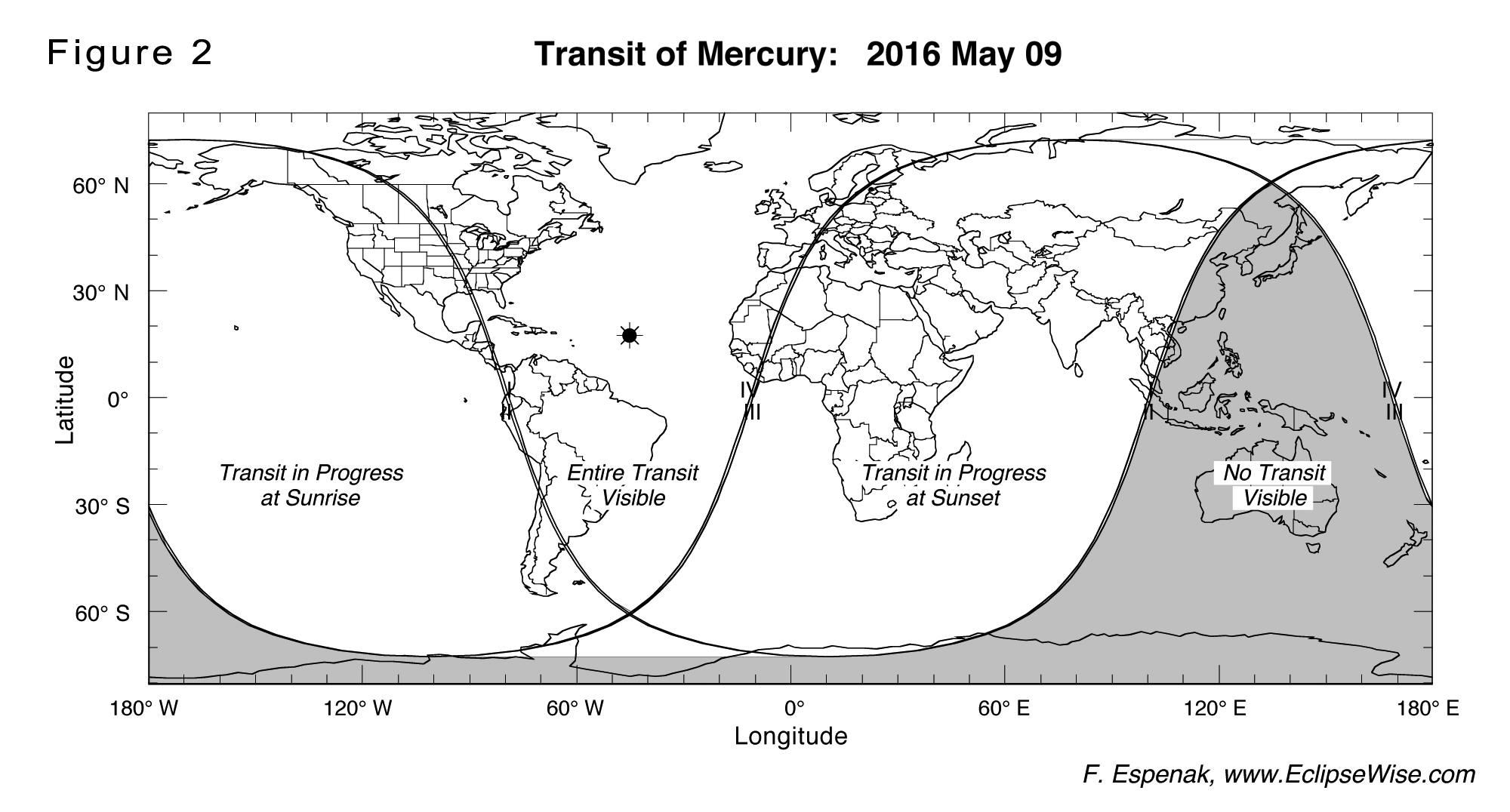
A transit of Mercury Map
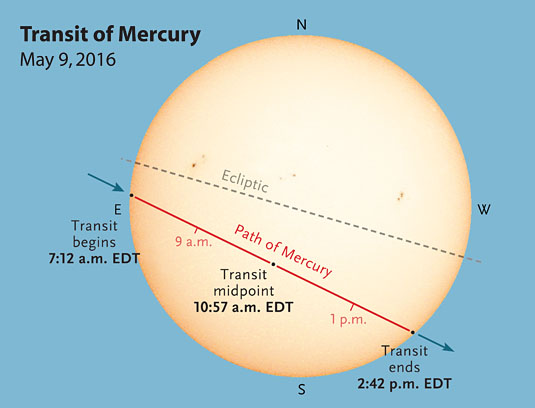
Those in the eastern half of North or South America get to see the entire transit on May 9th. At locations farther west, the event begins before sunrise.
Observers with access to a moderate-sized telescope with an appropriate safe filter should be able to see Mercury as a dark disk, comparable in apparent size to a sunspot, but somewhat darker. At the beginning and end of the transit, when Mercury’s limb is close to the edge of the Sun, it may also be possible to see the ‘black drop’ effect, where a broad line appears to connect the planet to the solar limb. This is thought to result from the quality of the telescope in use, and turbulence in the Earth’s atmosphere (so-called ‘seeing’), and has in the past compromised efforts to record transit times.
As it is so close to the Sun, Mercury is difficult to study in detail using telescopes on Earth. Two NASA space probes have visited Mercury, Mariner 10 in 1974 and 1975, and MESSENGER, which orbited the planet from 2011 until a deliberate crash landing in 2015. The European Space Agency mission BepiColombo will launch next year, and is expected to study the planet from 2024 onwards. UK scientists are making a significant contribution to this project.
Transit techniques are also deployed outside our Solar system, and missions like Kepler have used it to confirm the presence of more than 1,000 planets in orbit around other stars. The same technique will be used by the European Space Agency’s PLATO mission, expected to launch in 2024. https://www.ras.org.uk/news-and-press/2822-rare-transit-of-mercury-to-take-place-on-9-may


Recent Comments