
aging tagged posts

It’s not just what you Eat, it’s what’s Eating You

Aging Study, C. elegans, Worms

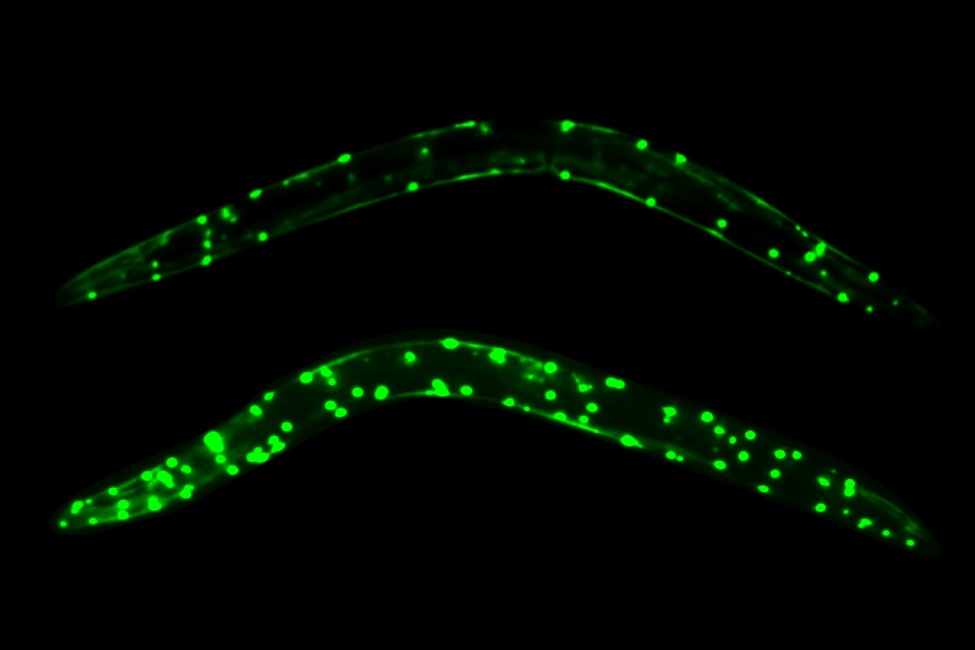
With disease, when you decrease autophagy (a garbage disposal-like process where cells “eat” debris they produce) the disease process is exacerbated and when you increase it you get the opposite effect. Aggregation of polyglutamine expansion protein is a hallmark of Huntington’s disease and other neurodegenerative diseases. The picture shows that there are more aggregates of green fluorescence protein-labelled polyglutamine expansion protein in autophagy deficient worms (bottom) compared to normal worms (top).

Restricting how much you eat without starving has been shown to robustly extend lifespan in more than 20 species of animals including primates. How this works is still unclear...

Read More

The Protein CHIP unfurls Anti-Aging activity

In a human cell, CHIP (red) is recruited to clusters of a dementia-inducing protein (yellow). There is not enough CHIP for insulin receptor degradation in this situation. The cell undergoes premature aging. (Photo: CECAD)

In a human cell, CHIP (red) is recruited to clusters of a dementia-inducing protein (yellow). There is not enough CHIP for insulin receptor degradation in this situation. The cell undergoes premature aging. (Photo: CECAD)

Researchers uncover the link between protein aggregation, aging. Early in evolution, sugar intake and the regulation of life span were linked with each other. The hormone insulin is crucial here. It reduces blood sugar levels by binding to its receptor on the cell surface. However, many processes for stress management and survival are shut down at the same time. When there is a good supply of food, they appear unnecessary to the organism, although this reduces life expectancy over the long term. The insulin receptor thus acts like a brake on life expectancy...

Read More

New Protein discovered in Aging, Cancer

ITGB3 (integrin β3) is regulated by the Polycomb protein CBX7 •β3 regulates senescence by activating TGF-β in a paracrine and autocrine fashion •β3 is highly expressed in OIS and induces senescence via ligand-independent pathway •There is a positive correlation between β3 levels and aging in different tissues

ITGB3 (integrin β3) is regulated by the Polycomb protein CBX7 •β3 regulates senescence by activating TGF-β in a paracrine and autocrine fashion •β3 is highly expressed in OIS and induces senescence via ligand-independent pathway •There is a positive correlation between β3 levels and aging in different tissues

A protein has been found to have a previously unknown role in the aging of cells, according to an early study by Queen Mary University of London (QMUL). The researchers hope that the findings could one day lead to new treatments for aging and early cancer. A number of ‘abnormal’ cells have previously been found in tissues derived from old patients and at the initial stages of cancer...

Read More

Longevity-promoting Superstar gets revealed in Caenorhabditis Reproducibility Project

(a–c) Dose response effects on the median lifespan of select C. briggsae strains after treatment with chemicals that exhibited strong positive effects on the C. elegans strains. Dosing was performed only on strains that failed to respond positively in the initial tests (single dose experiments), as we did not attempt to identify peak responses, instead we only sought to identify whether positive effects could be obtained by altering doses. Chemical doses were chosen to center around the effective dose identified for C. elegans strains and were sometimes expanded after preliminary rounds of testing. ThT exhibited a positive effect on strain JU1348 at 25 μM, but was profoundly toxic to all strains at and above 100 μM

(a–c) Dose response effects on the median lifespan of select C. briggsae strains after treatment with chemicals that exhibited strong positive effects on the C. elegans strains. Dosing was performed only on strains that failed to respond positively in the initial tests (single dose experiments), as we did not attempt to identify peak responses, instead we only sought to identify whether positive effects could be obtained by altering doses. Chemical doses were chosen to center around the effective dose identified for C. elegans strains and were sometimes expanded after preliminary rounds of testing. ThT exhibited a positive effect on strain JU1348 at 25 μM, but was profoundly toxic to all strains at and above 100 μM

The amyloid dye Thioflavin T emerged as the superstar when age rese...

Read More