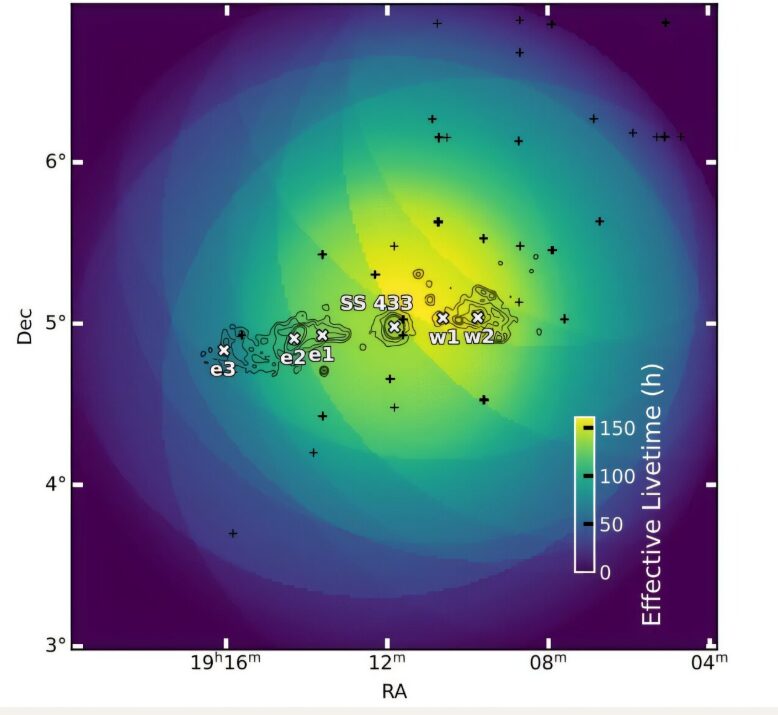
SS 433 region acceptance corrected livetime map: Computed by dividing the exposure map by the VERITAS on axis effective area evaluated at an energy of 1 TeV. The map is overlaid by black X-ray contours. The VERITAS observation pointings are indicated by black markers and SS 433, the eastern and western jet emission regions are indicated by white crosses. Credit: arXiv (2025). DOI: 10.48550/arxiv.2509.21063
Using the Very Energetic Radiation Imaging Telescope Array System (VERITAS), German astronomers have observed a unique microquasar known as SS 433. Results of the observational campaign, published Sept. 25 on the arXiv pre-print server, could help us better understand the nature and behavior of this peculiar object.
Quasars, or quasi-stellar objects (QSOs), are active galactic n...
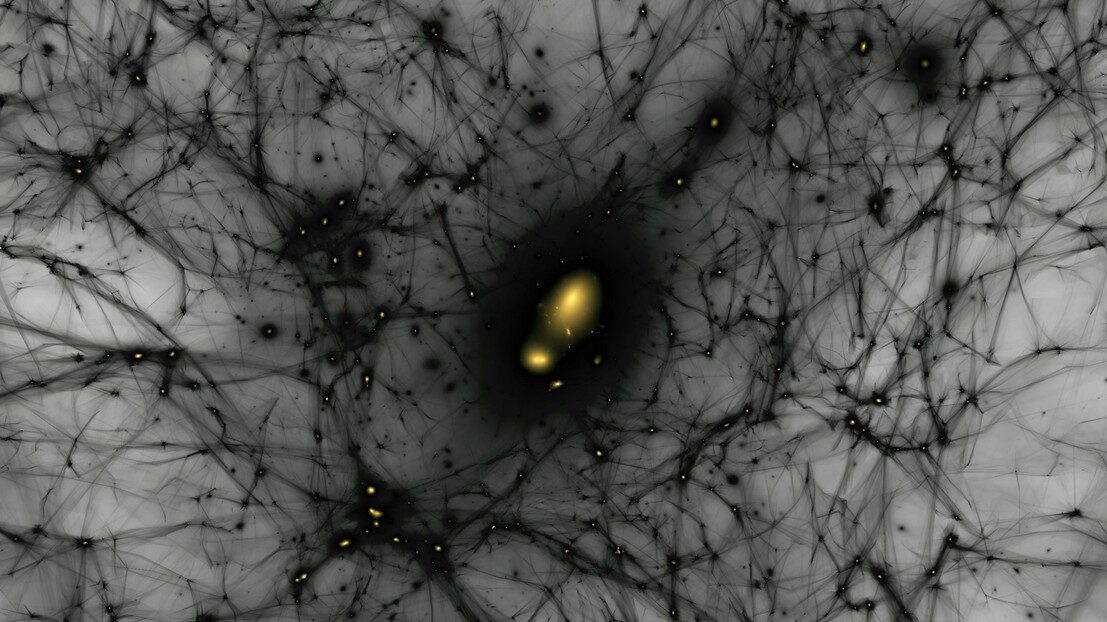
An AI-powered tool can distinguish dark matter’s elusive effects from other cosmic phenomena, which could bring us closer to unlocking the secrets of dark matter.
Dark matter is the invisible force holding the universe together – or so we think. It makes up around 85% of all matter and around 27% of the universe’s contents, but since we can’t see it directly, we have to study its gravitational effects on galaxies and other cosmic structures. Despite decades of research, the true nature of dark matter remains one of science’s most elusive questions.
According to a leading theory, dark matter might be a type of particle that barely interacts with anything else, except through gravity...
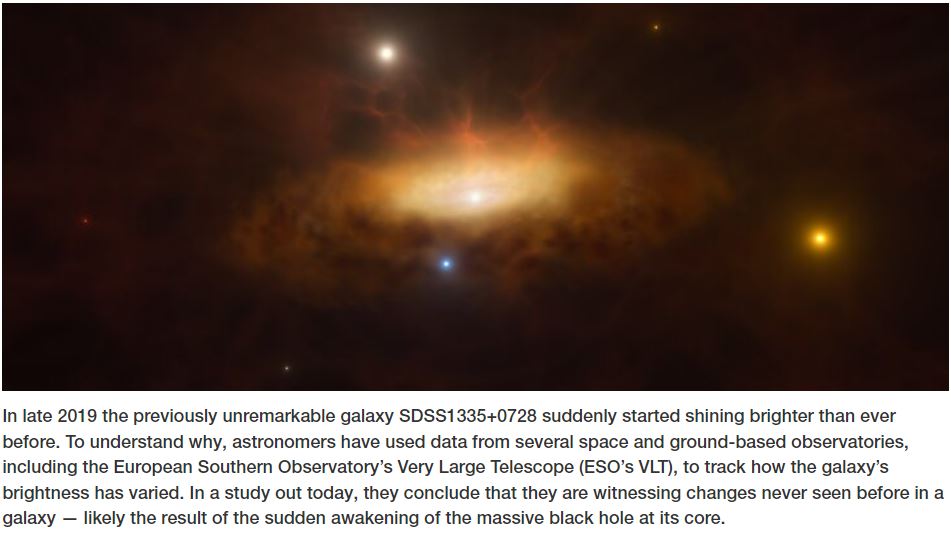
In late 2019 the previously unremarkable galaxy SDSS1335+0728 suddenly started shining brighter than ever before. To understand why, astronomers have used data from several space and ground-based observatories, including the European Southern Observatory’s Very Large Telescope (ESO’s VLT), to track how the galaxy’s @brightness has varied. In a study out today, they conclude that they are witnessing changes never seen before in a galaxy – likely the result of the sudden awakening of the massive black hole at its core.
“Imagine you’ve been observing a distant galaxy for years, and it always seemed calm and inactive,” says Paula Sánchez Sáez, an astronomer at ESO in Germany and lead author of the study accepted for publication in Astronomy & Astrophysics...
VLBI image of PKS 2215+020 at 1.7 GHz. Credit: Universe (2024). DOI: 10.3390/universe10020097
European astronomers have conducted very long baseline interferometric (VLBI) observations of a radio jet structure in a powerful quasar known as PKS 2215+020. The collected VLBI data provide important insights into the properties of this jet, suggesting that PKS 2215+020 is a blazar. The findings were presented February 17 in the Universe journal.
Quasars, or quasi-stellar objects (QSOs) are active galactic nuclei (AGN) of very high luminosity, emitting electromagnetic radiation observable in radio, infrared, visible, ultraviolet and X-ray wavelengths.
They are among the brightest and most distant objects in the known universe, and serve as fundamental tools for numerous studies in as...
Recent Comments