ALMA tagged posts

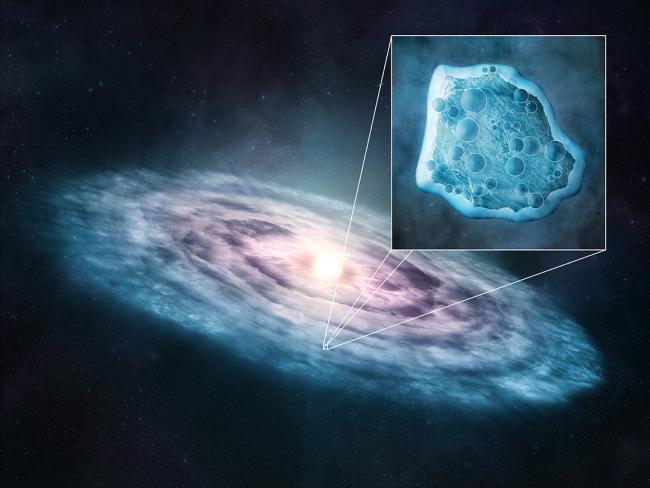
Astronomers Solve the Case of Missing Carbon Monoxide in Protoplanetary Disks

Credit Required: M.Weiss/Center for Astrophysics | Harvard & Smithsonian

Astronomers frequently observe carbon monoxide in planetary nurseries. The compound is ultrabright and extremely common in protoplanetary disks—regions of dust and gas where planets form around young stars—making it a prime target for scientists.

But for the last decade or so, something hasn’t been adding up when it comes to carbon monoxide observations, says Diana Powell, a NASA Hubble Fellow at the Center for Astrophysics, Harvard & Smithsonian. A huge chunk of carbon monoxide is missing in all observations of disks, if astronomers’ current predictions of its abundance are correct.

Now, a new model—validated by observations with ALMA—has solved the mystery: carbon monoxide has been hiding in ice format...

Read More

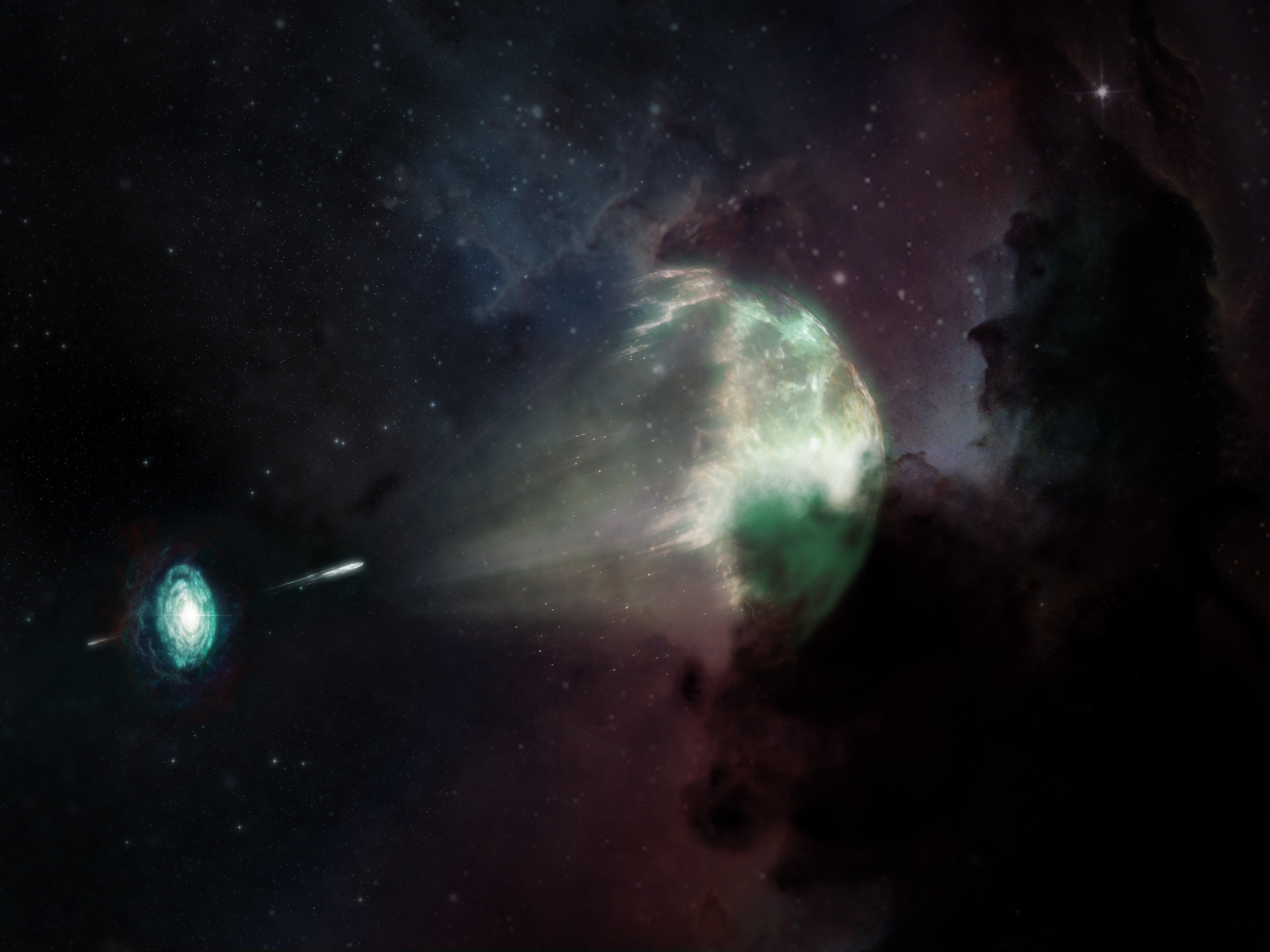
Out with a Bang: Explosive Neutron Star Merger captured for the first time in Millimeter Light

Credit: ALMA (ESO/NAOJ/NRAO), M. Weiss (NRAO/AUI/NSF)

Scientists using the Atacama Large Millimeter/submillimeter Array (ALMA) — an international observatory co-operated by the US National Science Foundation’s National Radio Astronomy Observatory (NRAO) — have for the first time recorded millimeter-wavelength light from a fiery explosion caused by the merger of a neutron star with another star. The team also confirmed this flash of light to be one of the most energetic short-duration gamma-ray bursts ever observed, leaving behind one of the most luminous afterglows on record. The results of the research will be published in an upcoming edition of The Astrophysical Journal Letters.

Gamma-ray bursts (GRBs) are the brightest and most energetic explosions in the Universe, capable of emi...

Read More

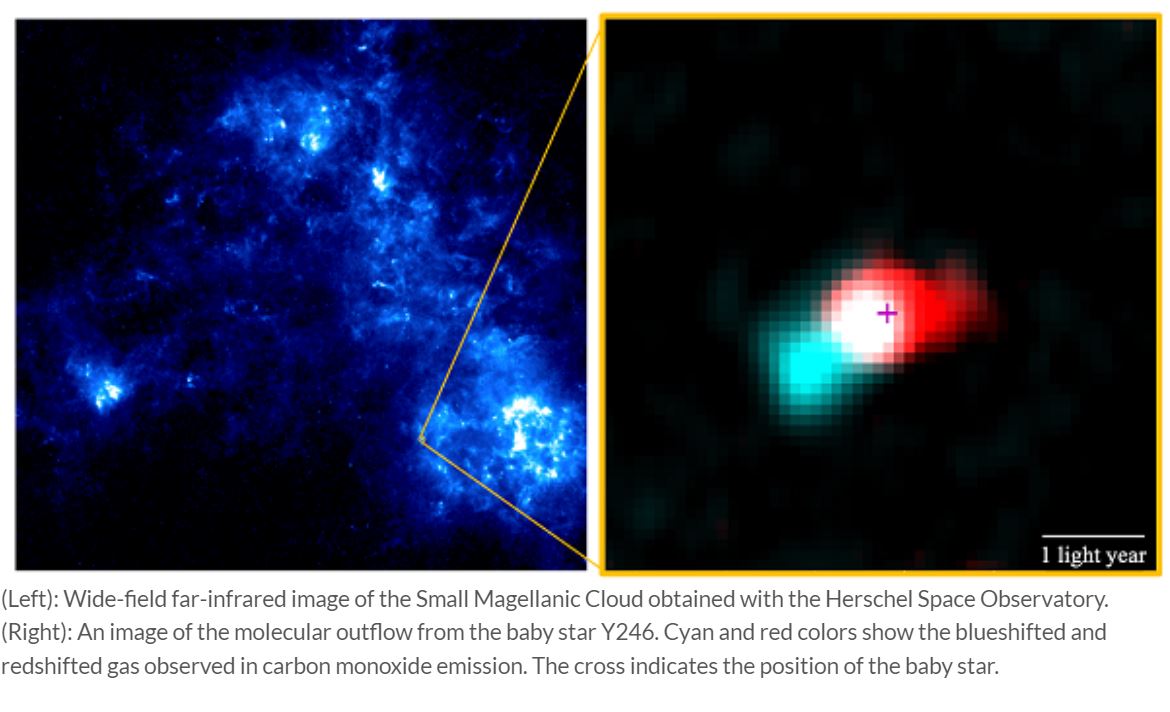
Planets of Binary Stars as possible homes for Alien Life

Simulation of binary star (from the scientific article by Jørgensen, Kuruwita et al.)

Nearly half of Sun-size stars are binary. According to University of Copenhagen research, planetary systems around binary stars may be very different from those around single stars. This points to new targets in the search for extraterrestrial life forms.

Since the only known planet with life, the Earth, orbits the Sun, planetary systems around stars of similar size are obvious targets for astronomers trying to locate extraterrestrial life. Nearly every second star in that category is a binary star.

“The result is exciting since the search for extraterrestrial life will be equipped with several new, extremely powerful instruments within the coming years...

Read More

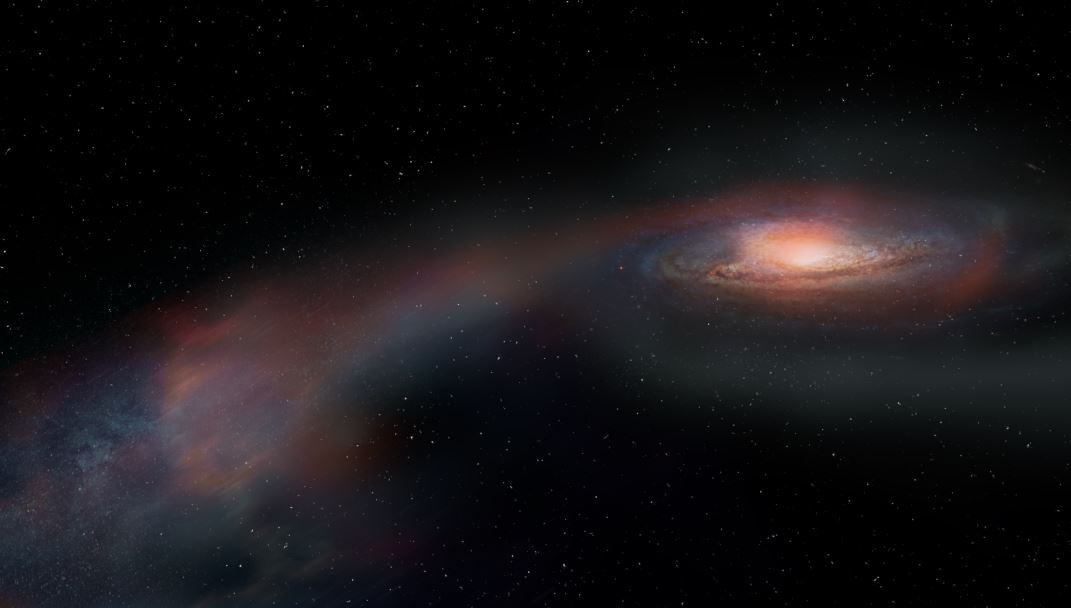
Scientists find Elusive Gas from Post-Starburst Galaxies Hiding in Plain Sight

Credit: ALMA (ESO/NAOJ/NRAO)/S. Dagnello (NRAO/AUI/NSF)

Post-starburst galaxies were previously thought to scatter all of their gas and dust — the fuel required for creating new stars — in violent bursts of energy, and with extraordinary speed. Now, new data from the Atacama Large Millimeter/submillimeter Array (ALMA) reveals that these galaxies don’t scatter all of their star-forming fuel after all. Instead, after their supposed end, these dormant galaxies hold onto and compress large amounts of highly-concentrated, turbulent gas. But contrary to expectation, they’re not using it to form stars.

In most galaxies, scientists expect gas to be distributed in a way similar to starlight. But for post-starburst galaxies, or PSBs, this isn’t the case...

Read More