ALMA tagged posts


Scientists serendipitously discover two heavily dust-enshrouded galaxies that formed when the Universe was only 5% of its present age. When astronomers peer deep into the night sky, they observe what the Universe looked like a long time ago. Because the speed of light is finite, studying the most distant observable galaxies allows us to glimpse billions of years into the past when the Universe was very young and galaxies had just started to form stars. Studying this “early Universe” is one of the last frontiers in astronomy and is essential for constructing accurate and consistent astrophysics models. A key goal of scientists is to identify all the galaxies in the first billion years of cosmic history and to measure the rate at which galaxies were growing by forming new stars.
Vari...
Read More
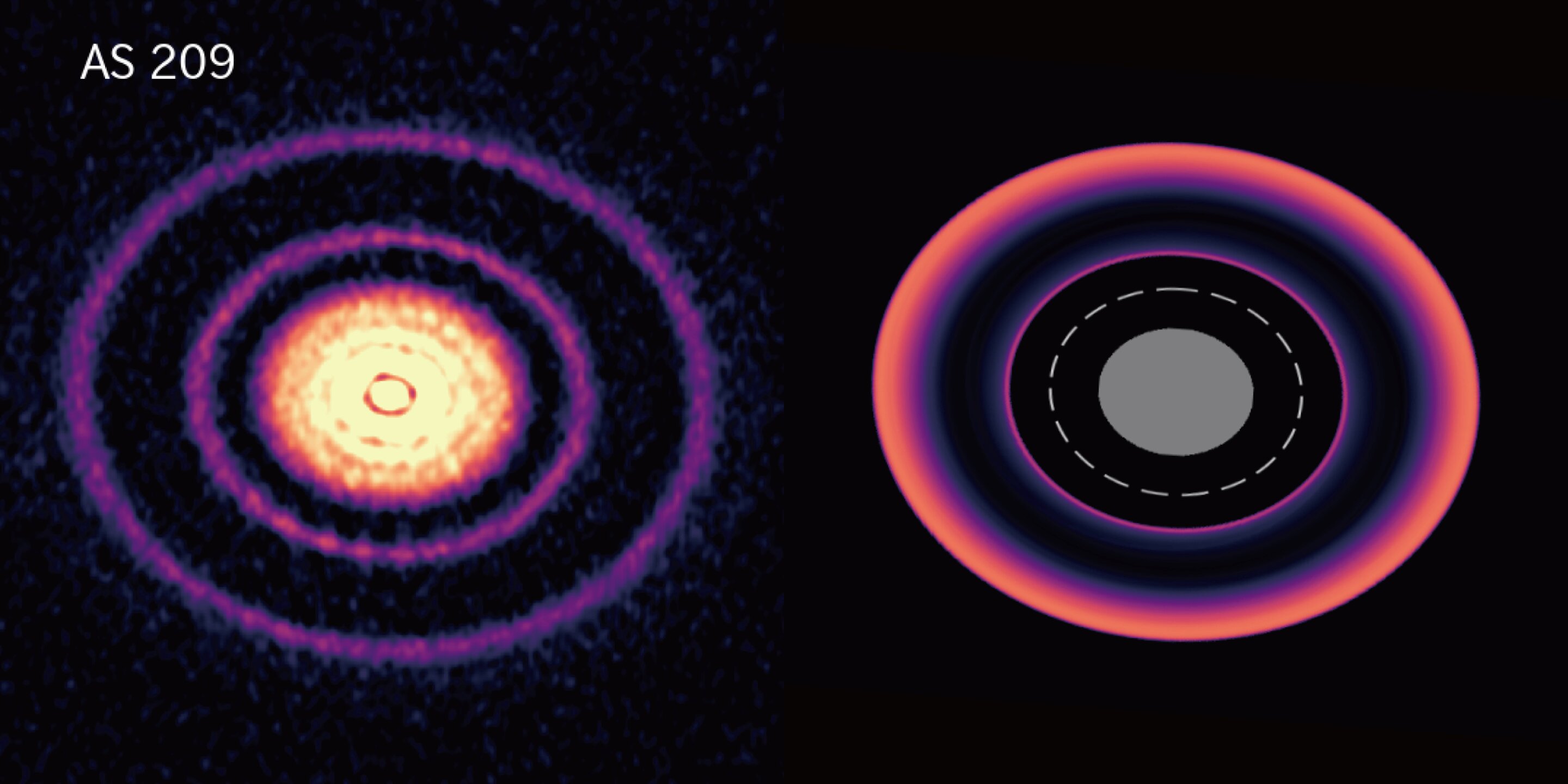
A series of new images reveals that planets form in organic soups – and no two soups are alike. Astronomers have mapped out the chemicals inside of planetary nurseries in extraordinary detail. The newly unveiled maps reveal the locations of dozens of molecules within five protoplanetary disks – regions of dust and gas where planets form around young stars.
“These planet-forming disks are teeming with organic molecules, some which are implicated in the origins of life here on Earth,” explains Karin Öberg, an astronomer at the Center for Astrophysics | Harvard & Smithsonian (CfA) who led the map-making project...
Read More
Astronomers at the Center for Astrophysics | Harvard & Smithsonian have helped detect the clear presence of a moon-forming region around an exoplanet — a planet outside of our Solar System. The new observations, published Thursday in The Astrophysical Journal Letters, may shed light on how moons and planets form in young stellar systems.
The detected region is known as a circumplanetary disk, a ring-shaped area surrounding a planet where moons and other satellites may form. The observed disk surrounds exoplanet PDS 70c, one of two giant, Jupiter-like planets orbiting a star nearly 400 light-years away...
Read More


Recent Comments