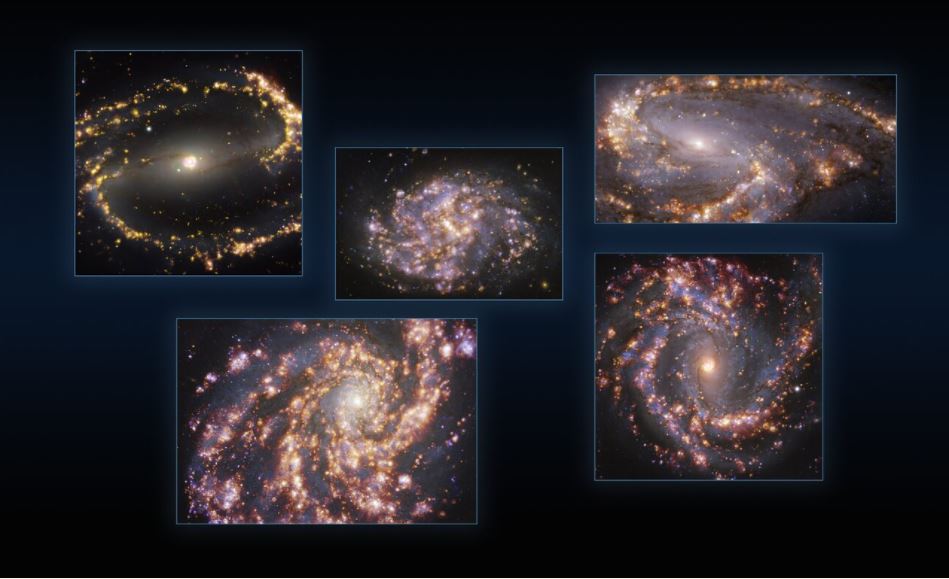
A team of astronomers has released new observations of nearby galaxies that resemble colourful cosmic fireworks...
Read More

A team of astronomers has released new observations of nearby galaxies that resemble colourful cosmic fireworks...
Read More
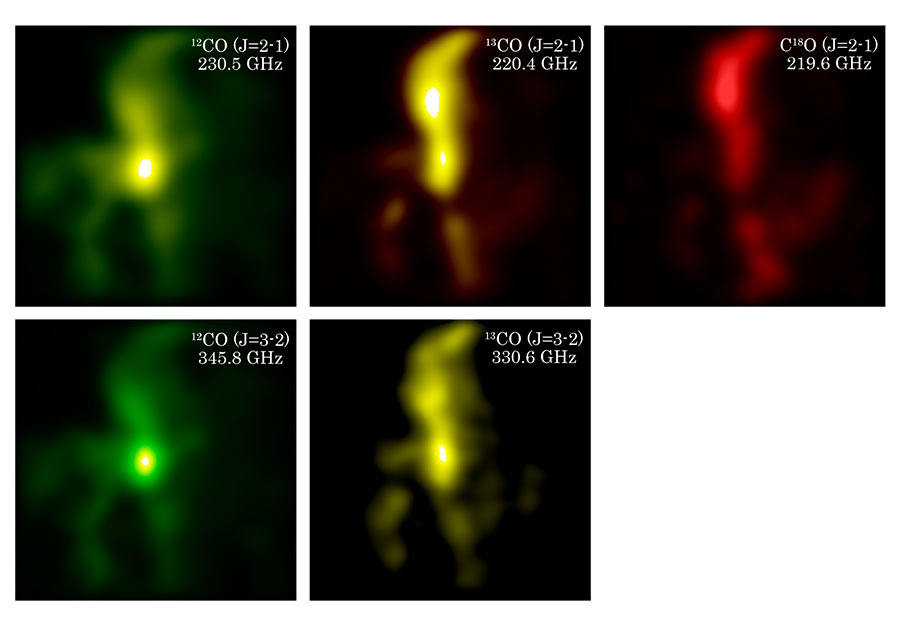
Researchers have used the latest wireless technology to develop a new radio receiver for astronomy. The receiver is capable of capturing radio waves at frequencies over a range several times wider than conventional ones, and can detect radio waves emitted by many types of molecules in space at once. This is expected to enable significant progresses in the study of the evolution of the Universe and the mechanisms of star and planet formation.
Interstellar molecular clouds of gas and dust provide the material for stars and planets...
Read More
Researchers using the Atacama Large Millimeter/submillimeter Array (ALMA) discovered a titanic galactic wind driven by a supermassive black hole 13.1 billion years ago. This is the earliest example yet observed of such a wind to date and is a telltale sign that huge black holes have a profound effect on the growth of galaxies from the very early history of the universe.
At the center of many large galaxies hides a supermassive black hole that is millions to billions of times more mas...
Read More
Using the Atacama Large Millimeter/submillimeter Array (ALMA), astronomers found a rotating baby galaxy 1/100th the size of the Milky Way at a time when the Universe was only seven percent of its present age...
Read More
Recent Comments