ALMA tagged posts

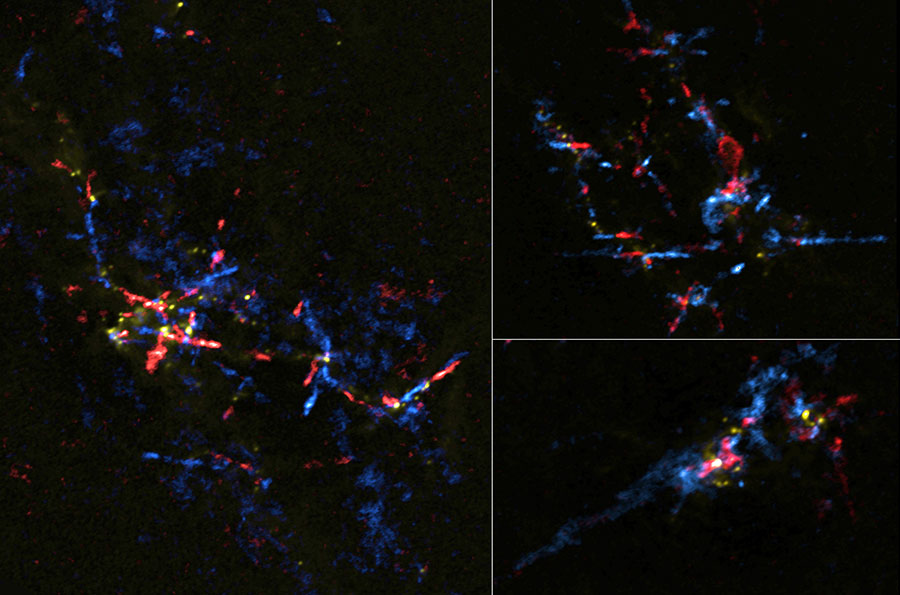
Stellar Eggs near Galactic Center hatching into Baby Stars

ALMA pseudo-color composite image of the gas outflows from stellar eggs in the Galactic Center region. Gas moving toward us is shown in blue and gas moving away from us is shown in red. Credit: ALMA (ESO/NAOJ/NRAO), Lu et al

Astronomers found a number of stellar eggs containing baby stars around the center of the Milky Way using the Atacama Large Millimeter/submillimeter Array (ALMA). Previous studies had suggested that the environment there is too harsh to form stars. These findings indicate that star formation is more resilient than researchers thought.

Stars form in stellar eggs, cosmic clouds of gas and dust which collapse due to gravity. If something interferes with the gravity driven contraction, star formation will be suppressed...

Read More

New Galaxy Sheds Light on How Stars Form

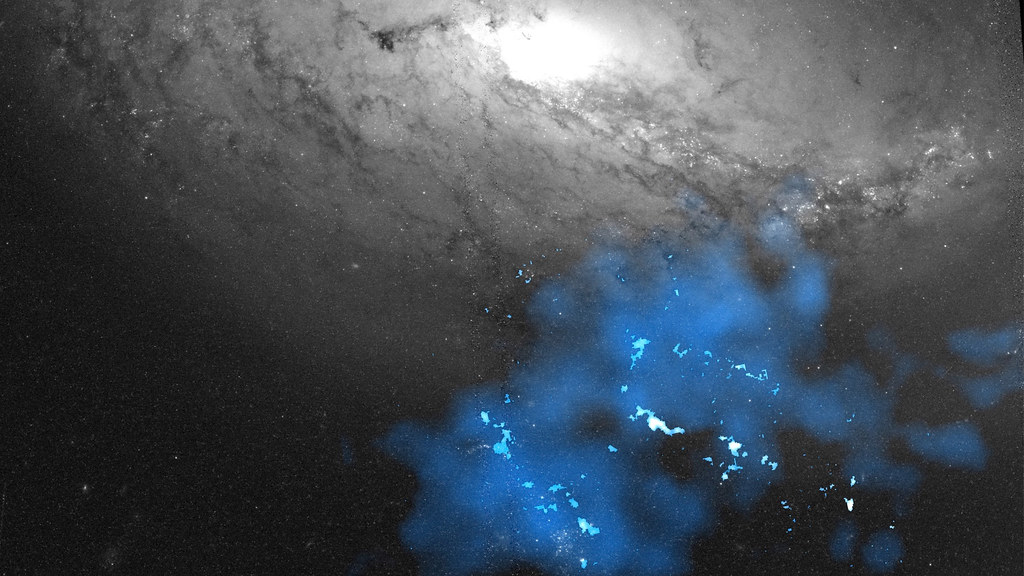
Image of galaxies
A tidal dwarf galaxy (blue) and a spiral galaxy (greyscale). The Milky Way is an example of a spiral galaxy. (Created from images taken by the Hubble Space Telescope and ALMA.)

A lot is known about galaxies. We know, for instance, that the stars within them are shaped from a blend of old star dust and molecules suspended in gas. What remains a mystery, however, is the process that leads to these simple elements being pulled together to form a new star.

But now an international team of scientists, including astrophysicists from the University of Bath in the UK and the National Astronomical Observatory (OAN) in Madrid, Spain have taken a significant step towards understanding how a galaxy’s gaseous content becomes organised into a new generation of stars.

Their findings have import...

Read More

Quasar discovery sets New Distance record

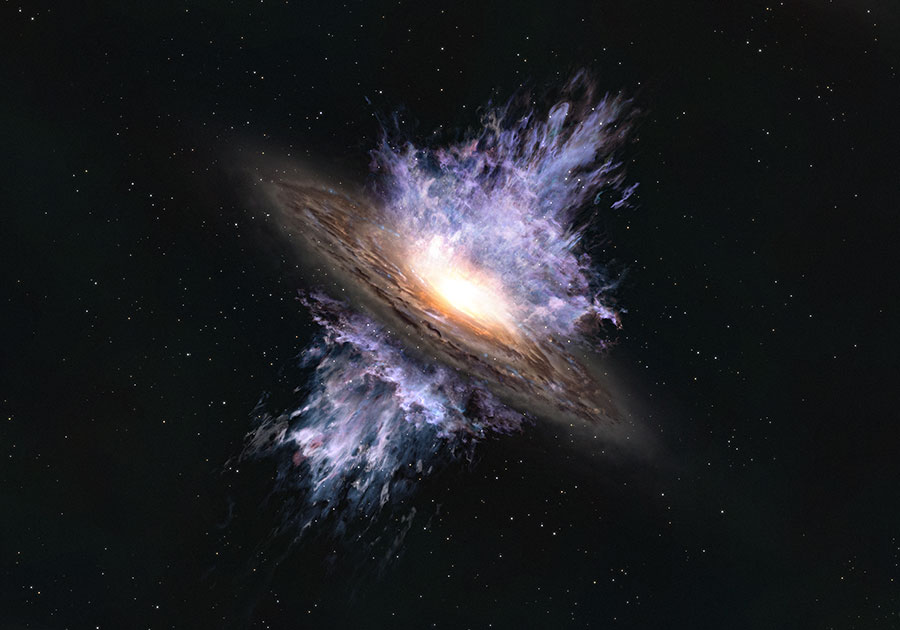
Artist’s conception of the quasar J0313–1806, seen as it was only 670 million years after the Big Bang.
Credit: NOIRLab/NSF/AURA/J. da Silva

An international team of astronomers has discovered the most distant quasar yet found — a cosmic monster more than 13 billion light-years from Earth powered by a supermassive black hole more than 1.6 billion times more massive than the Sun and more than 1,000 times brighter than our entire Milky Way Galaxy.

The quasar, called J0313-1806, is seen as it was when the Universe was only 670 million years old and is providing astronomers with valuable insight on how massive galaxies — and the supermassive black holes at their cores — formed in the early Universe...

Read More

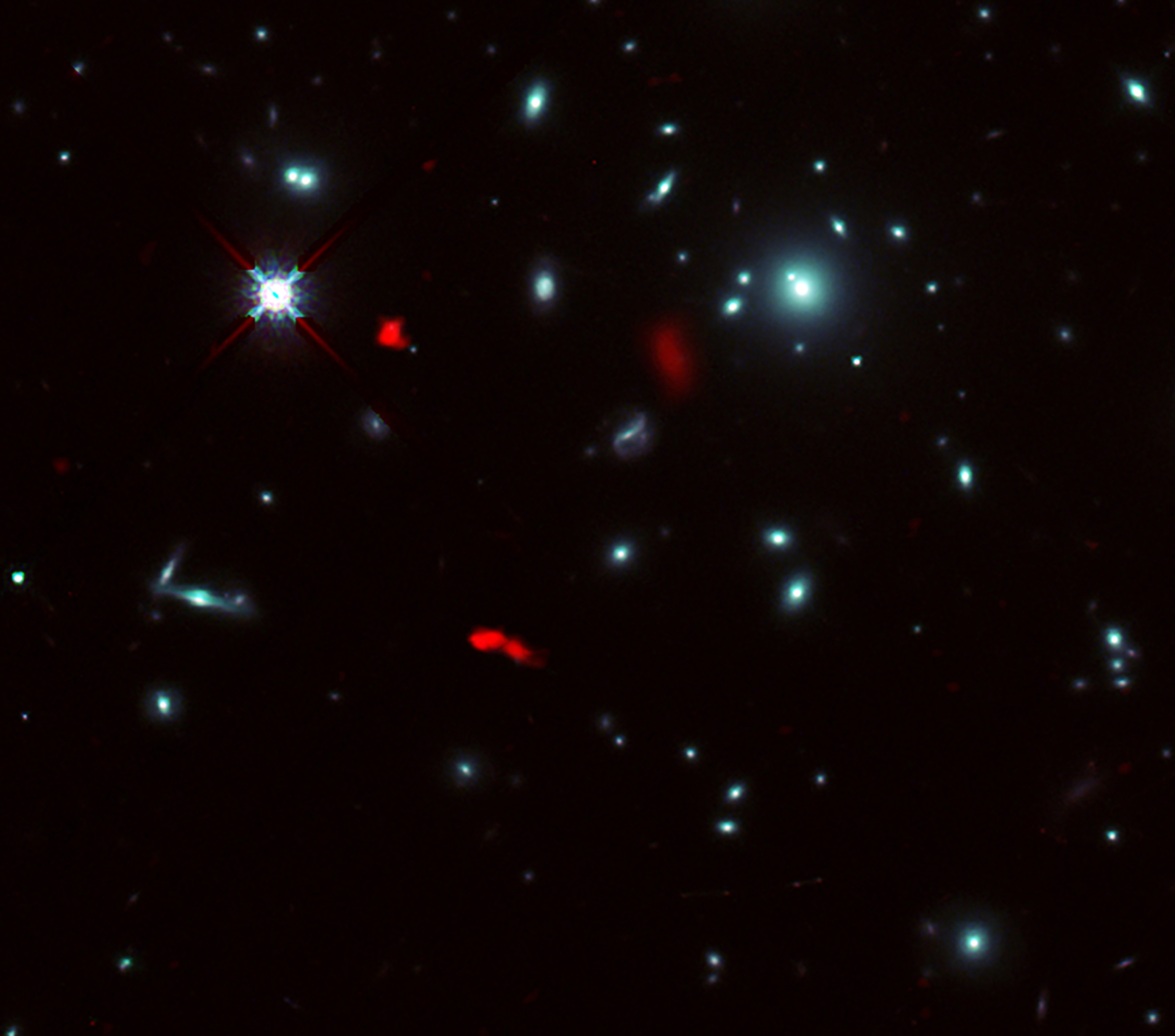
Galaxies in the Infant Universe were Surprisingly Mature

Artist’s illustration of a dusty, rotating distant galaxy
Credit: B. Saxton NRAO/AUI/NSF, ESO, NASA/STScI; NAOJ/Subaru

ALMA telescope conducts largest survey yet of distant galaxies in the early universe. Massive galaxies were already much more mature in the early universe than previously expected. This was shown by an international team of astronomers who studied 118 distant galaxies with the Atacama Large Millimeter/submillimeter Array (ALMA).

Most galaxies formed when the universe was still very young. Our own galaxy, for example, likely started forming 13.6 billion years ago, in our 13.8 billion-year-old universe. When the universe was only ten percent of its current age (1-1.5 billion years after the Big Bang), most of the galaxies experienced a “growth spurt...

Read More