ALMA tagged posts

New Cosmological Constraints on the Nature of Dark Matter

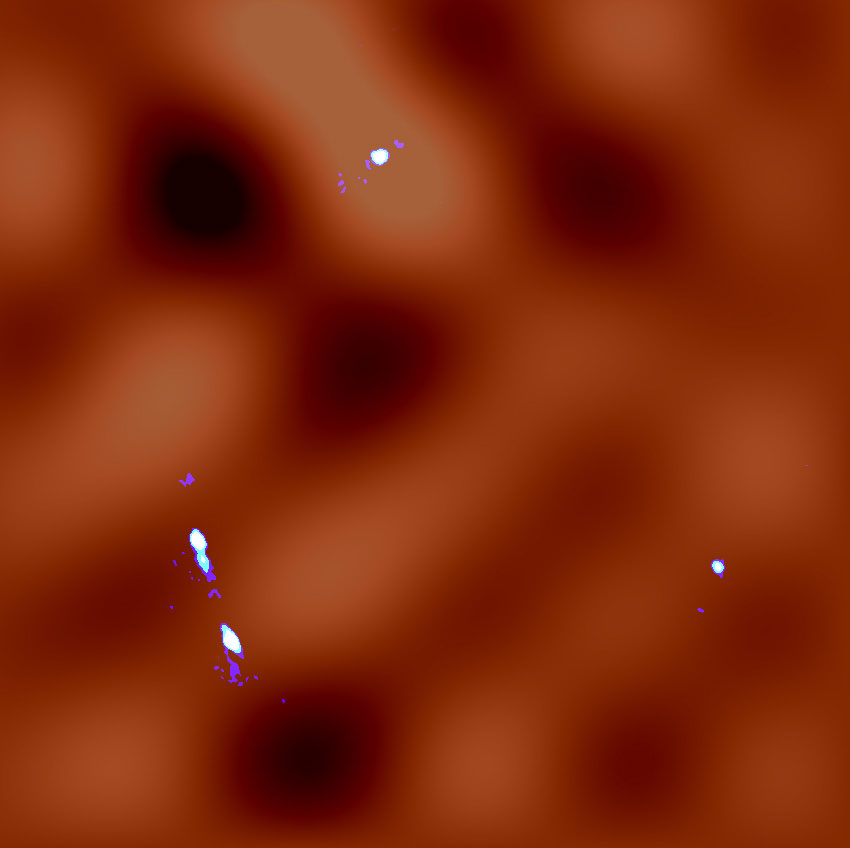
Dark matter fluctuations in the lens system MG J0414+0534. The whitish blue color represents the gravitationally lensed images observed by ALMA. The calculated distribution of dark matter is shown in orange; brighter regions indicate higher concentrations of dark matter and dark orange regions indicate lower concentrations. (Credit: ALMA (ESO/NAOJ/NRAO), K. T. Inoue et al.)

New research has revealed the distribution of dark matter in never before seen detail, down to a scale of 30,000 light-years. The observed distribution fluctuations provide better constraints on the nature of dark matter.

Mysterious dark matter accounts for most of the matter in the Universe. Dark matter is invisible and makes itself know only through its gravitational effects...

Read More

Furthest Ever Detection of a Galaxy’s Magnetic Field

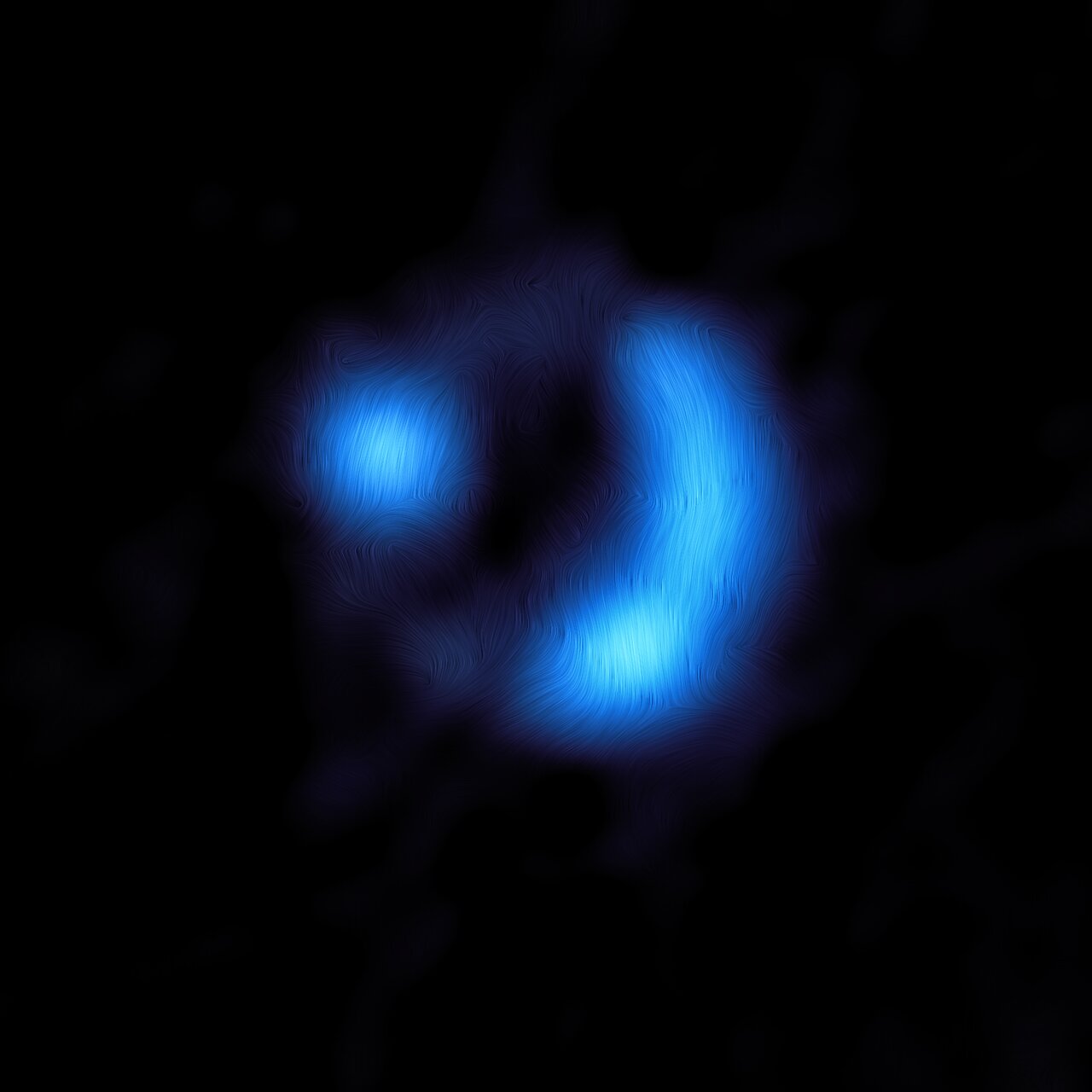
Located centrally on a dark background is an electric blue donut-shaped blob, showing the orientation of the magnetic field of the distant galaxy. The bright donut is not complete, and there are only two main features. The lines of the magnetic field give it an almost furry texture. The right-hand side of the donut forms a bright, curved banana-like shape. Instead, on the left-hand side, there is another bright region, circular in shape.
Using the Atacama Large Millimeter/submillimeter Array (ALMA), astronomers have detected the magnetic field of a galaxy so far away that its light has taken more than 11 billion years to reach us: we see it as it was when the Universe was just 2.5 billion years old. The result provides astronomers with vital clues about how the magnetic fields of galaxies like our own Milky Way came to be.

Using the Atacama Large Millimeter/submillimeter Array (ALMA), astronomers have detected the magnetic field of a galaxy so far away that its light has taken more than 11 billion years to reach us: we see it as it was when the Universe was just 2.5 billion years old. The result provides astronomers with vital clues about how the magnetic fields of galaxies like our own Milky Way came to be.

Lots of...

Read More

Astronomers Discover a Forming Quadruple-Star System

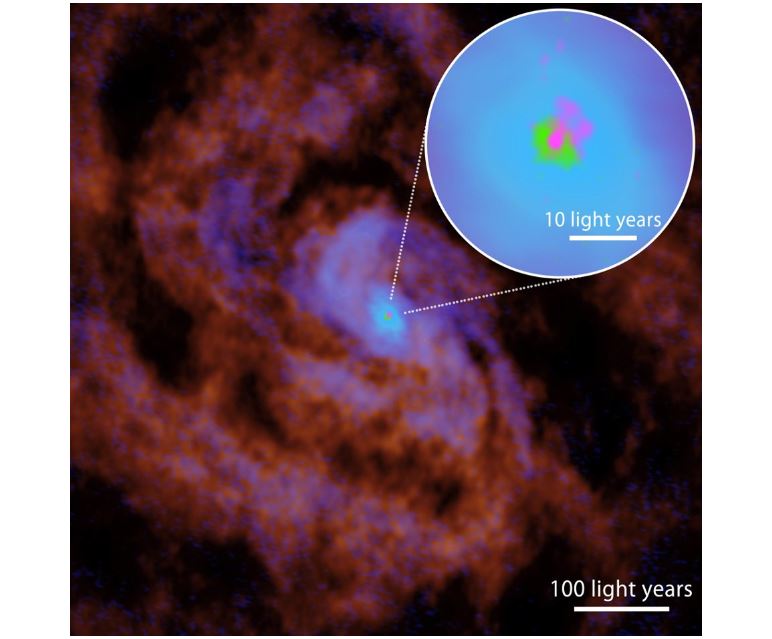
G206.93-16.61E2 is close to the reflection nebula NGC 2023 in the Orion B molecular cloud. The Zoom-in pictures show the 1.3mm continuum emission (blue) and CO molecular outflow (orange) of ALMA observation. These observations develop an in-depth understanding of the formation of multiple star systems in the early stage.
 (Image by SHAO)
 

Recently, the international team ALMA Survey of Orion Planck Galactic Cold Clumps (ALMASOP) led by Prof. Liu Tie from Shanghai Astronomical Observatory (SHAO) of the Chinese Academy of Sciences conducted a high-resolution investigation on 72 dense cores in the Orion Giant Molecular Clouds (GMCs) with the Atacama Large Millimeter/submillimeter Array (ALMA), and discovered a forming quadruple-star system within one core...

Read More

Gas Streamers Feed Triple Baby Stars

Gas distribution around the trinary protostars IRAS 04239+2436, (left) ALMA observations of SO emissions, and (right) as reproduced by the numerical simulation on the supercomputer ATERUI. In the left panel, protostars A and B, shown in blue, indicate the radio waves from the dust around the protostars. Within protostar A, two unresolved protostars are thought to exist. In the right panel, the locations of the three protostars are shown by the blue crosses. (Credit: ALMA (ESO/NAOJ/NRAO), J.-E. Lee et al.) 

New observations and simulations of three spiral arms of gas feeding material to three protostars forming in a trinary system have clarified the formation of multi-star systems.

Most stars with a mass similar to the Sun form in multi-star systems together with other stars...

Read More