ALMA tagged posts

ALMA digs deeper into the Mystery of Planet Formation

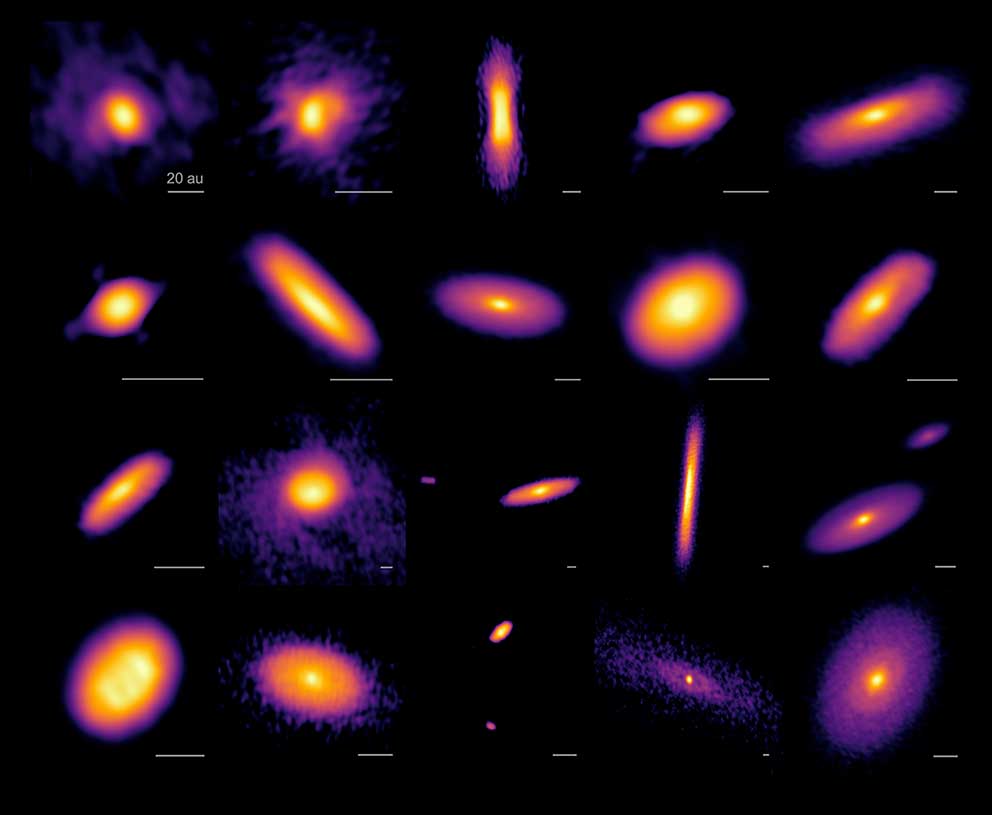
Images of disks around 19 protostars, including 4 binary systems observed with ALMA. For 1 binary system, disks around the primary and secondary are presented independently (2nd line rightmost and 3rd line leftmost). Disks are presented in the order of their evolutionary sequence (the one in the upper-left corner is the youngest while the one at the lower-right corner is the oldest). The two oldest disks show faint ring-gap structures. A scale bar of 20 au (roughly the distance between the Sun and Uranus) is shown for each disk image. (Credit: ALMA (ESO/NAOJ/NRAO), N. Ohashi et al.) Original size (1.0MB)

An international research team used the Atacama Large Millimeter/submillimeter Array (ALMA) to observe disks around 19 protostars with a very high resolution to search for the earliest...

Read More

A Surprise Chemical find by ALMA may help Detect and Confirm Protoplanets

Credit: ALMA (ESO/NAOJ/NRAO), M. Weiss (NRAO/AUI/NSF)

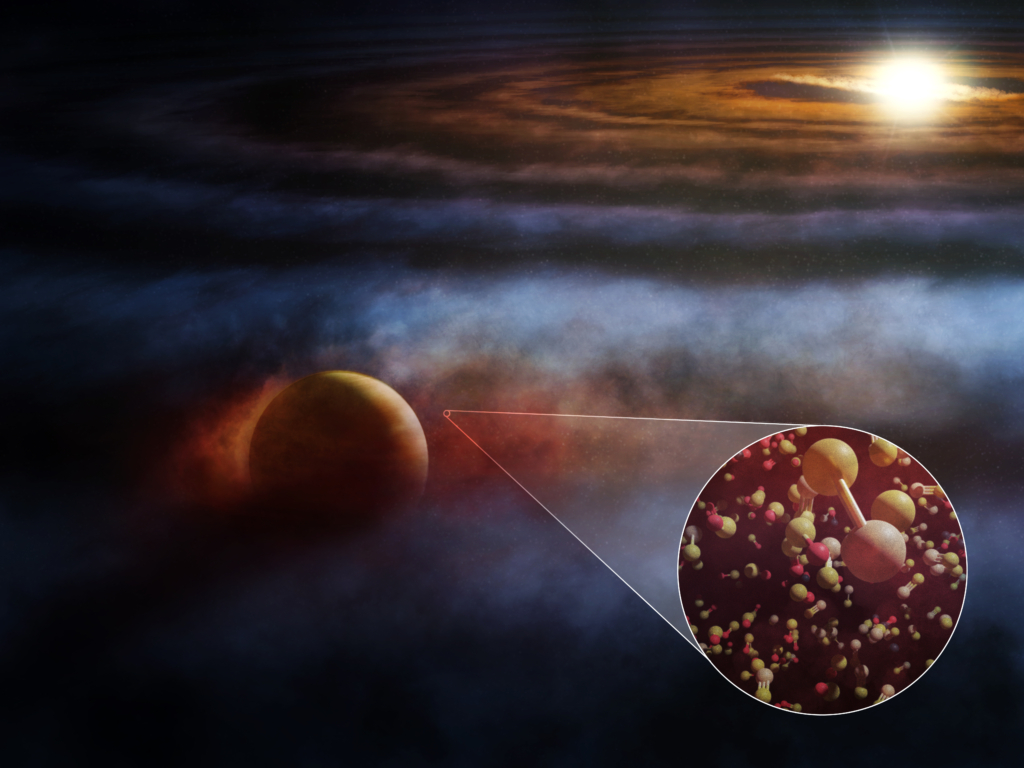
Scientists using the Atacama Large Millimeter/submillimeter Array (ALMA) to study the protoplanetary disk around a young star have discovered the most compelling chemical evidence to date of the formation of protoplanets. The discovery will provide astronomers with an alternate method for detecting and characterizing protoplanets when direct observations or imaging are not possible. The results will be published in an upcoming edition of The Astrophysical Journal Letters.

HD 169142 is a young star located in the constellation Sagittarius that is of significant interest to astronomers due to the presence of its large, dust- and gas-rich circumstellar disk that is viewed nearly face-on...

Read More

Astronomers witness the Birth of a very Distant Cluster of Galaxies from the Early Universe

This image shows several galaxies distributed over a black background. The galaxies have colours that range from blue, orange-red, yellow and white. In the centre of the image is a larger concentration of galaxies. Overlaid on the galaxies in the middle is a blue and semi-transparent region. It has a clumpy form with indistinct contours. There are smaller, dark blue regions around it.
Using the Atacama Large Millimeter/submillimeter Array (ALMA), of which ESO is a partner, astronomers have discovered a large reservoir of hot gas in the still-forming galaxy cluster around the Spiderweb galaxy — the most distant detection of such hot gas yet. Galaxy clusters are some of the largest objects known in the Universe and this result, published today in Nature, further reveals just how early these structures begin to form.

Astronomers have discovered a large reservoir of hot gas in the still-forming galaxy cluster around the Spiderweb galaxy — the most distant detection of such hot gas yet. Galaxy clusters are some of the largest objects known in the Universe and this result further reveals just how early these structures begin to form.

Using the Atacama Large Millimete...

Read More

ALMA traces History of Water in Planet Formation back to the Interstellar Medium

Credit: ALMA (ESO/NAOJ/NRAO), B. Saxton (NRAO/AUI/NSF)

Scientists studying a nearby protostar have detected the presence of water in its circumstellar disk. The new observations made with the Atacama Large Millimeter/submillimeter Array (ALMA) mark the first detection of water being inherited into a protoplanetary disk without significant changes to its composition. These results further suggest that the water in our Solar System formed billions of years before the Sun. The new observations are published today in Nature.

V883 Orionis is a protostar located roughly 1,305 light-years from Earth in the constellation Orion...

Read More