ALMA tagged posts

Resurrected Supernova Provides Missing-link

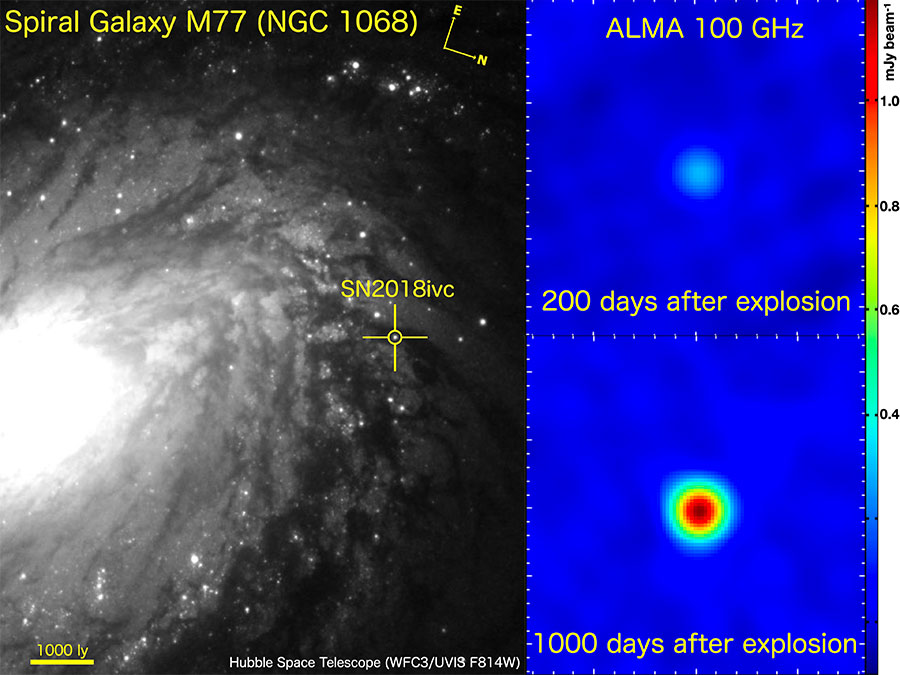
An image of the central region of M77 taken by the Hubble space telescope (left). Right panels show the expanded view around SN 2018ivc based on the data taken by ALMA, at ~200 days (upper right) and ~ 1000 days (lower right)
An image of the central region of M77 taken by the Hubble space telescope (left), in which the position of SN 2018ivc is marked. Right panels show the expanded view around SN 2018ivc based on the data taken by ALMA, at ~200 days (upper right) and ~ 1000 days (lower right), clearly showing that the rebrightening happened at about one year after the SN explosion. Credit: (left) Based on observations made with the NASA/ESA Hubble Space Telescope, and obtained from the Hubble Legacy Archive, which is a collaboration between the Space Telescope Science Institute (STScI/NASA), the Space Telescope European Coordinating Facility (ST-ECF/ESA) and the Canadian Astronomy Data Centre (CADC/NRC/CSA). (right) ALMA (ESO/NAOJ/NRAO), K. Maeda et al.

Astronomers have discovered a supernova exhibiting un...

Read More

VLA and ALMA study Jupiter and Io

VLA and ALMA study Jupiter and Io
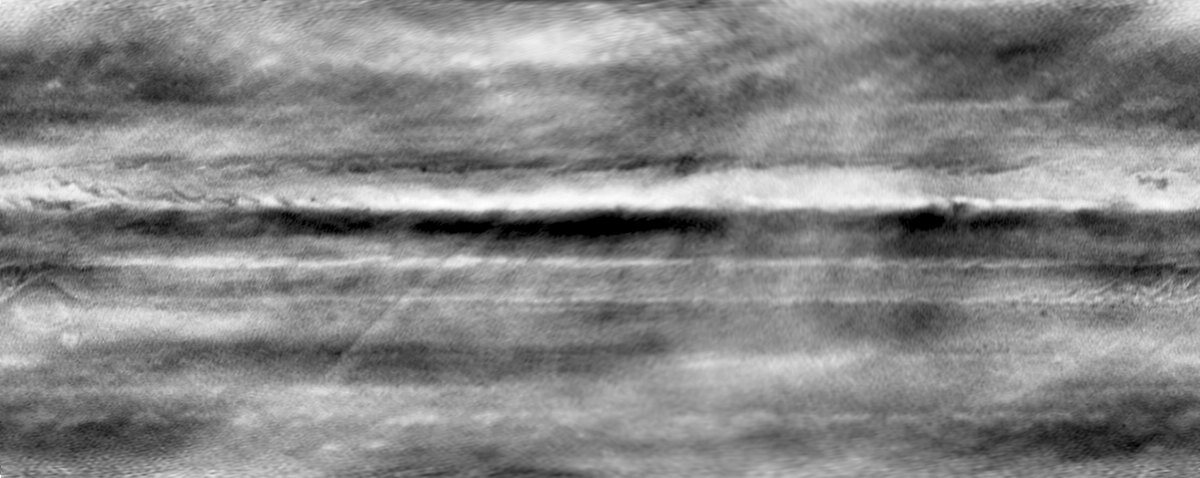
Detail from a VLA image of Jupiter made in conjunction with observations by the Juno spacecraft in orbit around that planet. Credit: Moeckel, et al., Bill Saxton, NRAO/AUI/NSF

VLA teams up with Juno spacecraft to study Jupiter’s atmosphere, and ALMA reveals new details about Io’s volcanoes. While the National Science Foundation’s Karl G. Jansky Very Large Array (VLA) and the Atacama Large Millimeter/submillimeter Array (ALMA) frequently reveal important new facts about objects far beyond our own Milky Way Galaxy — at distances of many millions or billions of light-years — they also are vital tools for unraveling much closer mysteries, right here in our own Solar System...

Read More

ALMA discovers Birth Cry from a Baby Star in the Small Magellanic Cloud

Researchers at Osaka Metropolitan University have observed “baby stars” in the Small Magellanic Cloud, having an environment similar to the early universe. Toward one of the baby stars, they found molecular outflow, which has similar properties to those seen in the Milky Way galaxy, giving a new perspective on the birth of stars.

The heavy elements in interstellar matter significantly impact the mechanism of star formation. In the early universe, the abundance of heavy elements was lower than in the present universe because there was not enough time for nucleosynthesis to produce heavy elements in stars. It has not been well understood how star formation in such an environment differs from present-day star formation.

An international team led by Professor Toshikazu Onishi, Osaka...

Read More

ALMA witnesses deadly Star-slinging Tug-of-War between Merging Galaxies

Credit: ALMA (ESO/NAOJ/NRAO), S.Dagnello (NRAO/AUI/NSF)

While observing a newly-dormant galaxy using the Atacama Large Millimeter/submillimeter Array (ALMA) and the Hubble Space Telescope (HST), scientists discovered that it had stopped forming stars not because it had used up all of its gas but because most of its star-forming fuel had been thrown out of the system as it merged with another galaxy. The result is a first for ALMA scientists. What’s more, if proven common, the results could change the way scientists think about galaxy mergers and deaths. The results of the research are published in The Astrophysical Journal Letters.

As galaxies move through the Universe, they sometimes encounter other galaxies. As they interact, each galaxy’s gravity pulls on the other...

Read More