
carbon tagged posts

Dying Stars Breathe Life into Earth: Study

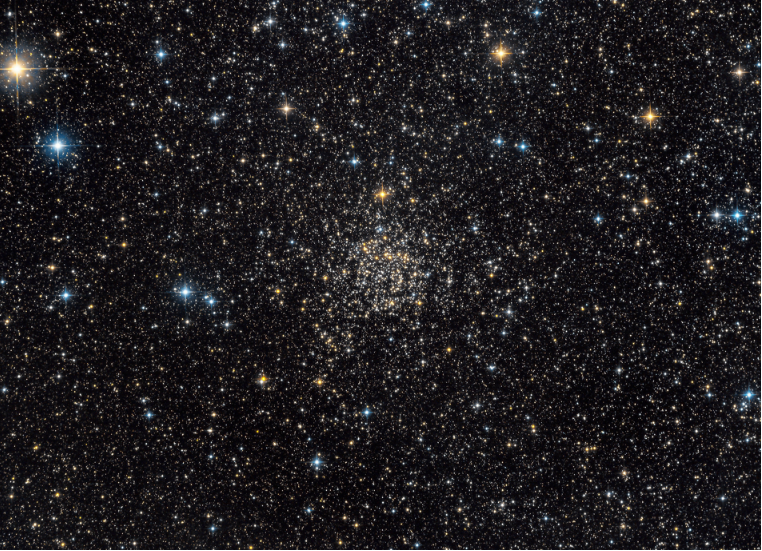
NGC 7789, also known as Caroline’s Rose, is an old open star cluster of the Milky Way, which lies about 8,000 light-years away toward the constellation Cassiopeia. It hosts a few White Dwarfs of unusually high mass, analyzed in this study.
Credit: Guillaume Seigneuret and NASA

As dying stars take their final few breaths of life, they gently sprinkle their ashes into the cosmos through the magnificent planetary nebulae. These ashes, spread via stellar winds, are enriched with many different chemical elements, including carbon.

Findings from a study published today in Nature Astronomy show that the final breaths of these dying stars, called white dwarfs, shed light on carbon’s origin in the Milky Way.

“The findings pose new, stringent constraints on how and when carbon was produce...

Read More

Planetary Collision that formed the Moon made Life possible on Earth Study:


A schematic depicting the formation of a Mars-sized planet (left) and its differentiation into a body with a metallic core and an overlying silicate reservoir. The sulfur-rich core expels carbon, producing silicate with a high carbon to nitrogen ratio. The moon-forming collision of such a planet with the growing Earth (right) can explain Earth’s abundance of both water and major life-essential elements like carbon, nitrogen and sulfur, as well as the geochemical similarity between Earth and the moon.
Credit: Image courtesy of Rajdeep Dasgupta

Planetary delivery explains enigmatic features of Earth’s carbon and nitrogen. Most of Earth’s essential elements for life – including most of the carbon and nitrogen in you – probably came from another planet.

Earth most likely received the b...

Read More

Turning Human Waste into Plastic, Nutrients could aid Long-distance Space Travel

Astronauts could someday benefit from recycling human waste on long space trips (photo illustration). Credit: American Chemical Society

Astronauts could someday benefit from recycling human waste on long space trips using a yeast and  a carbon fixing cyanobacteria or algae
Credit: American Chemical Society

Imagine you’re on your way to Mars, and you lose a crucial tool during a spacewalk. Not to worry, you’ll simply re-enter your spacecraft and use some microorganisms to convert your urine and exhaled CO2 into chemicals to make a new one. That’s one of the ultimate goals of scientists who are developing ways to make long space trips feasible. Astronauts can’t take a lot of spare parts into space because every extra ounce adds to the cost of fuel needed to escape Earth’s gravity...

Read More

Carbon Displays Quantum Effects

They played a key role in demonstrating the unusual behavior of carbon: Tim Schleif (left) and Joel Mieres Perez (right). Credit: © RUB, Marquard

They played a key role in demonstrating the unusual behavior of carbon: Tim Schleif (left) and Joel Mieres Perez (right). Credit: © RUB, Marquard

Chemists at Ruhr-Universität Bochum have found evidence that carbon atoms cannot only behave like particles but also like waves. This quantum-mechanical property is well-known for light particles such as electrons or hydrogen atoms. However, researchers have only rarely observed the wave-particle duality for heavy atoms, such as carbon. “Our result is one of few examples showing that carbon atoms can display quantum effects,” says Sander. Specifically, carbon atoms can tunnel. They thus overcome an energetic barrier, although they do not actually possess enough energy to do that.

Wolfram Sander explains the paradox: “It’s as though a tiger has ...

Read More