
Cosmic rays tagged posts

After 100 years, scientists finally uncover hidden rule behind cosmic rays

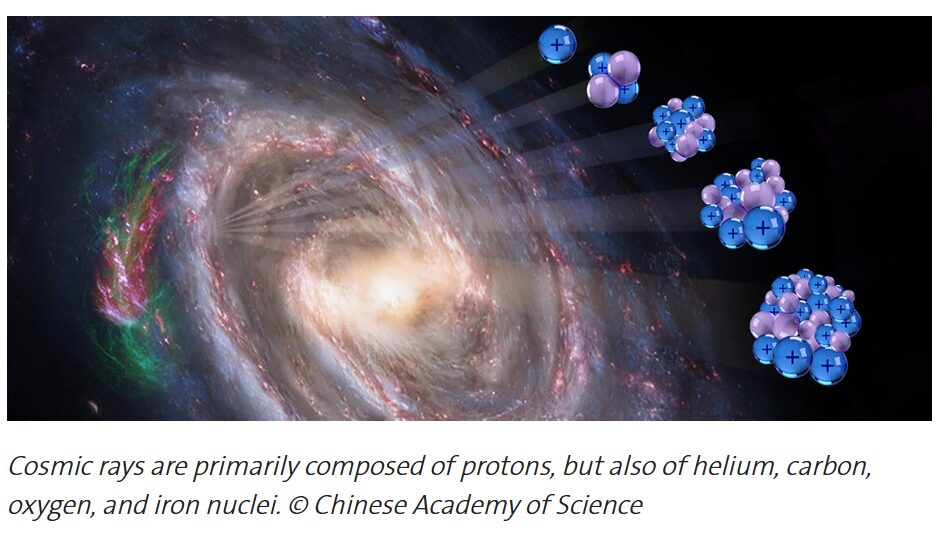
A mysterious new cosmic pattern discovered by the DAMPE space telescope may finally crack the century-old mystery of cosmic rays. Scientists studying mysterious ultra-powerful cosmic rays have uncovered a surprising hidden pattern that could finally help explain where these particles come from. Using the DAMPE space telescope, researchers found that cosmic ray particles—from tiny protons to heavy iron nuclei—all begin fading away more sharply at the exact same point, hinting at a universal rule governing their behavior across the galaxy.

For more than 100 years, scientists have been trying to understand cosmic rays, incredibly powerful particles that travel across the universe at extreme energies...

Read More

Cosmic rays from a nearby supernova may help explain Earth-like planets

Cosmic rays from a nearby supernova may help explain Earth-like planets
An illustration of a young solar system immersed in high-energy cosmic rays from a nearby supernova. Unlike considering only direct injection of supernova ejecta, this process naturally explains key radioactive nuclei without destroying the protoplanetary disk. Credit: R. Sawada (AI-assisted illustration)

How common are Earth-like planets in the universe? When I started working on supernova explosions, I never imagined that my research would eventually lead me to ask a question about the origin of Earth-like planets. Yet that is exactly where it brought me.

For decades, planetary scientists have believed that the early solar system was enriched with short-lived radioactive elements—such as aluminum-26—by a nearby supernova...

Read More

Where did cosmic rays come from? Astrophysicists are closer to finding out

Where did cosmic rays come from? MSU astrophysicists are closer to finding out
X-ray image of the newly discovered pulsar wind nebular associated with an extreme Galactic cosmic ray source 1LHAASO J0343+5254u, obtained by the XMM-Newton space telescope (DiKerby, Zhang, et al., ApJ, 983, 21). Credit: XMM-Newton space telescope

New research published by Michigan State University astrophysicists could help scientists answer a century-old question: Where did galactic cosmic rays come from?

Cosmic rays—high-energy particles moving close to the speed of light—originated from somewhere in the Milky Way galaxy and beyond, but exactly where has been a mystery since they were discovered in 1912. Shuo Zhang, MSU assistant professor of physics and astronomy, and her group led two studies that shed new light on where cosmic rays might have come from...

Read More

Researchers Capture First Images of a Radio ‘Ring of Fire’ Solar Eclipse

Upper row: Radio images of the 2023 Oct. 14 solar eclipse observed by the Long Wavelength Array at the Owens Valley Radio Observatory Bottom row: Schematic representation of what visible images of the eclipse looked like at the same time Credit: Sijie Yu

Researchers at New Jersey Institute of Technology’s Center for Solar-Terrestrial Research (NJIT-CSTR) have captured the Oct. 14 solar eclipse in a way never seen before — recording the first radio images of an annular eclipse’s famous “ring of fire” effect.

The eclipse was partially visible to much of the continental U.S. for several hours that Saturday, though the full “ring of fire” effect was only visible for less than five minutes, and only for those within its 125-mile-wide path of annularity.

However, the new observations o...

Read More