Astronomers have revealed the sharpest image ever captured of a filament in the cosmic web — the enormous hidden structure connecting galaxies across the Universe. The glowing strand stretches 3 million light-years and links two galaxies from nearly 12 billion years ago...
Dark matter is a confounding concept that teeters on the leading edges of cosmology and physics. We don’t know what it is or how exactly it fits into our understanding of the universe. We only know that its unseen mass is a critical part of the cosmos.
Astronomers know dark matter exists. They can tell by the way galaxies rotate, by exploiting gravitational lensing, and by analyzing fluctuations in the Cosmic Microwave Background. But new research suggests that there might be another way to detect its presence.
The research is “Dark Matter (S)pins the Planet,” and it’s available on the arXiv preprint server. Haihao Shi, from the Xinjiang Astronomical Observatory at the Chinese Academy of Sciences, is the lead author. The co-authors are all from Chinese research institutions.
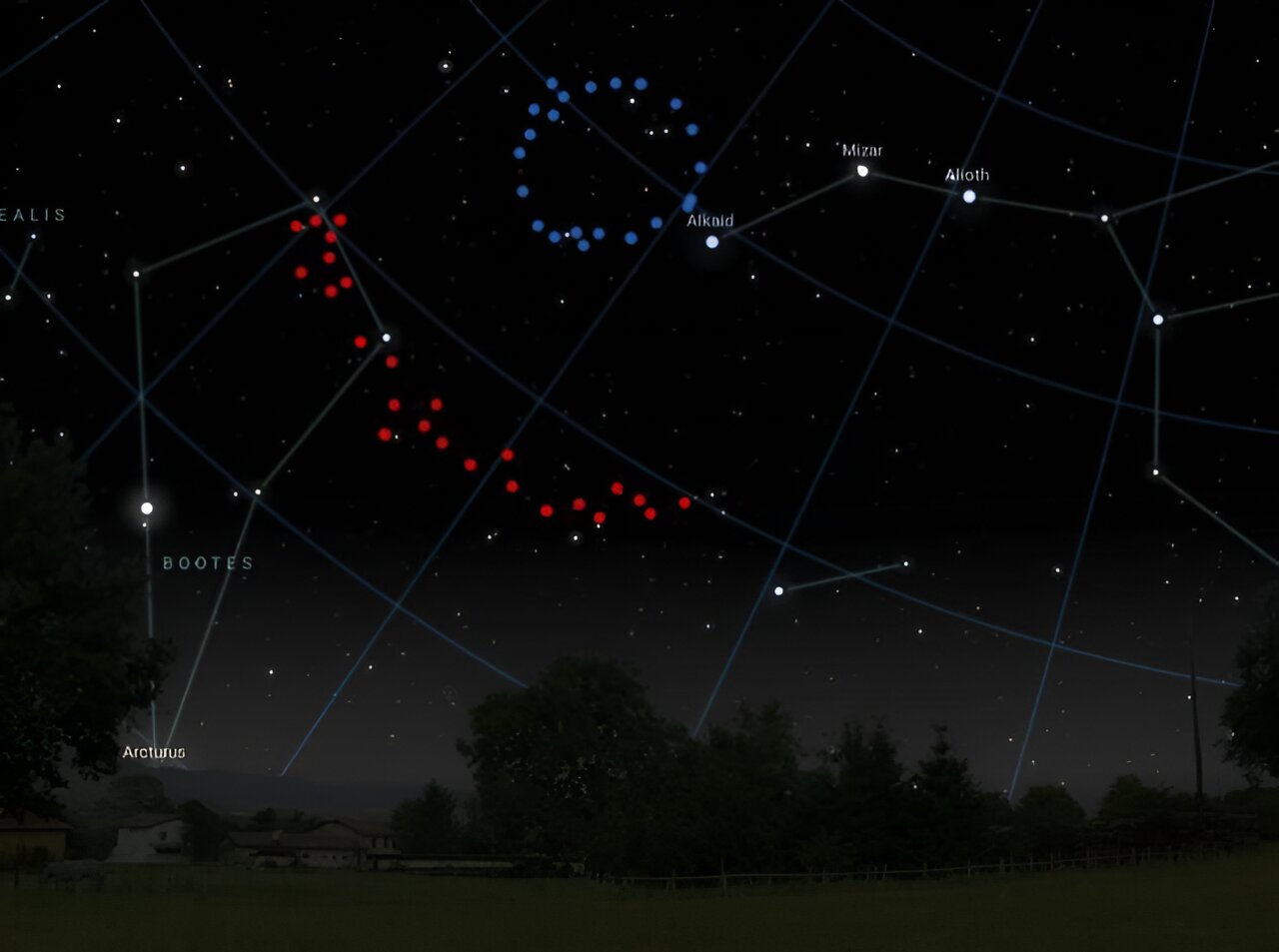
An artistic impression of what the Big Ring (shown in blue) and Giant Arc (shown in red) would look like in the sky. Credit: Stellarium
The Big Ring in the Sky is 9.2 billion light-years from Earth. It has a diameter of about 1.3 billion light-years, and a circumference of about 4 billion light-years. If we could step outside and see it directly, the diameter of the Big Ring would need about 15 full moons to cover it.
It is the second ultra-large structure discovered by University of Central Lancashire (UCLan) Ph.D. student Alexia Lopez who, two years ago, also discovered the Giant Arc in the Sky. Remarkably, the Big Ring and the Giant Arc, which is 3...
Our universe could be twice as old as current estimates, according to a new study that challenges the dominant cosmological model and sheds new light on the so-called “impossible early galaxy problem.”
“Our newly-devised model stretches the galaxy formation time by a several billion years, making the universe 26.7 billion years old, and not 13.7 as previously estimated,” says author Rajendra Gupta, adjunct professor of physics in the Faculty of Science at the University of Ottawa.
For years, astronomers and physicists have calculated the age of our universe by measuring the time elapsed since the Big Bang and by studying the oldest stars based on the redshift of light coming from distant galaxies...





Recent Comments