
exoplanet tagged posts

Dying stars are devouring giant planets, astronomers discover

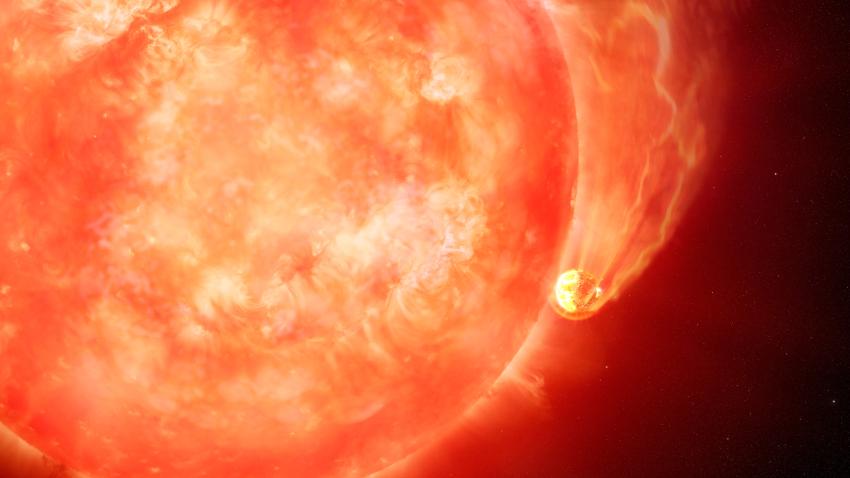
This artist’s impression depicts a dying Sun-like star engulfing an exoplanet. New research published in Monthly Notices of the Royal Astronomical Society suggests that ageing stars may be destroying the giant planets orbiting closest to them.
Credit
International Gemini Observatory/NOIRLab/NSF/AURA/M. Garlick/M. Zamani
Licence type
Attribution (CC BY 4.0)

A new study suggests that aging stars may be wiping out the giant planets that orbit closest to them. The research, led by astronomers at UCL (University College London) and the University of Warwick, provides fresh evidence that these planets can be pulled inward and destroyed as their host stars evolve.

Stars like our Sun eventually run out of hydrogen fuel...

Read More

TRAPPIST-1e observations narrow down possibilities for atmosphere and surface water on elusive exoplanet

Transmission spectroscopy of the habitable zone planet TRAPPIST-1 e
Scientists call this event a transit, when valuable data can be gathered as the exoplanet passes between the star and the telescope and starlight illuminates the atmosphere, if one is present. NASA’s James Webb Space Telescope has made initial observations of planets b, c, d, and e during their transits, with additional observations of planet e underway. While the star’s frequent flares make it difficult to detect an atmosphere, each transit builds up more and more information for scientists to get a more complete picture of these distant worlds. Credit: NASA, ESA, CSA, J. Olmsted (STScI)

University of Bristol astrophysicists are helping shed new light on an Earth-sized exoplanet 40 light years away where liquid water in the form of a global ocean or icy expanse might exist on its surf...

Read More

Researchers confirm an exoplanet potentially capable of sustaining life

An international team has confirmed the discovery of a super-Earth orbiting in the habitable zone of a nearby sun-like star. The planet was originally detected two years ago by Oxford University scientist Dr. Michael Cretignier. This result, drawing on more than two decades of observations, opens a window to future studies of Earth-like exoplanets that may have conditions suitable for life.

The new planet, named HD 20794 d, has a mass six times that of Earth and orbits a star similar to our sun, located just 20 light years away. Its orbit places it within the habitable zone of the system, meaning it is at the right distance from its star to sustain liquid water on its surface, a key ingredient for life as we know it. The paper is published in the journal Astronomy & Astrophysics.

...Read More

Super-earth discovery reveals an exoplanet potentially capable of sustaining life

Earth planet
Credit: CC0 Public Domain

Thirty years after the discovery of the first exoplanet, astronomers have detected more than 7,000 of them in our galaxy. But there are still billions more to be discovered. At the same time, exoplanetologists have begun to take an interest in their characteristics, with the aim of finding life elsewhere in the universe. This is the background to the discovery of super-Earth HD 20794 d by an international team including the University of Geneva (UNIGE) and the NCCR PlanetS.

The new planet lies in an eccentric orbit, so that it oscillates in and out of its star’s habitable zone. This discovery is the fruit of 20 years of observations using the best telescopes in the world. The results are published in the journal Astronomy & Astrophysics.

‘”Are we alone i...

Read More