

Persistent pain often has no clear cause. However, studies show measurable differences in the structure and activity of the brains of those affected. This might explain why they experience chronic pain...
Read More

August 28, 2026,
 Biology/Biotechnology, Health/Medical
Persistent pain often has no clear cause. However, studies show measurable differences in the structure and activity of the brains of those affected. This might explain why they experience chronic pain...
Read More
June 16, 2026,
Biology/Biotechnology, Health/Medical
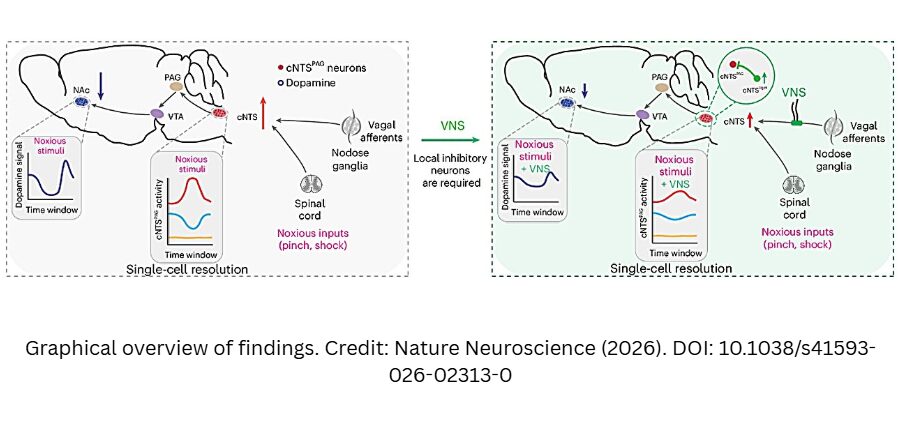
Physical pain is essential for survival, as it allows animals to detect when they are injured or unwell, seek shelter and address their ailments. Yet when it becomes chronic, pain can also become highly distressing and debilitating.
While there are now several therapeutic strategies for managing chronic pain, an emerging one that has been found to be particularly promising is vagus nerve stimulation (VNS). VNS entails the delivery of mild electrical pulses to the nerve that connects the brain to organs throughout the body.
Past studies suggest that VNS-based therapy can reduce the pain associated with various medical conditions, including chronic headaches, fibromyalgia and joint inflammation. The neural processes by which it can ease pain, however, are still poorly understood.
...Read More
July 2, 2021,
Health/Medical, Biology/Biotechnology

New research from the Institute of Psychiatry, Psychology & Neuroscience (IoPPN) at King’s College London, in collaboration with the University of Liverpool and the Karolinska Institute, has shown that many of the symptoms in fibromyalgia syndrome (FMS) are caused by antibodies that increase the activity of pain-sensing nerves throughout the body.
The results show that fibromyalgia is a disease of the immune system, rather than the currently held view that it originates in the brain.
The study, published today in the Journal of Clinical Investigation, demonstrates that the increased pain sensitivity, muscle weakness, reduced movement, and reduc...
Read More
June 23, 2019,
Health/Medical, Biology/Biotechnology

People with fibromyalgia show variations in microbiome composition. A research team has shown, for the first time, that there are alterations in the bacteria in the gastrointestinal tracts of people with fibromyalgia. Approximately 20 different species of bacteria were found in either greater or are lesser quantities in the microbiomes of participants suffering from the disease than in the healthy control group.
Fibromyalgia affects 2-4 percent of the population and has no known cure...
Read More
Recent Comments